
When a security incident occurs, the first questions are usually technical: What vulnerability was exploited? Which control failed? What tool missed the alert?
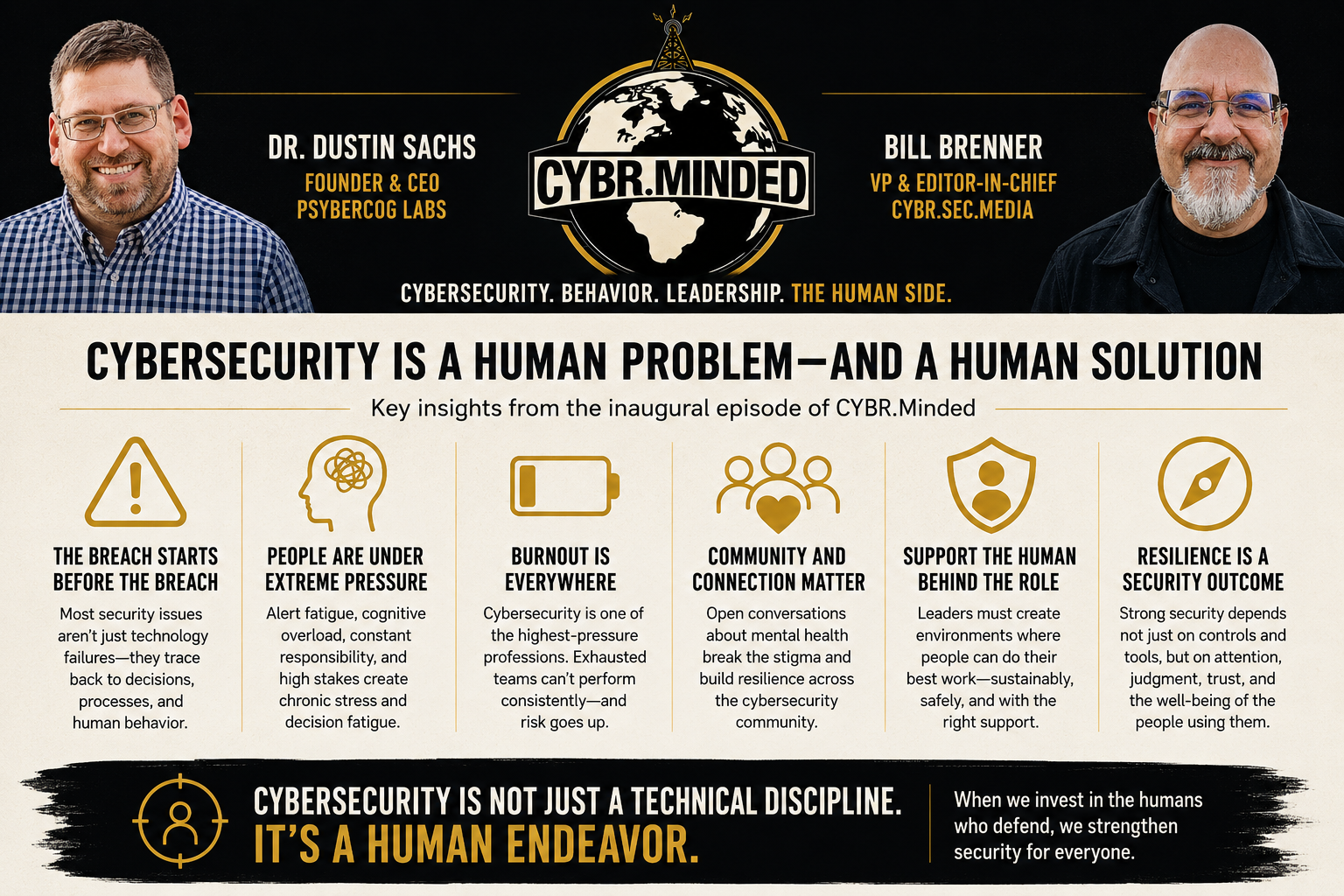
Dr. Dustin Sachs, host of the new CYBR.Minded podcast, says those questions often miss a deeper truth. Most cybersecurity failures are not purely technological failures. They are the result of decisions made under pressure, warnings overlooked, processes worked around, or exhausted teams trying to do too much with too little.
That premise formed the foundation of the inaugural episode, featuring CYBR.SEC.Media Editor-in-Chief Bill Brenner (the author of this article).
The conversation focused on a topic that has long lived in cybersecurity's blind spot: the people behind the controls.
Watch/listen to the full episode:
 , and CYBR.SEC.Media
"The human side of cybersecurity" is often treated as a separate conversation from security operations, governance, or incident response. Brenner argued that it shouldn't be.
The human side of cybersecurity is the reality experienced by practitioners every day. It encompasses the analysts chasing alerts, the engineers designing defenses, the risk professionals navigating competing priorities, and the CISOs carrying responsibility for outcomes they often cannot fully control.
Technology may be at the center of cybersecurity, but people are at the center of every cybersecurity decision.
Burnout Isn't a Personal Failure
The discussion also explored Brenner's own journey with mental health, depression, anxiety, and obsessive-compulsive tendencies. More than two decades ago, while beginning his cybersecurity journalism career, he started publicly documenting those experiences. In late 2009, the result was a blog called The OCD Diaries.
The response from the cybersecurity community surprised him. Security practitioners from across the industry reached out with stories of their own struggles. Many had never openly discussed them before. What became clear was that the challenges weren't isolated. They were widespread.
Cybersecurity has become one of the highest-pressure professions in the modern workforce. Teams face a constant stream of alerts, escalating threats, organizational politics, staffing shortages, and growing expectations from leadership. At the same time, the consequences of failure continue to increase.
For many practitioners, the result is chronic stress, disrupted sleep, difficulty disconnecting from work, and a growing sense of responsibility for problems that can never be completely solved.
Brenner pointed to a common experience familiar to many security leaders: the inability to truly step away.
Even during vacations, weekends, or family time, many professionals remain tethered to Slack channels, email notifications, text messages, and dashboards. The fear of missing something important becomes difficult for him to shut off.
The industry often describes this as alert fatigue, but Sachs suggested the problem goes deeper than alerts alone.
People are not simply overwhelmed by notifications. They are overwhelmed by responsibility.
Cybersecurity attracts people who care deeply about protecting others. That sense of responsibility is one of the profession's strengths. It can also become one of its greatest liabilities when it goes unchecked.
Building More Human-Centered Security
One of the central themes of CYBR.Minded is that organizations need to move beyond asking whether people followed the process.
Instead, they should ask whether the process was designed for real people operating under real-world constraints.
That shift requires leaders to think differently about resilience.
Rather than expecting practitioners to simply become tougher, organizations must create environments that support sustainable performance. That means acknowledging cognitive overload, decision fatigue, competing priorities, and the emotional toll that comes with defending increasingly complex environments.
The need is becoming more urgent.
Artificial intelligence, geopolitical tensions, critical infrastructure threats, and an endless stream of vulnerabilities are creating even greater demands on security teams. The pressure is unlikely to decrease anytime soon.
For Brenner, mental health is not a separate conversation from cybersecurity. It is cybersecurity.
The tools, controls, and technologies will continue to evolve. But behind every alert, every investigation, and every security decision remains a human being.
If the industry wants better security outcomes, it must spend as much time understanding those people as it does understanding the systems they protect.
CYBR.SEC.Media has focused increasingly on the subject since Brenner joined its ranks in January 2026.
Here are just a few examples:
 Bill Brenner
 Bill Brenner
 , and CYBR.SEC.Media
 Bill Brenner
 Bill Brenner