This article is based on the latest episode of CYBR.HAK.CAST. Here is the full episode and related article:
 Lauren Andrus
 Bill Brenner
For years, cybersecurity conferences celebrated technical brilliance while quietly ignoring something affecting many of the people filling those rooms: mental health. Amanda Berlin helped change that.
The founder of Mental Health Hackers and senior product manager at Blumira never planned to become one of cybersecurity's most recognizable advocates for mental health. In fact, she never planned to work in cybersecurity at all. But one deeply personal keynote and the response it received set off a chain of events that continues to reshape conference culture across the industry today.
Sometimes the best career plans are accidents
Berlin laughs when she tells the story of how she entered technology.
She had planned to join the Marines as a trumpeter before becoming pregnant in high school. Looking for the fastest path to stable employment, she enrolled in a two-year computer program because, as she put it, "I'm a really fast typer."
That decision led her through ISP help desk work, hospital IT, networking, systems administration, Active Directory, Cisco infrastructure, and eventually into security after legendary penetration tester Dave Kennedy invited her to watch a penetration test and handed her tickets to DerbyCon.
"I didn't know security was an entire field," Berlin said. "I got to DerbyCon, realized there was an entire security industry, and just completely fell in love."
Like many practitioners, she immersed herself in learning everything she could, eventually moving into detection engineering before joining what would become Blumira.
But another passion was beginning to emerge alongside her technical career.
More on Mental Health Hackers:
 Bill Brenner
 Bill Brenner
One keynote changed everything
Berlin had become a regular conference speaker, presenting technical sessions on phishing education and blue team operations. When organizers asked her to deliver her first keynote, she found herself asking a simple question.
"What can I talk about that would resonate with everyone?"
The answer wasn't technical.
At the time, she was dealing with depression, anxiety, and other mental health struggles of her own. What surprised her wasn't living with those challenges—it was how often people told her they never would have guessed.
"People would say, 'Well, you don't look like you're depressed,'" she recalled. "You seem like you're always smiling... That's called masking. Lots of people do that."
Instead of talking about tools or techniques, Berlin used her keynote to explain what anxiety, depression, and PTSD can actually look like inside the cybersecurity profession.
The response stunned her.
Attendees lined up afterward, many in tears.
"They're like, 'Oh my God, I thought I was the only person dealing with this.'"
Those conversations revealed something larger than individual struggles. Many people working in cybersecurity had never heard respected peers openly discuss their own mental health. Simply hearing someone else say it out loud was enough to make them realize they weren't alone.
From one talk to a movement
Berlin wanted to reach more people than a single keynote audience.
She asked DerbyCon if she could run a four-hour workshop on mental health.
Instead, organizers handed her an entire room for all three days of the conference.
"I figured four hours would be great," she said. "They gave me full three days... I'm like, 'Oh crap. It's just me. What am I supposed to do with three days?'"
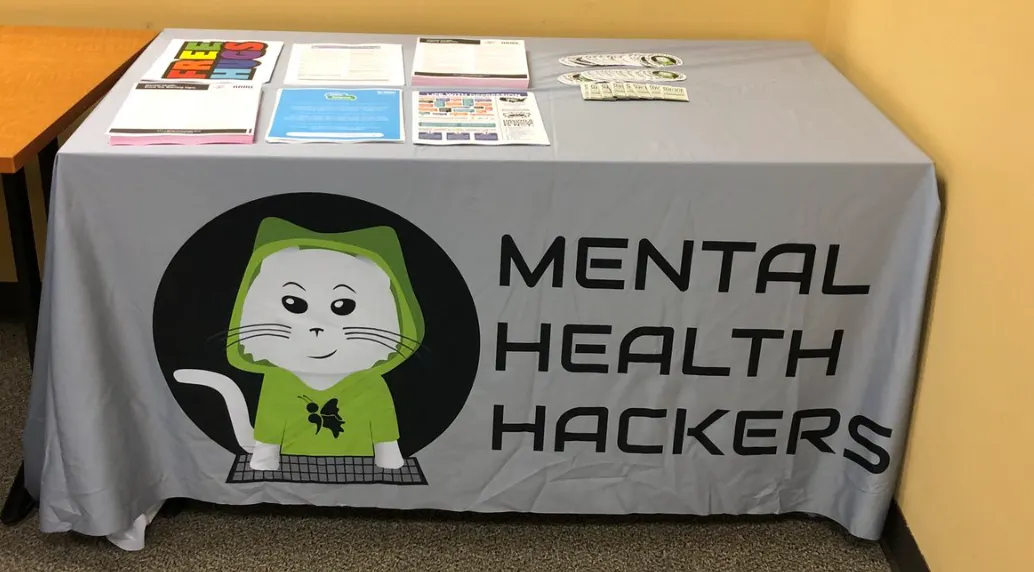
What followed became the first Mental Health Village.
Rather than creating a clinical environment, Berlin built a place where conference attendees could simply decompress. Volunteers organized peer-led discussions about living with ADHD, traumatic brain injuries, anxiety, and other experiences common throughout the technology community. There were therapy dogs, massage therapists, coloring books, knitting supplies, and quiet spaces where overwhelmed attendees could step away from the constant noise and stimulation of a cybersecurity conference.
The idea resonated immediately.
Conference organizers began asking how they could host similar spaces. Volunteers wanted to help. Within months, Berlin and a small group of supporters established Mental Health Hackers as a nonprofit dedicated to bringing those villages to conferences around the country.
Even today, Berlin is careful to draw an important distinction. The villages are not therapy clinics, nor do volunteers present themselves as mental health professionals. Instead, they provide peer support, a welcoming community, and connections to organizations like NAMI and the American Psychological Association when attendees need professional help.
The industry's mental health challenges haven't disappeared. Burnout, anxiety, isolation, and stress remain constant topics of conversation. But thanks in part to Berlin's willingness to tell her own story, they're no longer conversations that happen only behind closed doors.
Sometimes all it takes to start changing a culture is one person standing on a keynote stage and proving that vulnerability isn't weakness. It's permission for everyone else to stop pretending they're the only one.