
"Art didn't end with the brush."
That observation from Gadi Evron, made in the context of AI's impact on hacking and creativity, has been rattling around in my head since [un]prompted II.
The point, as I took it, wasn't that AI makes human creativity obsolete. Quite the opposite. New tools change how we create, but they don't eliminate the need for imagination, judgment or the human desire to make something original.
I've been thinking about that a lot lately because I've been experimenting with AI-generated visuals for CYBR.SEC.Media. Those experiments have reinforced something I've believed throughout my career in journalism: The image accompanying a story should do more than fill space. It should help tell the story.
AI is giving us new ways to do that. But using it responsibly requires acknowledging some uncomfortable questions.
Why stock photography isn't enough
I've spent much of my career working with talented designers, illustrators and photographers. I've learned from them, collaborated with them and developed relationships I cherish.
I have no interest in seeing those people pushed out of their professions. Nor do I believe typing a few instructions into an AI tool makes me the equivalent of someone who has spent years mastering illustration or design.
But I must take my best shots with the tools at my disposal.
Cybersecurity news moves fast. When a major vulnerability emerges, a new research report lands or an AI security controversy erupts, we need to publish while the information is still relevant.
And every story needs an image.
For years, that meant searching Getty Images, Adobe Stock or similar libraries for something that vaguely represented the subject.
Anyone who has worked in cybersecurity publishing knows the routine. A story about ransomware gets a hooded figure staring at a computer. A data breach gets a glowing padlock or streams of binary code. Artificial intelligence gets a robotic hand touching a digital brain.
They're not necessarily bad photographs or illustrations. Many are technically excellent. But they're often so generic that they tell readers almost nothing about the actual story.
I want imagery that communicates something specific.
If I'm writing about AI-generated code passing more security tests while still producing dangerous vulnerabilities, I want the illustration to show that contradiction. If I'm covering AI agents protecting rural hospitals, I want readers to see the intersection of healthcare, security and automation.
I want the image to do some of the storytelling.
And I've found that AI image-generation tools let me get closer to that goal, quickly and with a degree of specificity that stock-image searches rarely provide.
Making the artificial obvious
There's another part of this that matters to me. I don't want readers wondering whether an AI-generated image is something real or if it was stolen from someone.
My preference is to make the artificial nature of the artwork apparent through the visual style itself.
That means leaning into recognizable AI-generated aesthetics: stylized robots, exaggerated digital environments, surreal compositions and other visual conventions that readers increasingly recognize as synthetic.
Some of those conventions have become so familiar that they are practically a visual language of their own. I'm not pretending they're groundbreaking works of art.
That's partly the point.
I'm not trying to pass off AI-generated images as handmade illustrations, or manufacture the impression that a photographer captured something that never happened.
I'm using a tool to create visual representations of ideas.
But recognizable style alone isn't sufficient disclosure. An image can look obviously artificial to me and still confuse someone else. That's why I believe publishers should be willing to identify AI-generated imagery explicitly, particularly when there's any possibility it could be mistaken for documentary photography.
Transparency should be a deliberate editorial practice, not something we assume readers will figure out.
The artists' concerns are real
None of this makes the ethical questions disappear.
Artists have legitimate grievances about how generative AI systems were developed, what material was used to train them, whether creators gave permission and whether companies are profiting from work without adequately compensating the people who made it.
I don't dismiss those concerns.
I also don't have a satisfying answer for every one of them.
My hope is that the industry eventually develops meaningful mechanisms for attribution, licensing and compensation, so creators whose work contributes to AI systems can share in the value those systems generate.
That won't resolve every objection, but it would be a step toward a more equitable arrangement.
I don't believe the future should require choosing between technological progress and respecting the people whose creativity helped make that progress possible.
And I certainly don't want my use of AI to suggest that professional illustrators and designers have somehow become unnecessary.
There will always be creative work that demands the expertise, originality and collaboration of skilled human artists.
The fact that AI can produce an illustration in seconds doesn't mean it can replace everything a good designer brings to a project – especially where marketing and branding is concerned.
Human judgment still matters
This is where Gadi's observation about the brush becomes especially relevant.
Music offers another useful comparison.
Musicians have always absorbed influences from the artists who came before them. They borrow techniques, experiment with familiar sounds, combine styles and sometimes create something distinctive in the process.
That doesn't mean copying someone else's song and calling it your own is acceptable. There are boundaries, and there should be.
But influence and creative evolution are inseparable. I see some parallels in how I'm experimenting with AI visuals.
I start with a familiar visual idea. I decide what works, what doesn't, what should change and what would better communicate the story. I iterate until the image reflects the message I'm trying to convey.
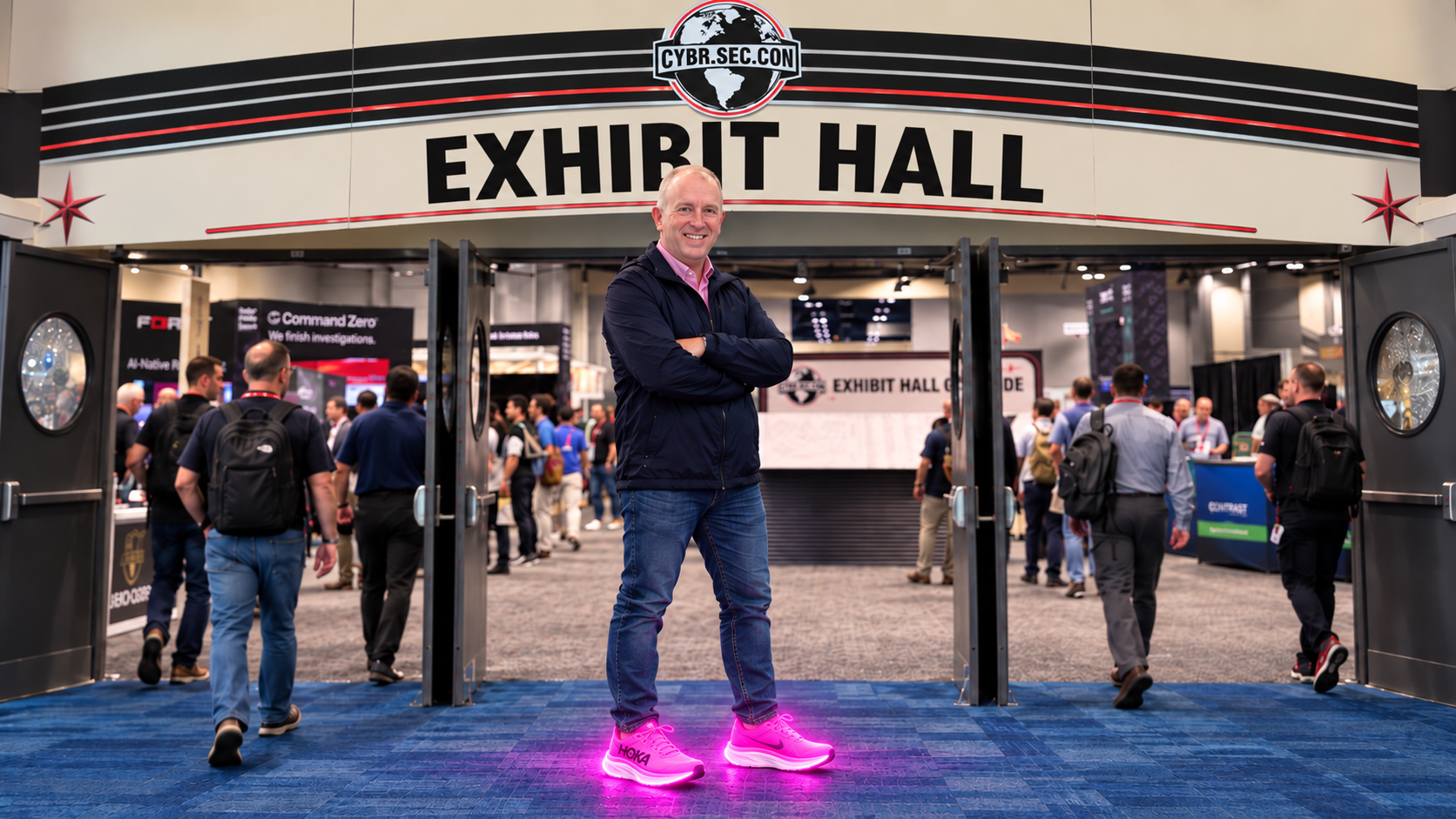
That includes taking some of our Community Corner bloggers and putting them in humorous, even ridiculous situations. Take my treatments of Andy Ellis. The facial features are never perfect, but part of the point is to make it cartoonish. I mean look at this guy, with his pink HOKAs and shirts:
I also love opportunities to mix the news with some of my favorite cultural references. My all-time favorite so far is this image, created for an article about some knuckleheads flying home from Hacker Summer Camp and deciding to play games with the in-flight wi-fi:

Most people would recognize it as a take on the famous posters for the classic "Airplane!"
Does all this make me a professional illustrator? Absolutely not. Does it mean I'm making creative choices? I believe it does.
I think there's room to recognize that distinction without diminishing the work of trained artists or ignoring the unresolved questions surrounding generative AI.
Still figuring it out
One thing I don't want this article to become is a declaration that I've figured out the right way to use AI.
I haven't.
I'm experimenting, just as many people across journalism, cybersecurity and other professions are experimenting.
I'll make mistakes. I'll undoubtedly create images that miss the mark. I'll probably look back at some of today's work and wonder what I was thinking.
When that happens, I intend to be open about it, listen to criticism and make adjustments.
My goal, and the goal for CYBR.SEC.Media, is to use AI as transparently, responsibly and honestly as we can.
That means recognizing what these tools make possible without pretending there are no costs. It means respecting the people whose work and expertise helped shape the creative world these technologies draw upon. And it means continuing to exercise human judgment rather than surrendering it to the machine.
Gadi's observation keeps bringing me back to the same idea.
Art didn't end with the brush.
Photography didn't eliminate painting. Digital editing didn't eliminate photography. Electronic instruments didn't eliminate musicians.
Those transitions weren't painless, and AI's impact may prove more disruptive than any of them. We shouldn't minimize that.
But I don't think the answer is to stop experimenting.
I think the answer is to experiment thoughtfully, be transparent about what we're doing, acknowledge the people and professions affected, and remain willing to change course as we learn.
I don't want AI to replace the human creativity behind our journalism.
I want it to give that creativity another way to express itself.