
This week, Black Hat USA is unfolding at Mandalay Bay in Las Vegas: six days of training, research briefings, open-source demonstrations, commercial technology, policy discussion, and an expanded focus on artificial intelligence. The official language is about staying ahead, pushing boundaries, and preparing for the future of cybersecurity.
All of that matters.
The vulnerabilities matter. The exploits matter. Identity, access, segmentation, provenance, resilience, incident response, software bills of materials, safety cases, artificial intelligence governance... All of it matters.
But none of it is the reason.
Security is machinery. Necessary machinery, often beautiful machinery, but machinery nonetheless. Its purpose is not to perpetuate itself. We do not make systems so that we may secure systems so that we may buy more systems to secure.
We make them because somewhere beyond the machinery, somebody is trying to live.
- A child is learning something.
- A physician is caring for a patient.
- A musician is playing for a room full of people.
- A family is speaking across a border.
- A researcher is listening to nightingales and discovering that what first appeared to be a tangled field of sound may contain distinct individuals, territories, responses, and relationships.
That last example has stayed with me.
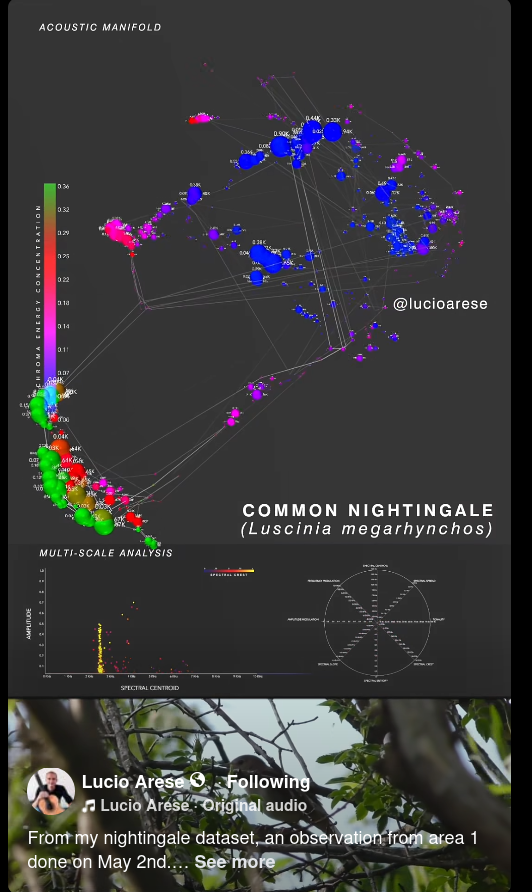
A researcher recorded birdsong across several observation areas and turned the sound into a visual field of spectral events. Bright clusters began to suggest individual voices. Repetition became pattern. Pattern became possible identity. The forest appeared to be drawing its own social structure in sound.
That is much closer to the reason for cybersecurity than another glowing operations dashboard.
The recording needs integrity. Its origin matters. Time and place matter. The distinction between observation and interpretation matters. The researcher’s confidence and uncertainty matter. The data must remain available without becoming detached from the living context that gave it meaning. Those are security problems, but security is not the song.
Security makes space around the song.
It protects the possibility that one living system may listen carefully enough to another that meaning can emerge between them.
The levels below meaning
Human life has layers.
- There is functioning: eating, sleeping, communicating, keeping the lights on.
- There is persisting: enduring illness, conflict, grief, disaster, exclusion, failure, and change.
- There is maintenance: patching servers, renewing certificates, answering messages, replacing broken hardware, documenting processes, complying with standards.
These layers are not trivial. Without them, the structure collapses.
But they are not the upper floors.
Above them are art, joy, curiosity, companionship, purpose, play, memory, discovery, and love. Above them is the moment when noise becomes birdsong, when data becomes knowledge, when another person becomes visible, when a tool allows us to perceive something that was always present but previously beyond our reach.
Cybersecurity exists to defend the path between those layers.
- Availability matters because interruption steals time from life.
- Integrity matters because meaning cannot survive arbitrary alteration.
- Confidentiality matters because intimacy, dignity, experimentation, and dissent require protected spaces.
- Identity matters because relationships depend upon knowing who is speaking and under what authority.
- Provenance matters because knowledge without history becomes manipulation.
- Resilience matters because people should be able to continue living when systems fail.
These are not merely technical properties. They are conditions under which human and nonhuman life can unfold with some measure of freedom.
Security as stewardship
The security industry often speaks the language of war: attack surfaces, kill chains, adversaries, targets, weapons, zero days. That language is sometimes accurate. There are adversaries. There are campaigns. There is coercion, fraud, espionage, sabotage, and destruction.
But a discipline that understands itself only through conflict eventually forgets what it is defending.
The gardener also understands threats. Frost, disease, insects, drought, erosion, and fire are real. Yet gardening is not fundamentally the study of pests. It is the creation and preservation of conditions in which life can grow.
Security is a form of stewardship.
- A secure hospital is not one with the largest collection of security products. It is one in which clinicians can continue caring for patients when something breaks.
- A secure city is not one covered by the greatest number of sensors. It is one whose people can move, speak, associate, work, and receive services without those systems becoming instruments of domination.
- A secure artificial intelligence system is not simply one that resists prompt injection. It is one whose authority is bounded, whose actions are attributable, whose uncertainty remains visible, and whose operation leaves room for human judgment and refusal.
- A secure archive is not merely unaltered. It remains understandable.
- A secure ecosystem record does not reduce birds to feature vectors and discard the valley. It preserves enough relationship that future listeners may still understand what was heard.
What are we securing?
That is the question worth carrying through the halls of Black Hat.
Not only:
What can this system resist?
But also:
What does this system permit to exist?
- Does it create room for trust?
- Does it preserve agency?
- Does it help communities survive disruption?
- Does it allow knowledge to accumulate without severing it from context?
- Does it protect the quiet spaces in which people create, grieve, experiment, disagree, and begin again?
- Does it make joy more possible?
Joy may sound like a soft word for a cybersecurity conference.
It is not.
Joy is one of the things coercive systems remove first. Surveillance changes how people speak. Instability consumes attention. Fraud destroys trust. Harassment drives people from public life. Ransomware turns hospitals, schools, and municipalities into bargaining chips. Manipulated information makes shared reality difficult to inhabit.
Security cannot manufacture joy. No control framework can guarantee meaning. But security can protect the conditions from which joy emerges. It can keep the door open. It can keep the record honest.
It can keep the lights on long enough for the music to continue.
Beyond the desert
By the end of the week, the booths will come down. The demonstrations will be packed away. The temporary city of badges, screens, meetings, vulnerabilities, and promises will dissolve back into the Las Vegas desert. The question that should remain is not whether we saw the future of cybersecurity.
It is whether we remembered why that future matters.
We are not securing systems for the sake of systems. We are securing the space in which a life can become more than persistence.
- The space in which a person can create something unnecessary and beautiful.
- The space in which a community can remember.
- The space in which intelligence can become care rather than appetite.
The space in which seven nightingales may sing across a dark valley, and somebody may be present, safe, patient, and free enough to hear that they are not noise.
That is what security is for.
-chris