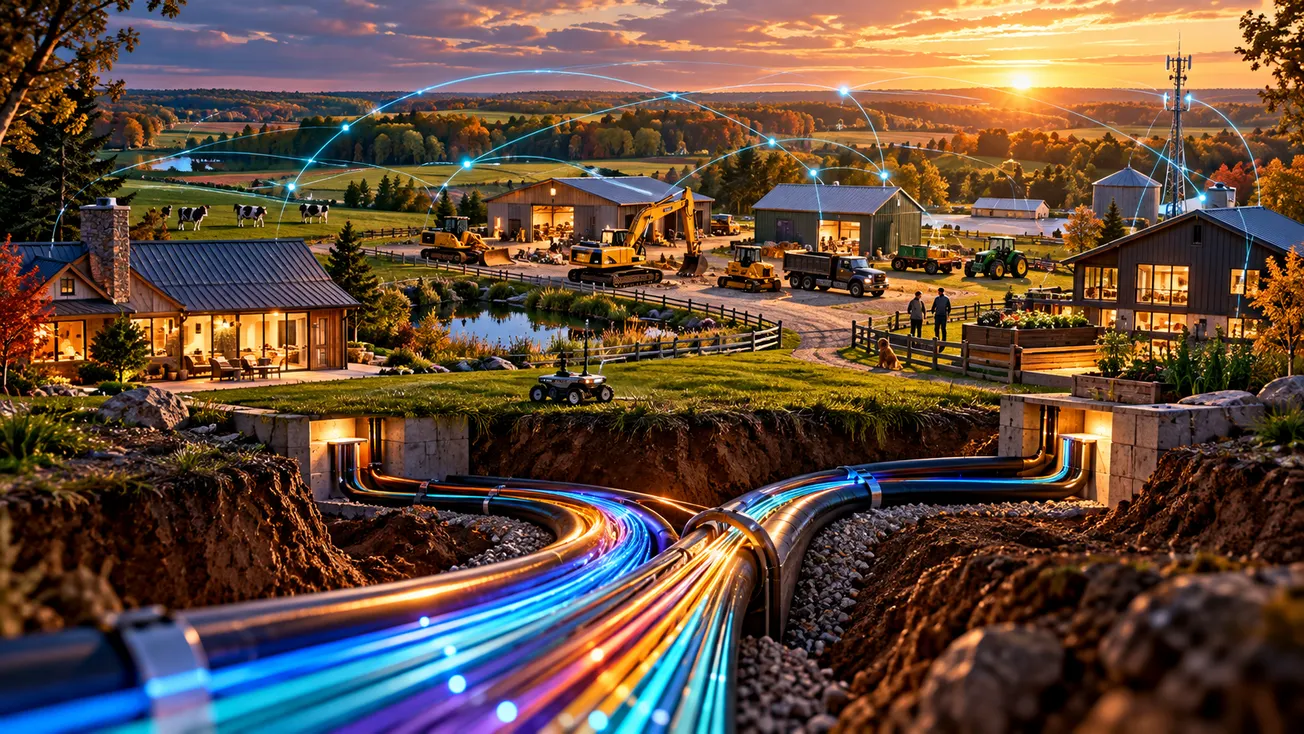
We have just spent a fair amount of time persuading approximately a kilometer of 24-strand Corning fiber-optic cable to take up residence beneath a piece of southern Ontario farmland. The cable now reaches the foundations of two houses that sit within the broader property we are developing as QuietWire's Canadian campus.
This sounds more elegant than the process looked.
Fiber is a marvelous technology. It carries an astonishing amount of information through hair-thin strands of glass, indifferent to most of the electromagnetic nonsense that bothers copper, and it can join buildings separated by distances that make an ordinary Wi-Fi plan start to look optimistic. On paper, this is a very satisfying way to connect things. In a field, it involves dirt, excavators, conduit, awkward bends, weather, more dirt, and occasionally the realization that a hole you have already drilled through a foundation is not quite large enough to accommodate the thing you intended to put through it. There is a lesson in there about theoretical capacity and physical reality, and I am inclined to regard it as a fairly important one.
The fiber is in. Termination, testing and turning a piece of glass into a dependable communications service are separate jobs, which is worth saying because our industry is very good at describing things as operational when the physical world has merely reached the next stage of assembly.
But stand up from the trench for a moment and look around.
The broader property is roughly 200 acres, mostly agricultural, with a mixture of working and potential future uses. There are two houses. One is where I live and work. The other is a large, currently empty seven-bedroom house that we would like to turn into a mixture of laboratories, offices and living space for other QuietWire people, subject to the ordinary arrangements that govern anybody's right to occupy or change a building. There are two barns and another building, and the assortment of equipment you might expect around an ambitious rural construction operation: cranes, caterpillar tracked excavators, bulldozers, diesel Mack trucks, tractors, and something on the order of a hundred tons of heavy equipment, enough to make the phrase moving a few things around sound irresponsibly casual.
There are also little Traxxas remote-control cars that we have started turning into robots.
One end of the property involves machines capable of moving serious quantities of earth. Another involves a small radio-controlled vehicle that can be carried under one arm. Both are interesting to us, although I strongly recommend against confusing the safety case for one with the safety case for the other.
We have farmers and tradespeople working in and around this landscape, people who know the equipment, people who know the land, people who know how water moves through a particular patch of it when the snow melts. There are residents, visitors, colleagues, neighbors, animals, future occupants and a local community with its own knowledge, practices and priorities. There are economic relationships and legal boundaries that do not go away because we happen to be enthusiastic about networking. Some spaces are active QuietWire working areas. Others are homes or candidate future facilities; appearing on our map does not make them ours to administer.
This is a fairly strange place to build the headquarters of an AI and cybersecurity company.
Or, perhaps, it is exactly the right place.
A world model is more than a map
The term world model has become fashionable in AI. Depending on the conversation, it may refer to a model that predicts physical events, represents a robot's surroundings, reasons about cause and effect, or maintains an internal representation of the environment through which an agent moves.
Fine. Those are all useful things to study.
But we have been building world models for as long as there have been humans walking around trying to figure out where the water is, where the food is, which path leads home, and which neighbor might lend them a shovel. A family has a world model. A farmer has one. A business has one, although in many businesses it is divided among seventeen databases and three employees who are due to retire. A community has one. A country has one. Those models overlap, disagree, age, and change as the world changes.
The starting point is not a vendor's dashboard or an inventory of machines. It is a person, a family, a business, or a community saying: here we are, these are the things we know and depend on, these are the obligations we have, and these are the things we are trying to remain free to do. Put yourself at the center of your own world model, not because the universe revolves around you but because somebody has to take responsibility for the account you maintain and the actions you take on its basis. Then build outward through the physical world of land and equipment, the economic relationships that make the work possible, the social and cultural lives that give it meaning, the logical relationships among systems and the legal boundaries that determine rights and responsibilities. Other people's models will overlap yours without being identical. That's not a defect to be resolved by better synchronization. That's the world.
A world model is not just a geometric description of what exists. It contains relationships: what a thing does, what it depends on, what it costs, who cares about it, who may use it, what history brought it here and what happens if it fails. It contains places, people, purposes, machines, laws, money, weather, animals, stories, obligations, assumptions and the memories of people who can tell you that the little rise behind the barn floods every spring even though the drainage drawing says it shouldn't.
You can make a remarkably accurate three-dimensional model of an excavator without having much idea what an excavator means in the world around it. The machine has an operator. That operator has training, responsibilities, and a reason for being there. Somebody is paying for the work. Somebody has the authority to decide where the machine may dig. There may be buried services, property boundaries, wildlife habitat or a utility line that exists in the real world but never made it onto the survey. If the excavator moves ten meters in the wrong direction, the consequences are not measured in pixels.
Now attach an AI system to that environment.
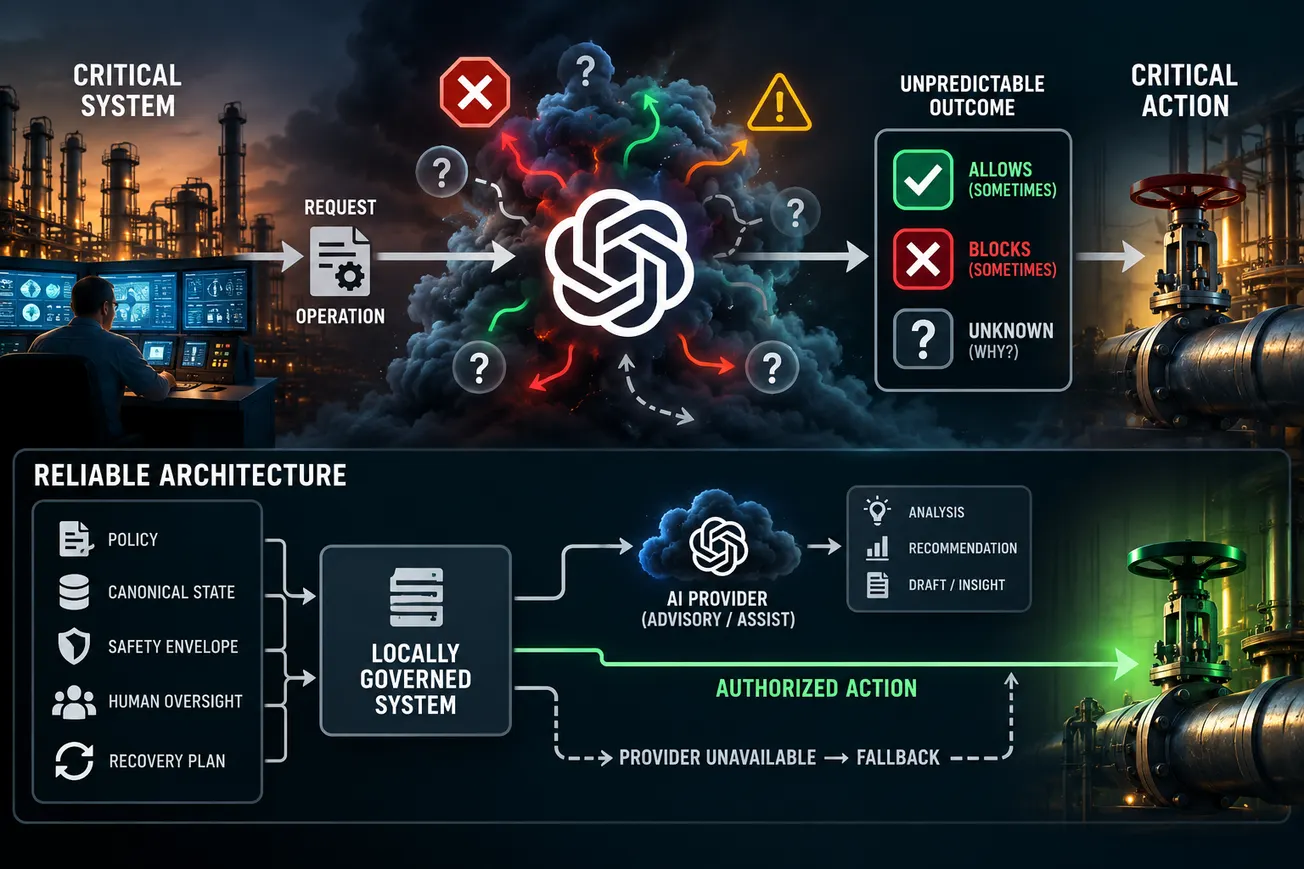
If its world model contains only the excavator's location, a task list, and a set of available commands, you have missed most of the information necessary to decide whether a command ought to be executed. You can call that an automation system. You should be very careful about calling it a safe one.
The difference matters because cybersecurity has been moving in this direction for a long time. We began with networks and machines, then identities, vulnerabilities, assets, supply chains, data flows and business processes. Each enlargement of the field was an admission that the previous boundary was too small to contain the consequences of what could happen inside it. Industrial control-system security learned early that the interesting thing about compromising a controller is not the controller. It is the valve, the generator, the ship, the refinery, the worker, or the community on the other end of the command.
A world model carries that reasoning farther. Instead of starting with the technology and asking what threats might affect it, we start with the world somebody is trying to inhabit and ask what must remain true for that world to function.
Security is part of keeping those truths possible.
Twenty-four strands of glass are not a world
So why put fiber through the property?
Because we want the ability to connect things locally, reliably, and on terms we can understand. A fiber run is not a sovereign information system, any more than pouring a foundation is a finished house. It is an enabling relationship, a physical path between places where people may eventually need to share data, computation, observations and decisions. In our case it connects a home that already contains parts of QuietWire's working environment with another building that may become a substantially larger shared working and living space.
Over time we want those connections to support local compute and AI, tools, communications, robotics, and environmental observations. We've been developing a mesh of QuietWire nodes with their own identities, memories, functions, and boundaries. Some of that machinery already runs; some is under construction; some exists on the architectural drawing because the required physical or human arrangements are not ready yet. We do not have a magic switch that makes 200 acres intelligent when the fiber reaches the wall.
There is a separate power story. We are working through solar generation, batteries, charging, inverter systems, thermal management, and the practical business of keeping useful local computing equipment alive without assuming that a cloud service, or the utility, or our own cleverness, will always be there to rescue us. Those plans involve real electrical and building safety constraints and should be commissioned by people with the appropriate qualifications. A proposed microgrid is not an operational microgrid merely because I can draw a lovely diagram of it. The electrons are distressingly literal about these distinctions.
Eventually we want field nodes that can help farmers understand weather, soil, water, machinery and seasonal changes; robotic platforms that can observe and assist in bounded ways; and a living record of the campus that can tell us what we actually know about its present condition. Some observations may come from fixed sensors, some from machines moving through the fields, some from computer systems, and an enormous amount from people. The person who has worked the same land for thirty years is not a deficient sensor waiting to be replaced with a more expensive sensor. That person may be our best source of evidence about something the instruments have not yet learned to notice.
The point is to assemble these contributions into a coherent, locally governed account of a place.
That word locally does not mean isolated.
Our campus is connected to the outside world and will remain so. We work with colleagues, customers, communities and systems that exist far beyond the fields around us. We want excellent external connectivity, not a digital moat full of alligators. There are good reasons to use external models, specialist services, shared scientific data, public standards, international collaborators, and ordinary internet connections. Sovereignty is not the same thing as refusing to communicate.
The important question is where the authority to describe and govern your world resides.
If the only useful representation of your business is held by a vendor, if the history that explains its decisions cannot be exported, if an outage somewhere else leaves you unable to understand your own facilities, or if an external service quietly becomes the arbiter of what happened on your property, then the system may be very well connected while your organization has remarkably little control over its own affairs.
I do not want to be disconnected from the world. I want to be able to participate in it without surrendering the local foundation from which I participate.
There is a fairly large difference.
The dangerous part is not the little robot
Consider one of our small Traxxas vehicles. It is a useful experimental platform precisely because you can build an embodied node on something inexpensive, repairable and not terribly intimidating. It can carry cameras or other sensors, explore how observations become evidence, and teach us what happens when software starts moving in physical space. There is plenty of serious work to do there, but you can also pick the thing up, turn it off and put it on a bench while you think. That is a pleasant feature in a prototype.
Now look at the excavator.
A tracked machine the size of a modest building is not simply a larger robot. The consequences are different. Its working envelope is different. The training and responsibility of the operator are different. Its interactions with soil, underground utilities, people, vehicles and structures are different. The acceptable failure modes are different. One cannot responsibly take the permissions and assumptions designed for the little RC car, scale up the motors and declare the resulting arrangement autonomous.
This should sound familiar to anyone who has spent time dealing with industrial security. As soon as information systems have consequences in the physical world, the security problem becomes a safety, operations, and authority problem as well. A model may suggest a route through a field. It should not infer from that suggestion that it has permission to move heavy machinery along the route. A sensor may report that a gate is open. The report does not grant permission to close it. A camera may observe a person approaching a building. That observation does not automatically authorize identifying, tracking, confronting, or publishing information about them.
We already know how to express some of these distinctions. Separate identities and network domains. Least privilege. Equipment-specific safety interlocks. Local emergency controls that do not depend on a language model being in a cooperative mood. Human authorization for meaningful physical actions. Logs and independent receipts. Procedures for recovering from a failed command rather than pretending that issuing the command means it succeeded.
What a world model offers is a way to relate those controls to their actual purposes.
Why is this action allowed here but not there? Which person or institution has the authority to say so? What would be damaged if the control failed? What alternatives remain when the network disappears? Which relationships should continue functioning locally and which should stop safely? Can the person affected by a decision understand the evidence behind it, challenge it and correct a mistake?
Those are world-model questions, not merely firewall questions.
And the people inside the model remain people.
A home is not automatically part of the company's administrative domain because the fiber reaches its foundation. A farm worker is not a company-owned source of location telemetry. A neighbor is not a threat actor because they happen to walk across a field. A pet, a child, an elderly relative, a visitor, or somebody trying to have a quiet afternoon may matter enormously to the safety of the system without needing to become a permanent entry in somebody's surveillance database.
If we are going to talk about owning our own world models, we should be very clear about what owning means. It means retaining the ability and responsibility to govern your representation of your world, to know where its information came from, to correct it, carry it elsewhere, and decide what may be shared. It does not mean claiming ownership of every person, community, creature, or fact represented inside it. Other people have their own worlds and their own rights. The models have to meet at actual social, legal, and technical boundaries.
A world model that erases those boundaries is not sovereign. It is merely ambitious.
The world is entitled to disagree with the model
There is an unpleasant little habit in information systems of treating the database as the world and the world as an imperfect attempt to comply with the database.
Anybody who has worked on a farm, in a factory, or on a construction site knows how quickly that habit becomes ridiculous. A drawing says the conduit should run here. A rock says otherwise. The plan says the water flows toward the ditch. The next spring thaw says otherwise. The building inventory says a particular room is available. The human who actually lives there has other plans.
The correct response is not to order the rock, the water, or the human to be more compliant.
The correct response is to update the model.
This is one reason I think continuity and provenance are becoming security requirements rather than nice administrative extras. A useful world model needs to preserve the difference between something witnessed directly, something inferred from partial evidence, something remembered by a person, something proposed for next year, and something currently authorized. It needs to retain enough history that we can explain not just the state we think we're in, but how we came to believe it. When a correction arrives, we should be able to see what changed and why, rather than silently replacing yesterday's account with today's more attractive story.
We are learning that lesson every time we work on our own mesh. A repository may say what was intended. A machine may report what is running. A human may remember what was done. Those are three different kinds of evidence. Sometimes they agree. Sometimes one is newer than the others. Sometimes an AI system composes an entirely plausible account from yesterday's documentation while the thing itself has been moved across the room. Confidence is useful, but an incorrect model delivered confidently is a particularly energetic form of confusion.
Security practitioners deal with this problem constantly. They inherit asset inventories that disagree with network scans, permission records that disagree with operational practice, supplier lists that omit dependencies, architecture diagrams that omit the emergency repair made two winters ago. During ordinary operations, experienced people compensate. During an incident, those discrepancies become the work. Before responders can decide what to protect, they must reconstruct enough of reality to know what they are looking at.
That reconstruction should not have to begin from scratch at three in the morning.
An organization that maintains its own living world model has a better starting point. Not a perfect omniscient model; I would distrust one that claimed to be. A governable collection of claims about real things, tied to the sources and people who can confirm or correct them, updated as the world changes and capable of saying we do not know when that is the truth.
That is coherence. It is not perfection.
What security practitioners are going to have to become good at
A security person arriving at our campus could make a perfectly respectable start by cataloguing the servers, switches, laptops, radios, cameras, and identities. I'd like them to do that. Then I'd like them to walk outside.
Where does the power come from? Which loads matter when it fails? What remains useful if the internet connection is gone? Which parts of the network belong to a home and which to a business? Which proposed facilities are actually available, and who has the authority to approve their use? Where do farm operations cross paths with laboratories or visitors? What could a remotely issued command make happen in the physical world? What does the farmer know that the network diagram does not? Which events need durable evidence, and which observations should disappear because keeping them would create more risk than value?
Then come back inside and look at the systems again.
The result might be a different firewall rule. It might be a separate physical network, a local data store, a human approval gate, a battery-backed piece of essential communications equipment, a better procedure for stopping a machine, or simply an accurate description of the business process everyone thought somebody else understood. It might also be a decision not to collect a particular kind of data. Security practitioners should be as interested in preserving people's ability to live and work without needless observation as they are in noticing malicious activity.
At the scale of a company this becomes enterprise architecture grounded in consequences. At the scale of a community it becomes a question of shared infrastructure, consent, stewardship and whose knowledge is allowed to count. At the scale of a country it becomes a question of critical capacity, legal authority, resilience and the ability to exchange information with neighbors without making every essential function dependent on institutions outside the country's control.
The scale changes. The underlying problem remains recognizable.
There are always some things you need to know, some things you are allowed to do, some things you need other people to agree to, and some things that will hurt someone if you get them wrong. Cybersecurity is the discipline that helps those relationships remain trustworthy while the world continues doing whatever it is supposed to do.
Which brings me back to the cable.
A kilometer of glass in a trench doesn't by itself create local sovereignty. It doesn't make the barns intelligent, the solar panels generate electricity before they're installed, or the excavators safe to operate by software. It gives us a physical connection around which we can deliberately assemble a set of systems that know something about where they are and what they are for. A system we can examine, correct and extend. One that can cooperate enthusiastically with the wider world while retaining the ability to understand its own affairs when the wider world is having a bad day.
I would like the farmer to have a better understanding of the land, the technician to have a better understanding of the equipment, the residents to have more control over their information, the researchers to have a safer place to experiment, and the organization to know which of its assertions are facts, guesses, plans, or somebody's fond recollection from last Tuesday. I would like our protections to make all of those people more capable of acting, not merely more thoroughly monitored.
That is the world model we are trying to build at QuietWire.
Other organizations will have different worlds. A hospital, a port, a manufacturer, a city, a school, a family, and a national government should not be forced into the same model simply because the same software vendor sells them a dashboard. Their values, risks, rights, histories, and dependencies are not interchangeable. They can share standards and connect their systems without surrendering the authority to describe their own realities.
So here is the question I would ask the next time a security team presents a beautiful architecture full of boxes, arrows and reassuring colors.
Whose world is this a model of, and can the people who live in it tell when the model is wrong?
If the answer is unclear, I wouldn't start by buying another appliance.
I'd start by walking around the property.
And maybe bringing a shovel.
-chris