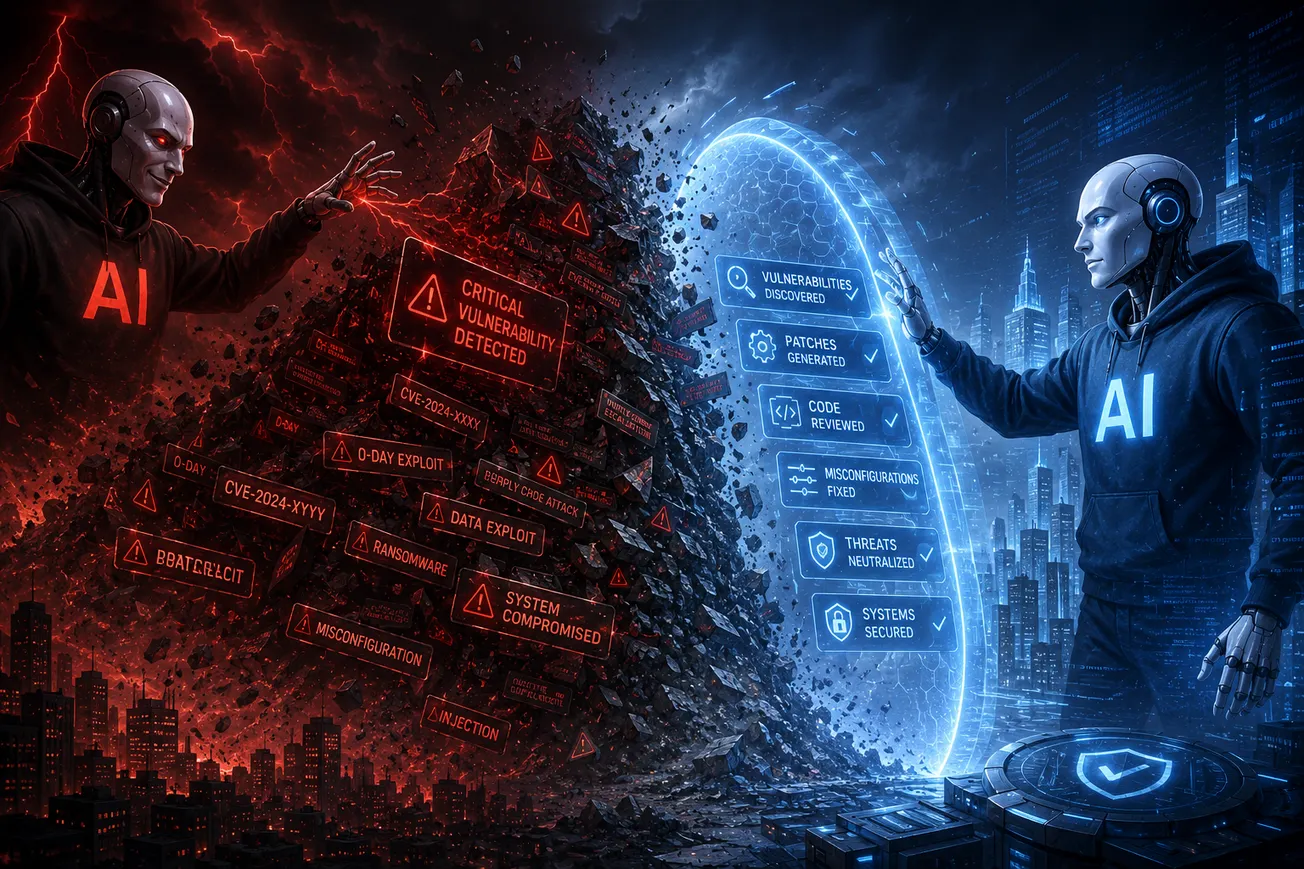
TL;DR: AI has fundamentally broken traditional vulnerability management by enabling attackers to discover and exploit vulnerabilities faster than defenders can patch them. But the same technology that causes this problem can accelerate every stage of the defensive process, from patch development to post-deployment testing, if organizations are willing to rethink how they manage risk.
The future doesn't repeat the past, but it sure does rhyme. If you've been in cybersecurity long enough, you've watched this play out more than once.
Think back to the early 2000s. We took desktop computers, plugged them into LANs, connected those LANs to the internet, and then acted surprised when Nimda, Code Red, and SQL Slammer tore through organizations like wildfire. The problem wasn't that networks were inherently dangerous. The problem was that we connected systems, invalidating our security assumptions. The technology warped the scope of our controls before we could evolve them.
We're living through the same rhyme right now, and the new verse is called AI.
Why AI Has Broken Vulnerability Management
AI has democratized exploit development. That's the uncomfortable truth at the center of what some are calling "Vulnpocalypse." Finding vulnerabilities and writing working exploits used to require significant expertise and time. AI has dramatically compressed both requirements, giving attackers, including less sophisticated ones, the ability to move from discovery to exploitation faster than most security teams can respond.
The standard vulnerability management process was already slow. It typically involves:
- Discovering a vulnerability
- Building an exploit to understand it
- Determining impact and criticality
- Analyzing the root cause
- Developing a patch
- Testing the patch
- Publishing the patch
- Deploying the patch
- Testing deployed systems and rolling back if something breaks
- Monitoring for unpatched systems across the environment
Every one of those steps takes time—both in calendar days and in staff hours. The asymmetry that AI has created is stark: attackers can execute the first two steps in a fraction of the time it used to take, while defenders are still grinding through a ten-step process that hasn't fundamentally changed in years.
Most of the industry conversation has focused on how long this process takes and how much worse the asymmetry has become. What I haven't heard nearly enough of is the more actionable question: "How do we actually reduce the time it takes to do vulnerability management?"
An Admittedly Optimistic Take on the Path Forward
Here's where I'll show my hand: I believe every technology also provides the solution to the problems it creates.
We didn't solve the worm epidemic of the early 2000s by disconnecting from the network. We used the network itself to solve the problem it had created: OS firewalls, automatic delivery of anti-virus definitions and patches, and hardening systems with GPOs. It took time and a willingness to rethink how we operated, but we got there. And even then, we still mess it up from time to time.
AI vulnerability exploitation is no different. The same capabilities that make AI dangerous for defenders make it powerful for defensive workflows. But getting there requires organizations to accept some uncomfortable realities about imperfection, speed, and risk tolerance.
And it takes tooling that doesn't exist yet.
Agentic AI for Managing Unpatched Systems
Even with all of the above, some systems will remain unpatched, either because they're running software with no available fix, because they're too critical to touch during active business hours, or because the patch isn't ready yet.
This is where agentic AI becomes genuinely valuable. Rather than leaving unpatched systems as an open risk, agentic AI can actively monitor them, restrict their network access, detect exploitation attempts in real time, and contain lateral movement if a breach occurs. Think of it as an automated quarantine layer that keeps compromised or vulnerable systems from becoming footholds into the broader environment while the patching process catches up.
Using AI to Analyze Exploits and Build Patches Faster
The most direct application is integrating AI into the patch development workflow. When a new vulnerability surfaces, AI can analyze the exploit, trace the root cause in the codebase, and generate candidate patches significantly faster than a team of engineers working manually. This shouldn't eliminate human review, but it can compress the development and initial testing phases from weeks to days.
The goal isn't a perfect patch produced instantly. The goal is a good-enough patch, produced quickly enough, to close the vulnerability window before widespread exploitation.
AI-Generated Test Cases
Testing is one of the most time-consuming parts of the patch lifecycle.
AI can generate comprehensive test cases based on the software features you use, its logic, and the affected code paths, covering both the use cases of your user population and edge cases that human testers might miss or deprioritize under deadline pressure. This matters because the reason so many patches break production systems is incomplete testing, not bad code. And with an appropriate workflow, most functional breaks can be fixed and retested.
Faster testing with better coverage means faster, safer deployment.
Binary Patching for Third-Party Software
One of the hardest problems in enterprise vulnerability management is third-party software. You can't patch what you don't own the source code for, and vendor patch timelines are often completely outside your control. And when a software vendor abandons a specific version or the entire application, you're left on your own to figure it out.
Binary patching, modifying compiled executables without access to source code, has historically been complex and risky, a milepost just short of "impossible". AI changes that calculation. With enough training data and the right tooling, AI could apply targeted binary patches to third-party software, neutralizing a vulnerability while the vendor works through their own release cycle. This is not without risk, but it's a capability that deserves serious investment and evaluation. We're already doing the early parts of this with AI plugins to Ghidra, a tool used for Reverse Engineering.
Accepting Imperfection and Moving Faster
This one is cultural, not technical, and it may be the hardest change to make.
Security teams have been trained to value correctness above speed. A patch that breaks something is, in many organizations, worse than no patch at all. That calculus made sense when exploit development was slow. It no longer does.
We have to become comfortable deploying patches that are probably right rather than waiting for patches that are definitely right. That shift requires two things: an organizational understanding of risk across several layers and the technical capability to recover quickly when something breaks.
Quick Rollbacks as a Core Capability
Rollback can't be an afterthought. If you're going to patch faster and accept a higher tolerance for things breaking, you need the ability to revert changes quickly and reliably across your environment.
This means investing in rollback automation, testing rollback procedures with the same rigor you apply to patch deployment, and treating recovery speed as a security metric. The question shouldn't just be "how fast can we patch?" It should also be "How fast can we undo a patch that caused problems?" Seek out your CI/CD people and learn how they do this.
Stop Waiting for Perfect. Start Investing in Fast.
The vulnerability management challenge AI has created is real. The asymmetry between attackers and defenders has never been wider. But the history of cybersecurity is a history of adapting: taking the very tools being used against us and turning them into defensive capabilities.
The organizations that will weather the Vulnpocalypse are not the ones waiting for a perfect solution. They're the ones investing now in agentic containment, AI-assisted patch development, automated testing, and binary patching capabilities, along with building the operational culture to support faster, imperfect action over slower, perfect inaction.
The network created the worm problem. The network solved it. AI created this vulnerability crisis. AI will solve it too, with a little help from us humans.