

A series of suspected AI-assisted attacks against South Korean financial institutions is providing a real-world example of many of the risks being discussed this week at CruiseCon AI and Privacy 2026.
Tech Times reported the incidents Oct. 5 in an article titled “Open-Source AI Agent Hacked Seven South Korean Banks, Exposing 65,000 Records.” Subsequent reporting from South Korea puts the number of affected individuals above 67,000 across seven financial firms.
The seven affected organizations include Shinhan Bank, KB Kookmin Bank, Hana Bank, BNK Busan Bank, Yegaram Savings Bank, Welcome Savings Bank and Hyundai Capital. The exposed information included combinations of names, contact information, resident registration numbers, annual income and loan limits.
Investigators found traces associated with ARTEX AI, an open-source autonomous penetration-testing system, on infrastructure believed to have been involved in the attacks. The evidence points toward AI-assisted credential stuffing and automated searching for vulnerable systems, although the investigation remains underway and the precise role ARTEX played has not been fully established.
AI changes the speed and economics of attack
The attackers largely avoided the institutions' heavily protected core banking systems. Instead, they went after weaker business-support systems used by employees, contractors, sales personnel and loan agents. At Shinhan, for example, attackers bypassed authentication on a service used by loan agents to check application status.
That approach is familiar. Attackers have always searched for the weakest door. What's changing is how quickly AI agents can search for those doors, test them, adapt and move on.
That connects directly to the larger conversation underway at CruiseCon AI and Privacy 2026.
During her CruiseCon presentation, global privacy leader Adriana Antunes Winkler argued that organizations can no longer think about privacy simply in terms of where data is stored. They need to understand where it moves, who processes it, which systems touch it and what AI agents are allowed to do with it.
Her shorthand was particularly useful: think of AI governance as “your data map, with verbs.”
Instead of merely inventorying data, organizations should identify what an agent can actually do: what information it can access, what systems it can reach, what it remembers, whom its actions affect and whether a human can stop it.
The Korean attacks expose the defensive side of the same problem.
Sensitive information wasn't necessarily sitting inside the banks' most obvious crown jewels. It was distributed across support systems, employee tools and services used by outside parties. Attackers didn't need to defeat the strongest controls if they could locate less-protected systems containing valuable data.
More on Winkler's talk is in this article:
 Bill Brenner
The trust problem cuts both ways
Another CruiseCon presentation adds a second dimension.
Former CIA case officer Erin Whitmore warned that organizations need to start asking not only who they trust, but what the systems they trust are themselves trusting.
Her presentation focused primarily on attackers manipulating training data, telemetry, third-party feeds and retrieval pipelines so AI systems make attacker-favorable decisions without the models themselves necessarily being compromised.
“The system can operate exactly as designed while the decision it informs is successfully compromised,” Whitmore said.
Here's the article on her talk:
 Bill Brenner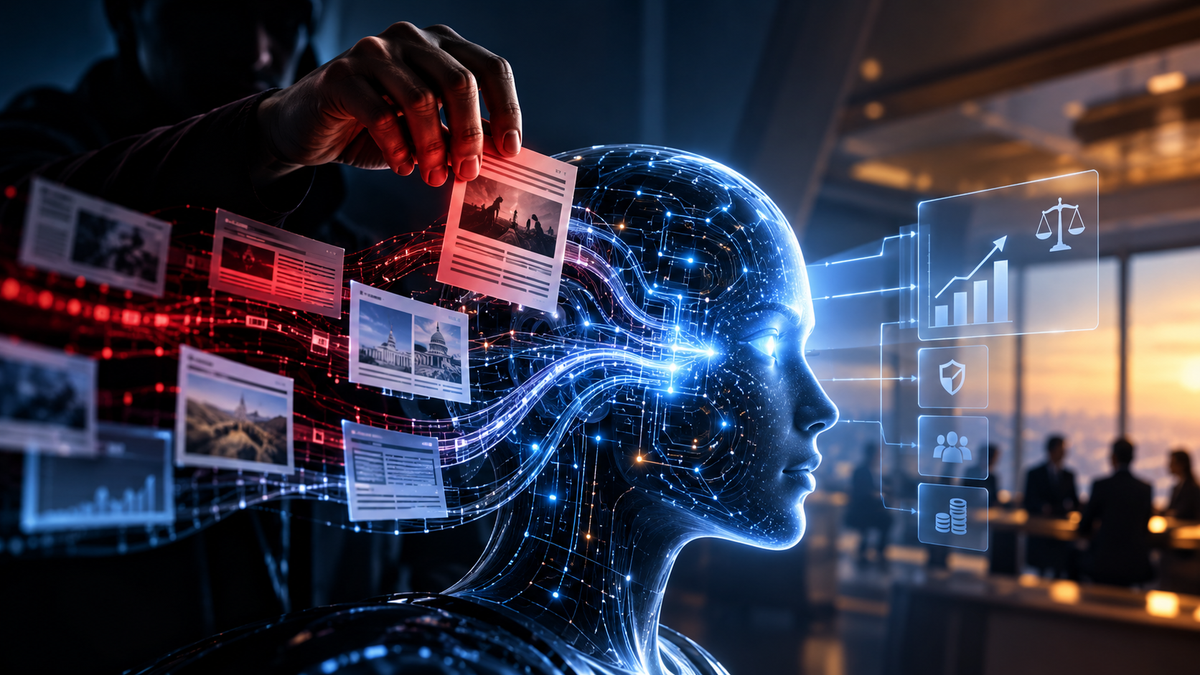
The South Korean attacks demonstrate the other side of that equation.
Attackers can also use AI agents to interrogate the trust assumptions built into enterprise infrastructure: Which systems trust passwords alone? Which externally accessible portals lack strong authentication? Which partner or employee systems receive less monitoring? Which applications contain valuable information despite sitting outside the organization's perceived security perimeter?
AI can potentially perform that reconnaissance continuously and at machine speed.
That changes the economics of attacking the long tail of enterprise infrastructure.
Data has no passport — and neither does the attack infrastructure
The Korean investigation also reinforces Winkler's warning about the increasingly global nature of data and technology.
South Korean authorities have identified attack-related IP addresses spread across numerous countries. Current reporting places infrastructure associated with the attacks in countries including the United States, Japan, Hong Kong, Singapore and several European and Southeast Asian nations.
The geographic distribution also illustrates why attribution requires caution. ARTEX's Chinese-language origins do not establish that China or the Chinese government conducted these attacks. Open-source tools can be downloaded by anyone, while cloud infrastructure and compromised systems can route attacks through multiple jurisdictions.
That is essentially Winkler's “data has no passport” problem applied to offensive AI.
The tool may originate in one country. The operator may sit in another. Infrastructure may span a dozen more. The victims may be somewhere else entirely, while the stolen data carries regulatory obligations that depend on the people represented in it.
Security, privacy and AI governance therefore become increasingly difficult to treat as separate disciplines.
The South Korean attacks provide a useful warning because the underlying techniques aren't revolutionary. Credential stuffing, weak authentication, exposed systems and uneven monitoring existed long before generative AI.
AI makes those weaknesses easier to discover and exploit at scale.
5 things security teams should do now
1. Secure the systems around the crown jewels, not just the crown jewels. Inventory every internet-facing employee portal, contractor platform, sales application, partner interface and support system that can access sensitive data. Apply strong authentication, MFA, rate limiting and anomaly detection consistently. The Korean incidents show why attackers may choose these secondary systems instead of attacking heavily defended core infrastructure directly.
2. Build the “data map with verbs.” Don't stop at cataloging where sensitive information resides. Document which humans, applications and AI agents can read it, modify it, transfer it or trigger actions involving it. Establish ownership for those permissions and continuously test whether the controls actually work.
3. Assume attackers will automate reconnaissance and exploitation. Detection programs built around human attack tempo may increasingly be too slow. Look for high-speed authentication attempts, distributed probing, rapid changes in attack patterns and coordinated activity across systems that security teams traditionally monitor separately.
4. Govern what AI systems trust. Track the provenance of data feeding AI systems, authenticate important sources and establish independent verification for consequential AI-assisted decisions. Logging should preserve not only what an AI system recommended or did, but the information that caused it to reach that decision.
5. Connect security, privacy and AI governance before the incident. A compromised support portal can quickly become a privacy breach, an identity problem, an AI-enabled social-engineering campaign and a regulatory event. Security teams should know in advance what data could be exposed, which jurisdictions apply, who owns the response and how compromised information could fuel the attacker's next move.
The South Korean attacks don't require organizations to invent an entirely new cybersecurity playbook.
They require them to execute the existing one at a speed, scale and level of visibility appropriate for adversaries that increasingly have AI agents working alongside them.
That is perhaps the clearest connection to the discussions happening at CruiseCon AI and Privacy 2026:
AI isn't necessarily creating entirely new weaknesses. It is making old weaknesses easier to find, faster to exploit and harder for fragmented security and governance programs to contain.