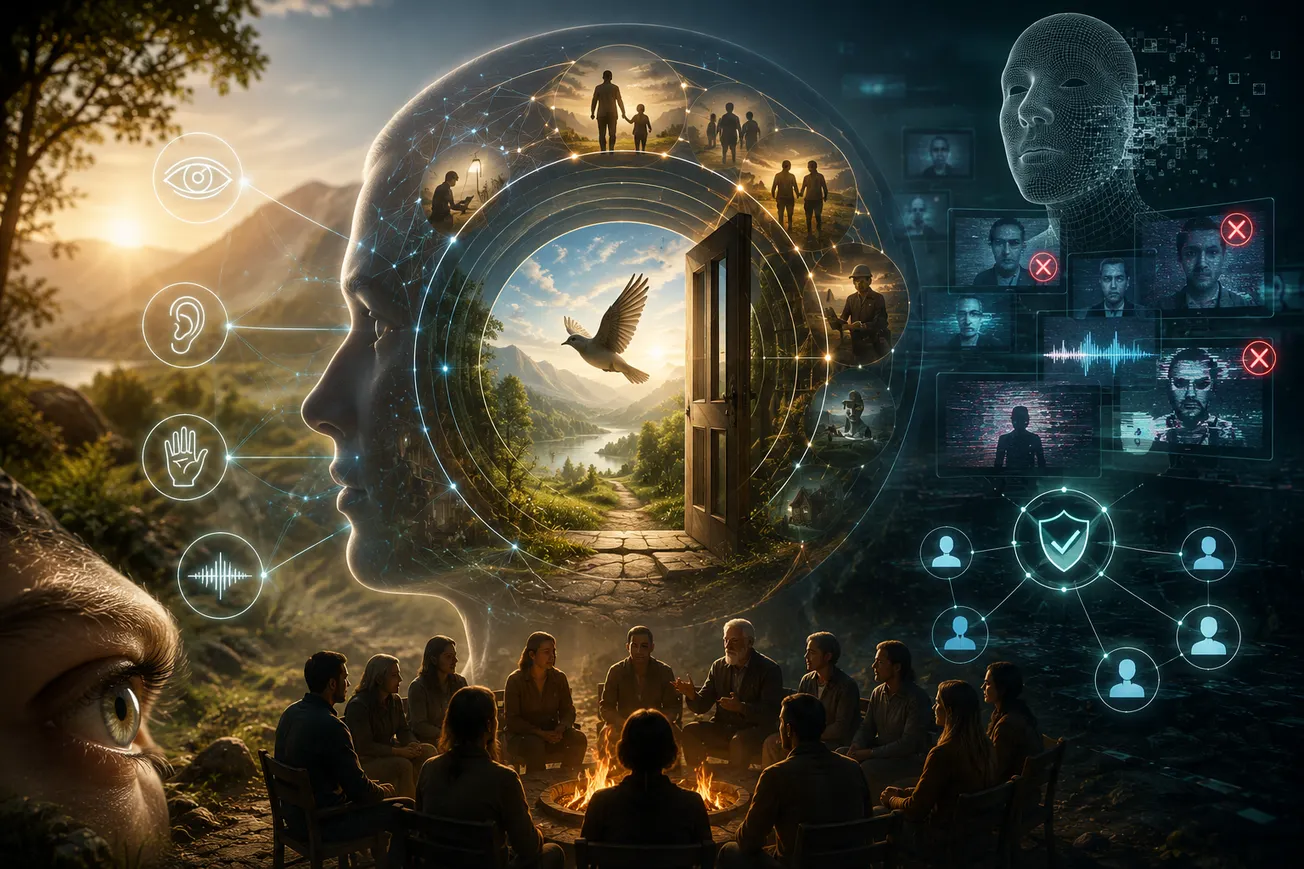
This morning, I watched a bird fly past the open door.
I am fairly confident it was a bird. Not perfectly certain in some abstract philosophical sense, but certain enough for daily mammal operations. Light hit my eyes. Motion crossed my visual field. I heard birds outside as well, so the sound matched the image. The object moved the way a bird moves. It did not appear as a frozen frame, hang motionless in the air, and vanish. It passed through the world in a way my brain could accept.
That is how most of reality arrives for us.
Not as a complete fact, delivered whole.
As return.
The bird appeared in one place, then another, then another. Light returned from it across fractions of a second. Sound returned from the same world. Motion returned in a coherent pattern. My brain updated the model and filed the event under: bird, probably real.
This is not just a cute observation from a Sunday morning doorway. It may be one of the central problems of trust in the age of AI.
Human beings do not experience reality directly, at least not in the clean way we often imagine. We maintain a model of the world and constantly update it. Our brains fill in gaps outside the center of our retinal attention. Memory fills in narrative gaps. Other people fill in social gaps. Language, habit, fear, love, reputation, and expectation all participate in the construction.
That does not mean reality is fake. The bird was probably real. The road is real. The grid is real. A hospital either has power or it does not. A bridge either holds or it does not.
But our access to reality is mediated through living models.
We build those models from what returns.
A child learns the world because the face returns, the voice returns, the bottle returns, the room returns after sleep, the caregiver returns after absence. Trust begins before language as repeated, coherent return.
A person trusts their body because the floor pushes back, the hand is where it was a moment ago, the cup has weight, the scar is still on the same knuckle.
A community trusts a neighbor because the neighbor returns to the same store, the same road, the same obligations, the same shared memory, the same corrections when the story drifts.
A utility trusts its operating picture because measurements return in expected ranges, alarms correlate with physical events, crews report back from the field, substations behave consistently, and the model of the grid keeps meeting the grid itself.
Return is how reality becomes believable.
When return breaks, reality becomes strange.
- The bird freezes in the air.
- The voice of your daughter calls from a number she never uses.
- A video shows a colleague saying something no one who knows them believes they would say.
- A trusted account posts in the wrong cadence.
- An alarm appears with no physical correlate.
- A person disappears from all channels and then returns sounding almost right.
That “almost right” is where the modern problem lives.
Artificial intelligence does not create the human condition of uncertainty. We were already model-building creatures. We were already filling in gaps. We were already vulnerable to rumor, panic, myth, misdirection, charisma, and bad memory.
What AI changes is the scale and quality of counterfeit return.
- A face can return without the person.
- A voice can return without the child.
- A screenshot can return without the event.
- A document can return without the authority.
- An account can return without the trusted human behind it.
A story can return again and again until repetition itself feels like evidence.
This is why the deepfake problem is not merely a media problem. It is a reality-maintenance problem. Synthetic media attacks the return loops by which mammals decide what is real enough to act on.
The standard technical answer is detection. Detection matters. We should build tools that identify generated images, cloned voices, manipulated video, suspicious accounts, and coordinated campaigns.
But detection alone is not enough.
A detector is just another signal asking to be trusted. In the moment when a voice that sounds like your child says they are in trouble, the question is not only whether an algorithm can calculate authenticity. The question is whether the message returns through a trustworthy path.
- Did it come through a known channel?
- Can the person confirm it another way?
- Does the cadence match their history?
- Do people close to them recognize the context?
- Is there provenance?
- Is there a community of witnesses who can receive, challenge, and stabilize the claim?
This is where community becomes security.
That may sound sentimental, but it is not. Community is a multi-node reality maintenance system. A healthy community does not merely provide comfort. It provides correction. It holds memory. It notices when someone sounds wrong. It remembers what happened before. It contains people willing to say, “No, that is not how it happened,” or “Yes, I was there,” or “Wait, check with her sister before you send money.”
A lone mammal can hallucinate itself into trouble. Groups can hallucinate too, of course, and history is full of terrifying examples. But healthy groups have stabilizing mechanisms: reputation, shared experience, local knowledge, direct relationship, humor, records, rituals, elders, dissent, and return.
The answer to AI-generated unreality is not to abandon trust.
It is to strengthen the paths by which trust is earned.
That means provenance, but not surveillance.
It means memory, but not permanent exposure.
It means evidence, but not dehumanization.
It means local relationships, but not tribal blindness.
It means technical systems that support accountable return: who said this, where did it come from, who witnessed it, what changed, what is source and what is inference, what is known and what is only suspected?
The cyber world already understands versions of this. We do not trust a system because it emits one log entry. We correlate. We compare. We look for continuity. We ask whether the signal returns through multiple independent paths. We care about chain of custody, repeatability, timing, source, and behavior over time.
The same logic now applies to public reality.
We do not know reality by seeing it once.
We know reality by what returns.
- A claim that appears once and vanishes is weak.
- A claim that returns through independent witnesses, records, context, and lived relationship is stronger.
- A claim that can survive correction is stronger than one that only survives isolation.
- A person is trusted because they return as themselves.
- An institution is trusted because it returns to its duties.
- A grid is trusted because power returns.
- A community is trusted because its people return to one another when the model of the world begins to wobble.
AI raises the stakes because it can counterfeit some of those returns. But it also gives us an opportunity to become more explicit about how trust actually works.
Trust was never just content.
Trust was never just information.
Trust was never just seeing.
Trust is continuity, witnessed over time.
The bird passed the doorway, and the world gave it back to me several times in half a second. That was enough for a bird.
For people, institutions, public claims, and critical infrastructure, we need more.
- We need return with provenance.
- Return with relationship.
- Return with memory.
- Return with correction.
- Return with community.
In the age of AI, our last line of defense may not be a single tool or detector. It may be the oldest thing we have, upgraded for the world we now inhabit: people who know each other well enough to notice when reality has been counterfeited, and systems designed to help them remember, verify, and return.