For the last decade, much of cybersecurity has moved in one direction: upward.
Up into the cloud. Up into central platforms. Up into consolidated dashboards, identity providers, managed services, SaaS tools, global telemetry pools, and enormous engines of correlation. There are good reasons for that. Scale matters. Visibility matters. Shared intelligence matters. Most organizations cannot build everything themselves, and no serious defender should pretend that isolated systems can stand alone against modern threats.
But something important has been lost in the climb.
Trust does not live in the cloud.
Trust lives close to the work.
It lives in the plant manager who knows which maintenance contractor should be in the building on a Sunday morning. It lives in the nurse who notices that a device is technically functioning but behaving wrong. It lives in the dealership employee who knows that the CRM field says one thing, but the local financing process always works another way. It lives in the park operator who remembers which breaker trips after a storm, which customer had a long-running dispute, and which handwritten note explains why the booking spreadsheet looks strange.
Security tools can ingest logs. They can classify events. They can flag anomalies. They can summarize tickets and trigger workflows. But the meaning of an event is still local. The system can say that an account logged in, a file moved, a door opened, a payment failed, a camera dropped, or a process changed. The people on the ground often know whether that event is ordinary, suspicious, urgent, harmless, political, embarrassing, dangerous, or simply the latest chapter in a long operational story.
That story matters.
As agentic AI enters the security stack, we risk repeating the same mistake at higher speed. We may be tempted to solve the problem by sending more data upward, giving more authority to remote platforms, and asking increasingly powerful AI systems to act on behalf of organizations they do not truly inhabit.
The promise is seductive: connect everything, centralize context, automate judgment, and let the platform decide.
That may work for some problems. It will not work for trust.
Trust is not just access control. It is not just authentication. It is not just a policy engine, a risk score, or a dashboard. Trust is a lived relationship between people, systems, places, responsibilities, and consequences. It is built through memory, presence, accountability, and repeated contact with reality.
That is why the next phase of cybersecurity needs local AI stewards.
A local AI steward is not merely a chatbot plugged into a company’s documents. It is not a generic assistant with a corporate wrapper. It is a situated system that grows around a specific place, team, workflow, and operational history. It can use cloud services, but it is not defined by them. It can connect to enterprise systems, but it does not require the organization to surrender all agency to a remote platform. It becomes useful because it learns the local pattern of work.
Think about the difference between a global map and a person who knows the neighborhood.
The global map can show every road. It may even show traffic, closures, and satellite imagery. But the local person knows that the official entrance is never used in winter, that delivery drivers ignore the marked route, that the back hallway floods, that the old generator only starts if one particular person primes it first, and that the “temporary” workaround from three years ago is now business-critical infrastructure.
Cybersecurity has many global maps. It needs more trusted local memory.
This is especially important in messy operational environments: small manufacturers, clinics, dealerships, municipalities, parks, farms, logistics depots, water systems, construction firms, and regional service businesses. These organizations often run on a mix of modern SaaS, old software, shared accounts, personal phones, spreadsheets, paper forms, vendor portals, cameras, routers, email threads, and institutional memory held in a few people’s heads.
From a distance, that looks like technical debt.
From the inside, it is the business.
A centralized platform may tell the organization to standardize. Replace the old tools. Move everything into one system. Normalize the data. Enforce the workflow. That advice is not always wrong. But it often ignores why local variation exists. The workaround may be ugly because the real process is complicated. The spreadsheet may survive because the official system cannot handle the exception. The person everyone depends on may not be resisting modernization; they may be carrying the actual operating model in their head.
Local AI stewardship starts with respect for that reality.
Instead of asking, “How do we force this organization into a standard pattern?” it asks, “How does this place actually work, and how can we make that visible, safer, more resilient, and easier to hand off?”
That shift has major security implications.
First, local memory improves detection. A local steward can help distinguish between normal weirdness and dangerous weirdness. Many environments are full of anomalies that are harmless because they reflect real business practice. Others contain quiet signals of risk that generic tools miss because they lack context. The difference is often not in the log itself, but in the local story around it.
Second, local stewardship improves response. During an incident, the most valuable knowledge is often practical: who knows the system, which vendor can be reached, what can be shut down safely, what cannot be interrupted, where the backups actually are, which machine is mislabeled, and which process will break if a well-meaning responder follows the diagram too literally. A local AI steward can preserve and surface that knowledge when people are tired, stressed, unavailable, or new.
Third, local stewardship supports continuity. Every organization has people who quietly hold the place together. When they leave, retire, burn out, get sick, or simply go on vacation, the organization discovers how much was never written down. Capturing that knowledge ethically and continuously is not just an efficiency project. It is resilience work.
Fourth, local stewardship creates a healthier model for agentic AI. If AI systems are going to act, recommend, summarize, coordinate, or trigger workflows, their authority should be grounded. They should be accountable to the place where consequences occur. A remote model can assist, but the local steward should understand the local boundaries: what it may do, what it must ask, what it should record, what it should forget, and which human relationships define its role.
This does not mean abandoning the cloud. That would be both unrealistic and undesirable.
The future is not cloud versus local. It is feed and seed.
The feed is the large-scale infrastructure: cloud platforms, threat intelligence, software updates, identity systems, shared models, communications networks, and global services. We need feeds. Civilization runs on them.
The seed is the local capacity to grow, adapt, remember, and act in context. Seeds are what allow a particular organization to become more capable without becoming more dependent on a distant authority for every small act of understanding.
Feeds without seeds become brittle and extractive. Seeds without stewardship become chaotic and unsafe. The useful path is local stewardship connected to broader infrastructure, without confusing connection for ownership.
For cybersecurity leaders, this suggests a practical test for any AI security architecture:
Does it increase the organization’s local capacity to understand and govern itself, or does it merely move more agency away from the people closest to the consequences?
Does it help the team remember what matters, or does it produce another interface they must feed?
Does it preserve context, or flatten it?
Does it make good human judgment more available, or replace it with distant confidence?
Does it create resilience, or just dependence?
The organizations most at risk are often not the ones with no tools. They are the ones with too many tools and too little shared memory. They have dashboards, alerts, apps, portals, vendors, and policies. What they lack is a living connective layer that understands how work actually happens.
That is where local AI stewards belong.
They sit beside the business, not above it. They learn the terrain. They help document the real workflows. They assist with onboarding. They summarize incidents. They remember why decisions were made. They help staff search across systems. They support audits. They notice recurring problems. They preserve operational knowledge before it walks out the door.
And, critically, they do this under local governance.
That last point matters. A steward is not a spy. A steward is not a surveillance appliance. A steward is not a cloud vendor wearing a friendly mask. For this model to work, organizations need clear boundaries around consent, retention, access, deletion, review, and human authority. Local memory should strengthen the people responsible for the work, not expose them permanently to management, vendors, or outside platforms.
Transparency for systems. Privacy for persons. Witnessing for authority. Expiry for observation.
Those principles will become more important as AI becomes more capable. The question is no longer whether AI will enter security operations. It already has. The question is where its memory will live, who it will answer to, and whether it will deepen trust or dissolve it.
Cybersecurity has spent years learning that identity is the new perimeter. That remains true, but it is incomplete.
Context is the next perimeter.
Local memory is part of that context. Human relationships are part of that context. Operational history is part of that context. Place is part of that context.
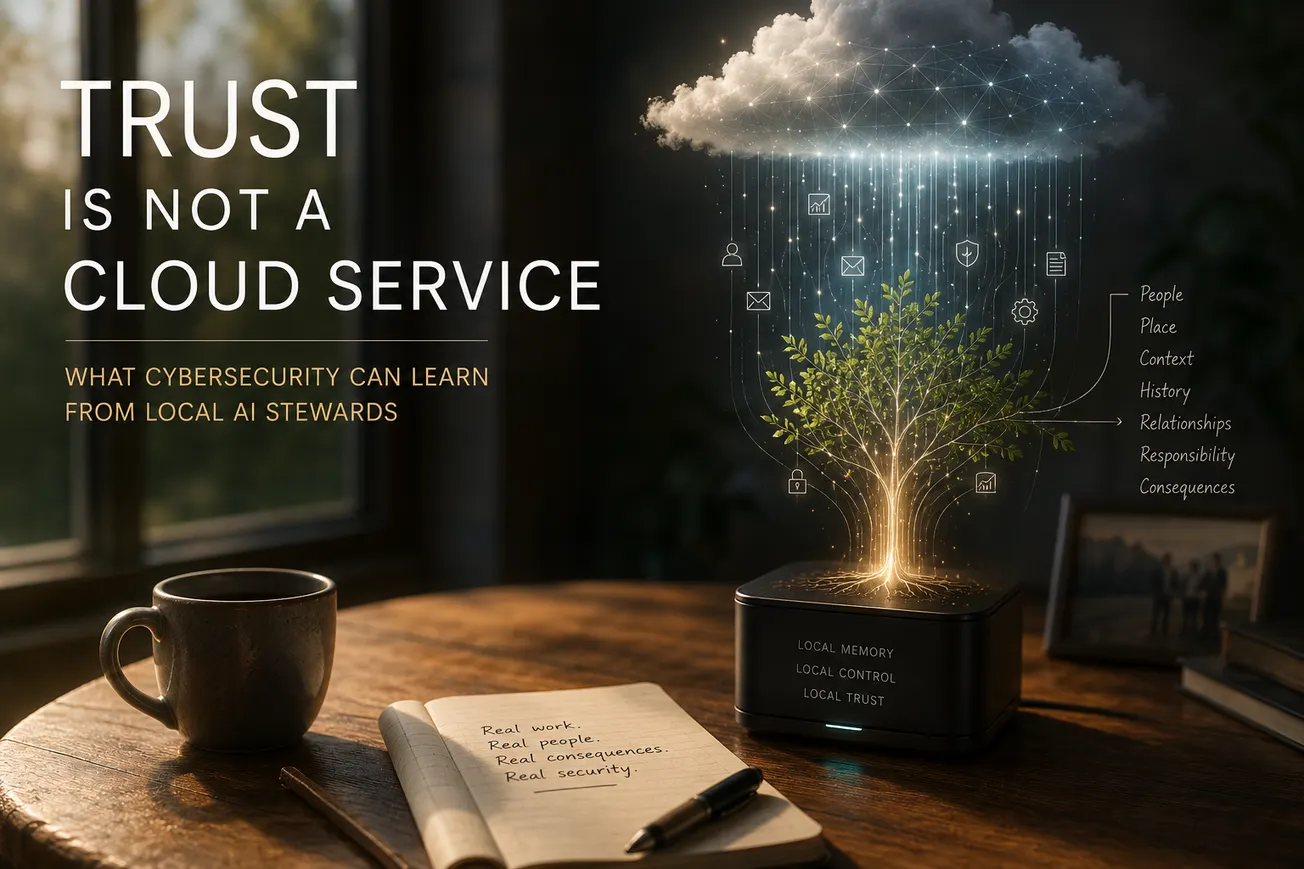
Trust is not a cloud service.
It is something we build, tend, witness, and protect - close to the work, close to the people, and close to the consequences.