

The hackers are back in the freezer aisle. And this time, the threat extends well beyond spoiled groceries.
A new wave of cyberattacks against supermarket refrigeration systems across Europe has demonstrated how attackers can turn vulnerabilities in connected equipment into physical and economic damage. By manipulating temperature controls, attackers can spoil food, disrupt retailers and potentially damage equipment without stealing data or deploying traditional ransomware.
For Duncan Greatwood, CEO of Xage Security, the incidents should serve as a warning to American businesses.
"Attackers didn't steal a single file. They just turned up the thermostat, and that was enough to empty the shelves," Greatwood said. "The latest wave of cyberattacks on supermarket refrigeration systems across Europe should be a wake-up call for the United States."
The attacks follow an earlier wave targeting French supermarkets in October. The latest incidents have reportedly affected retailers in Sweden, Finland, Belgium, Ireland and Estonia, with additional incidents reported in Luxembourg and the Netherlands.
Some refrigeration systems reportedly reached temperatures of 50 degrees Celsius (122 degrees Fahrenheit), threatening food inventories and normal operations.
The incidents reinforce a warning CYBR.SEC.Media raised in October: Internet-connected appliances and operational technology are increasingly attractive targets because compromising them can cause consequences far beyond the digital environment.
The expanding attacks also point to five actions security teams should take now.
From European supermarkets to the American food supply chain
The initial attacks reportedly affected hundreds of French supermarkets, including stores associated with Intermarché and Coopérative U. Attackers manipulated refrigeration controls, triggering abnormal temperature conditions and, in some cases, reportedly causing fires.
The latest incidents suggest a broader geographic problem, although investigators have not established whether the attacks share a common perpetrator or exploitation method.
According to NPR's November 3 reporting, similar concerns have emerged outside Europe.
In May, attackers reportedly targeted an Israeli food production facility, damaging refrigeration compressors, spoiling food and forcing operations to stop for more than a week.
In August, refrigeration failures also disrupted commissaries at several U.S. military installations. Federal investigators are examining whether those incidents were cyberattacks, but the Pentagon has not publicly confirmed that conclusion.
Greatwood argues that the United States should not view the European incidents as a distant problem.
"American grocers use similar technology, and the Pentagon is reportedly already investigating suspected attacks on refrigeration systems at military commissaries," he said. "If this can happen to a supermarket in Stockholm, it can happen in Ohio."
The implications extend beyond individual grocery stores.
"The incidents show that the food supply chain is now a cybersecurity issue," Greatwood said. "Attackers can cause real economic damage, and potentially cause fears of shortages, simply by manipulating the technology that keeps essential goods safe and available."
The underlying problem is familiar to operational technology security professionals: Aging controllers, exposed management interfaces, remote vendor access and equipment that cannot easily be patched or replaced.
Research published by Dataminr in early November identified thousands of potentially exposed refrigeration controllers accessible through the internet.
For attackers, those systems represent opportunities to interfere directly with physical operations.
AI could make the threat worse, but it isn't required
Our October coverage examined the refrigeration attacks alongside separate research from Anthropic exploring how smaller AI models might spread and operate across networks of connected devices.
That research raised concerns about autonomous AI agents potentially exploiting smart appliances and other Internet of Things devices.
There is no confirmed evidence that AI agents orchestrated the European refrigeration attacks, and no established connection between the incidents and Anthropic's research.
But the broader warning remains relevant.
AI could eventually make it easier for attackers to discover exposed controllers, identify vulnerabilities and automate attacks across distributed infrastructure.
For now, however, the refrigeration incidents demonstrate that attackers do not need sophisticated autonomous systems to cause significant physical disruption.
Existing weaknesses are already sufficient.
And addressing those weaknesses requires more than another round of software updates.
Five security actions organizations should take now
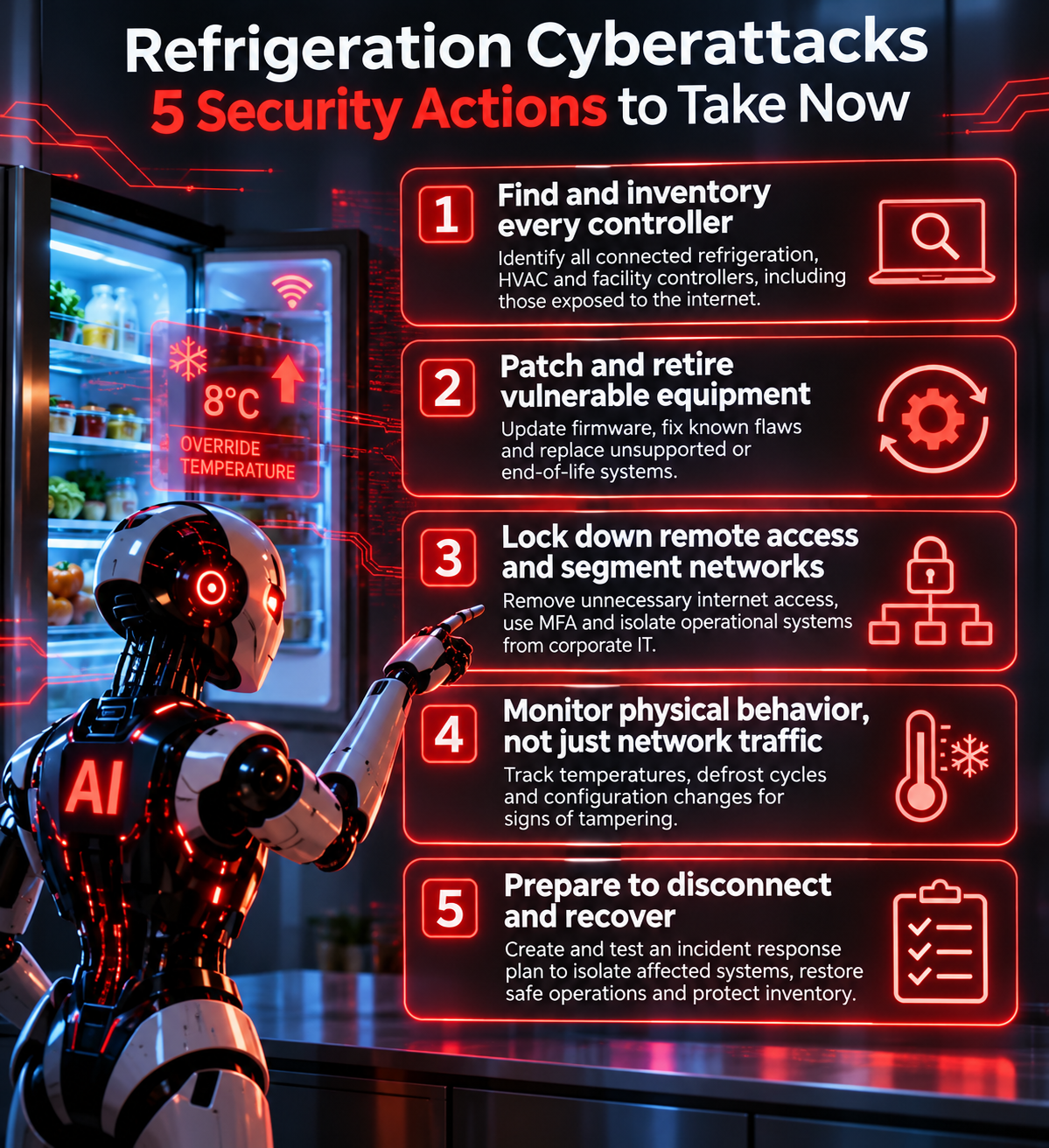
1. Find every internet-connected controller before attackers do
Organizations cannot protect equipment they do not know exists.
Security teams should inventory refrigeration controllers, HVAC systems, building-management devices, industrial gateways and other operational equipment connected to corporate networks or the internet.
The inventory should include firmware versions, support status, remote-access configurations and third-party maintenance connections.
Particular attention should go to devices managed through external vendors, cellular connections or legacy interfaces that may operate outside conventional IT security monitoring.
Greatwood says the exposure problem extends throughout food production and distribution.
"At Xage we work with clients across OT environments, including a European perishable food manufacturer," he said. "The same fundamental weaknesses exist across many parts of the food supply chain, from processing plants to cold storage warehouses and grocery stores."
Action item: Conduct an external exposure assessment, identify every internet-accessible operational controller and eliminate unnecessary connections.
2. Patch vulnerable systems and retire unsupported equipment
The refrigeration incidents highlight a longstanding problem with operational technology: Equipment often remains in service long after its software becomes difficult or impossible to update.
Some refrigeration controllers reportedly used at U.S. military commissaries date to the mid-2000s and can no longer receive security software updates.
Replacing these systems can be expensive and operationally disruptive. In many cases, organizations must coordinate maintenance with equipment manufacturers and outside service providers.
But Greatwood cautions against treating patching as a complete defense.
"Much of this equipment is vulnerable, often maintained remotely by outside vendors, and cannot easily be patched or replaced," he said.
Organizations therefore need compensating controls for equipment that cannot be updated, including network isolation, restricted access and monitoring for unauthorized changes.
Action item: Patch supported equipment, prioritize replacement of end-of-life controllers and isolate vulnerable systems that cannot be updated.
3. Lock down remote access and make critical equipment invisible to attackers
This may be the most important lesson from Greatwood's assessment.
Remote connectivity is essential to modern food production and retail operations. Manufacturers and service providers routinely manage refrigeration equipment across multiple locations.
But remote access also creates opportunities for attackers to reach operational systems through compromised credentials, exposed interfaces or vulnerable network connections.
Traditional network segmentation helps, but organizations should also consider identity-based access controls that prevent unauthorized users and devices from discovering or communicating with sensitive equipment.
"For companies that run refrigeration, production lines and other physical systems, patching matters, but it isn't enough on its own," Greatwood said.
"The smartest defense is to hide critical equipment from anyone who doesn't need it. If an attacker gets into a store's network but can't even see the refrigeration controls, they can't turn up the heat."
That approach reflects a broader shift toward zero-trust principles in operational technology environments.
Rather than assuming everything inside a network can be trusted, organizations should explicitly authorize access to individual systems and limit the ability of compromised accounts or devices to move laterally.
Action item: Eliminate direct internet exposure, enforce strong authentication, restrict third-party access and segment critical equipment using identity-based access controls wherever practical.
4. Monitor physical behavior, not just network traffic
Traditional cybersecurity tools are designed primarily to detect suspicious digital activity.
But attacks against refrigeration systems may produce their most important warning signs in the physical environment.
Unexpected temperature increases, abnormal defrost cycles, unauthorized configuration changes and unusual controller commands can indicate an attack even when conventional endpoint tools detect nothing.
Organizations need monitoring that connects cybersecurity telemetry with operational conditions.
Independent temperature sensors, alerts for unexpected control changes and logs of remote maintenance sessions can help identify tampering before food is spoiled or equipment is damaged.
Monitoring should also distinguish legitimate maintenance activity from unauthorized manipulation.
Action item: Establish alerts for abnormal temperatures, unexpected defrost cycles, controller configuration changes and suspicious remote-access activity. Ensure security and facility operations teams can respond together.
5. Build resilience so one compromised device cannot shut down operations
The final priority goes beyond preventing an initial compromise.
Organizations must assume that some attackers will eventually find a way into their environments.
The objective is to prevent that initial access from spreading into a larger operational failure.
"For these clients, production needs to stay running even in the face of a cyber attack," Greatwood said, referring to Xage's work with industrial customers.
"They must focus on resilience, which means assuming attackers will find a way in and ensuring they cannot turn a single compromised device or credential into a widespread operational disruption."
That requires coordinated planning between cybersecurity teams, facilities personnel, equipment manufacturers and business operations.
Organizations should establish procedures for isolating compromised controllers, restoring safe operating conditions and maintaining essential refrigeration or production functions when remote management systems become unavailable.
Incident-response exercises should test whether equipment can operate safely through local controls and how quickly affected systems can be recovered.
Greatwood summarized the defensive objective this way:
"Attackers roam networks looking for something to break. The answer is to make sure there's nothing for them to find."
Action item: Conduct an operational incident-response exercise that tests network isolation, containment of compromised credentials, safe manual operation and recovery without disrupting the wider facility.
The larger warning: Cybersecurity failures are becoming physical failures
The European refrigeration attacks demonstrate how quickly a digital vulnerability can become a physical and economic crisis.
The immediate consequences may include spoiled food, damaged equipment and lost revenue. But the potential implications reach further into food production, distribution and public confidence in essential supply chains.
Refrigeration systems are only one example.
Similar weaknesses exist in industrial ovens, building-management systems, water-treatment equipment, manufacturing machinery and other connected infrastructure.
The attacks also expose a fundamental limitation of cybersecurity programs built primarily around protecting data.
An attacker does not need to steal information to cause serious damage. Manipulating a physical process can be enough.
That is why the discussion must move beyond vulnerability management alone.
Patching remains essential, but organizations also need to reduce equipment exposure, restrict lateral movement, monitor physical conditions and maintain operations when individual systems are compromised.
The AI dimension makes those priorities more urgent, not less. As attackers gain access to more capable automation, the number of exposed systems they can discover and potentially exploit may increase.
But the current threat requires no futuristic technology.
In October, CYBR.SEC.Media warned that the next frontier of cyberattacks might be sitting in the kitchen.
Now, as refrigeration attacks spread across Europe and investigators examine suspicious incidents involving American military facilities, the warning is becoming harder to dismiss.
The lesson is not simply that refrigerators can be hacked.
It is that the infrastructure keeping food safe and available has become part of the cybersecurity battlefield.
And the measure of a successful defense is no longer just whether attackers can get in.
It is whether they can do real damage once they do.