

Two weeks ago I wrote about spending a crisis day with a large language model at my side — ten prompts, one PHP disclosure disaster, and a rule that survived the day intact.
Today is Election Day in the United States.
Nothing has happened yet. That is precisely the point of this post, and it is what makes it different from the last one. The PHP post narrated a day I had already lived. This one is the kit I am carrying into a day that has barely begun — the prompts written in advance, on a quiet Monday, because the founding lesson of the first post was that decisions should be encoded before fatigue, urgency and information overload arrive to make them badly for you.
Not a prediction of today — a prewritten procedure for the classes of claim election security produces.
The failure modes are not mysterious. They have all happened before, on the record. In January 2024, New Hampshire voters got a robocall carrying a cloned version of President Biden's voice, telling them not to vote in the primary.
In September 2023, two days before Slovakia voted, a fabricated audio recording of a party leader discussing how to rig the election spread during the country's pre-election silence period, when the people defamed by it were barred from answering properly.
In October 2024, a video purporting to show ballots being torn up in Bucks County, Pennsylvania, went viral; local officials debunked it within about three hours, and the next day the US intelligence community assessed that Russian actors had manufactured it.
The specific claims will be new. The failure modes are already familiar.
So the prompts below are staged, not recalled. The events they describe are hypothetical — I wrote them the day before, and I will not pretend otherwise. Where a prompt rests on something that genuinely happened, I name it. Where it is a rehearsal, it reads as one.
The most important rule is the same as last time:
Confirmed, reported, claimed and unresolved are four different states. Ten outlets repeating the same unverified claim don't make it ten times more credible.
One addition to last time's taxonomy: UNRESOLVED — credible evidence on more than one side, or its deciding evidence hasn't arrived. CLAIMED-ONLY is a claim with insufficient corroboration.
Here's the kit.
Morning: Don't believe the internet yet
1. Read the source, not the headline
The first viral artifact of election week will probably be a short video: a polling place supposedly closed, ballots supposedly destroyed, a line supposedly turned away. It will arrive as a screenshot of a post about a video, three reshares from anyone who was actually there. My first job won't be to decide whether it's real. It will be to establish what the artifact actually is.
The prompt: Read this firsthand. Report only what the artifact itself shows: where and when it claims to be, what is physically visible, what the caption asserts that the footage does not, and what it does not establish.Separate: observed in the artifact, asserted by the poster,asserted by people resharing it.
This matters because the Bucks County video survived exactly one level of that scrutiny. The man in it appeared to tear up ballots marked for one candidate. But the envelope and materials shown were, in the county Board of Elections' words, "clearly not authentic materials" belonging to or distributed by the board. The footage was real footage of something. It was not footage of what it claimed to be.
An artifact can be genuine and still not be evidence of the thing it is posted as evidence of.
2. Count evidence, not echoes
By midmorning, some county-level claim — a tabulation delay, a machine problem, a suspicious van — will be everywhere. Ten outlets will carry it. Nine will be repeating the tenth.
The prompt:
For each source, state its upstream: the election office itself, a named official speaking on the record, a reporter present at the location, or another outlet? List the tensions explicitly. End, per sub-claim, with CONFIRMED / REPORTED / CLAIMED-ONLY /UNRESOLVED.
This matters even more in an election, because repetition is often the operation. The Bucks County video was, per the intelligence community's assessment, "manufactured and amplified" — the amplification was part of the product. A summary that counts ten mentions as ten observations doesn't just make an analytical error. It completes the adversary's distribution strategy for them.
The number of sources isn't the same thing as the number of independent observations.
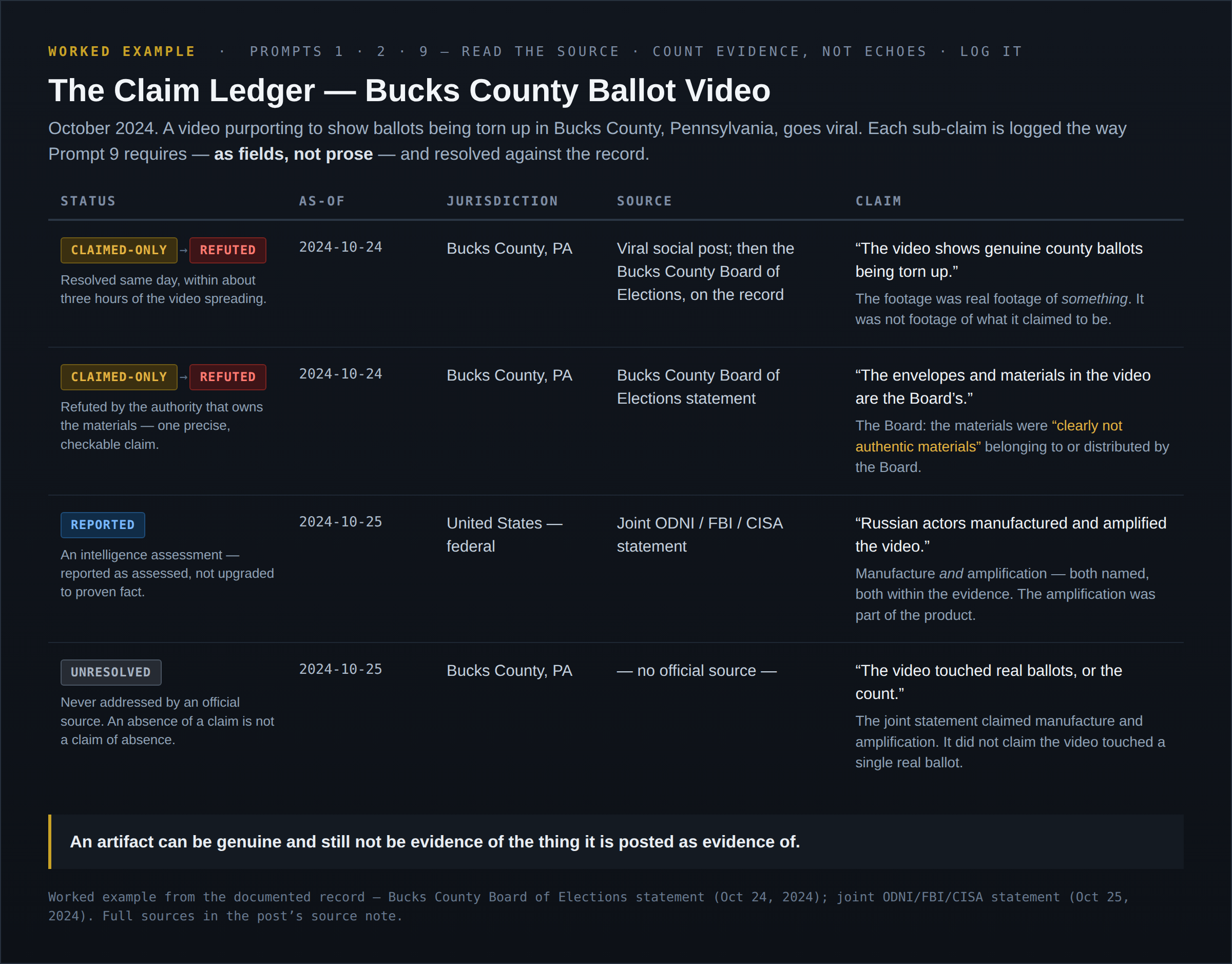
Worked example: the Bucks County ballot video (October 2024) logged as a claim ledger — the analysis of Prompts 1 and 2, recorded in Prompt 9's fields.
3. Schedule the verdict instead of guessing
Elections, unlike vulnerability disclosures, run on published clocks. Polls close at known times. Counties canvass on known schedules. States certify on dates fixed by law. The authoritative version of almost every election-week question arrives on a timetable you can write down in advance.
The prompt was written the day before, and it is mostly a list of appointments:At each scheduled check — poll close in the relevant states, the county canvass, the secretary of state's posting — fetch the official record for the jurisdictions in question from the election office or secretary of state. Reconcile it against what has been claimed during the day: what is now CONFIRMED, what is REFUTED, and what remains STILL UNSTATED by any official source. Report only. Do not upgrade a claim because the hour feels late.
The last sentence matters as much as the rest. Election night manufactures pressure to conclude — the feed is loud, everyone else is calling things, and silence from officials reads like guilt. It usually reads as counting. On election night the evidence mostly doesn't exist yet, and waiting is not a gap in the work. It is the work.
Sometimes the smartest automation is the one that tells you to wait.
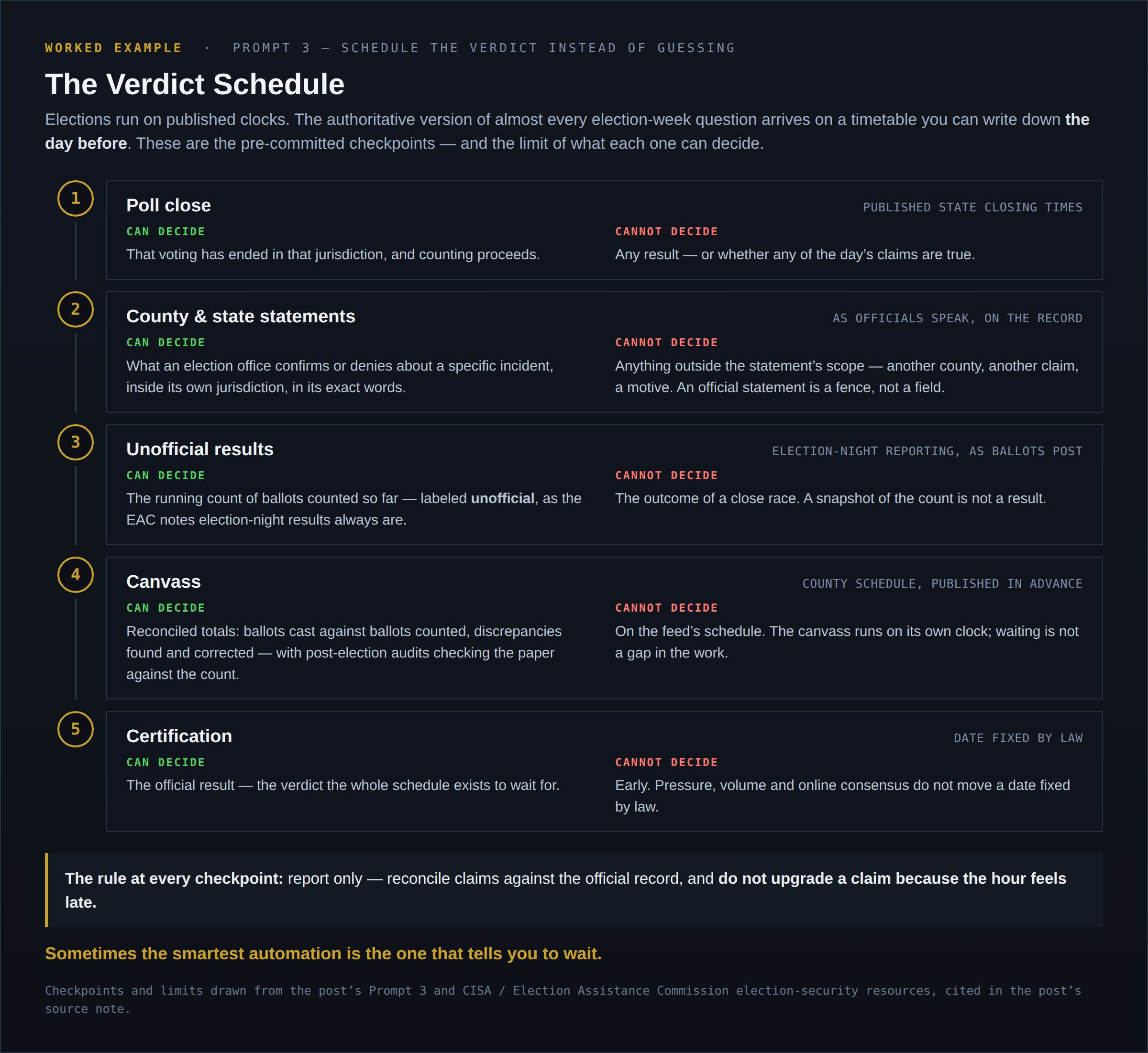
Worked example: Prompt 3's verdict schedule — the checkpoints committed to in advance, and the limit of what each one can decide.
Midday: Officials speak — in exact words, or not at all
4. Make the official's exact words the authority
Sooner or later an election official will say something real: a county confirming a tabulation delay, a secretary of state addressing a rumor, a federal agency issuing a statement. Within the hour, that statement will be paraphrased into something stronger, in both directions — proof of fraud for one audience, proof of nothing-to-see for another.
The prompt:
Extract the official's exact words. For each statement: what it affirms, what it denies, and hat it does not address. Quote, do not paraphrase. Note the jurisdiction it covers and thejurisdiction it does not.
A county confirming a tabulation delay is confirming a tabulation delay. It is not confirming fraud, and it is not confirming its absence everywhere else. When a federal statement says it has seen "no evidence" of something, the scope is the sentence: no evidence, of that thing, at that time, within that agency's visibility.
The Bucks County statement is the model: the board said the materials in the video were not theirs. One precise, checkable claim. It did not claim nobody anywhere was doing anything wrong.
An official statement is a fence, not a field. Report where it ends.
5. Stop calling screenshots proof
Election week's version of the partial workaround is the viral fix: a screenshot said to prove a result, a video of a machine screen said to prove a flip, a claimed workaround for a claimed problem — each one real as far as it goes and silently narrower than the conclusion pasted on top of it.
The prompt:
For each piece of claimed proof: what exactly does it show, in which jurisdiction, on which system, at what time? What would it look like if the innocent explanation were true? What does it explicitly not cover? Call it an exhibit unless an official source calls it a finding.
The correction discipline runs both ways. The Bucks County debunk was decisive — for Bucks County, for that video. It said nothing about a different claim in a different state, and borrowing its authority to wave off unrelated reports is the same error as borrowing a stopgap's authority to declare a system patched.
A debunk with a scope is a fact. A debunk without a scope is a slogan.
6. Ask what would verify the voice
The deepfake is the artifact this cycle is most rehearsed for. The New Hampshire robocall used a cloned presidential voice to tell voters to skip the January 2024 primary; the FCC's $6 million fine on the consultant behind it landed in September 2024, and its ruling that AI-generated voices count as artificial voices under the robocall law came the month after the calls. Slovakia's fake was cruder and better timed: audio only, no video, released into a 48-hour pre-election moratorium, which meant the rebuttal had almost nowhere legal to go. Šimečka's party finished second. Whether the recording changed that, nobody can honestly say — and the unanswerability is part of the damage.
So when this cycle's version arrives — a candidate, a clerk, an official, saying the thing they would never say — the prompt for it was staged in advance:
State what this artifact, at best, proves: that audio or video exists in which someone appears to say these words. Then work the verification hierarchy in order: the original, with provenance; an independent second capture of the same event; contemporaneous context; an authoritative confirmation or denial; forensic analysis. Treat the speaker's own words as evidence in the set, not authentication: a genuine recording can be denied, and a fabricated one accurately denied. Note which verifications exist and which are absent. Do not assess authenticity from how it sounds.
That last line is the one I will be most tempted to break. I cannot hear a deepfake reliably; neither can you — Slovakia's audio fooled people who knew the voices. The judgment has to come from provenance, not from how convincing it feels in headphones at midnight.
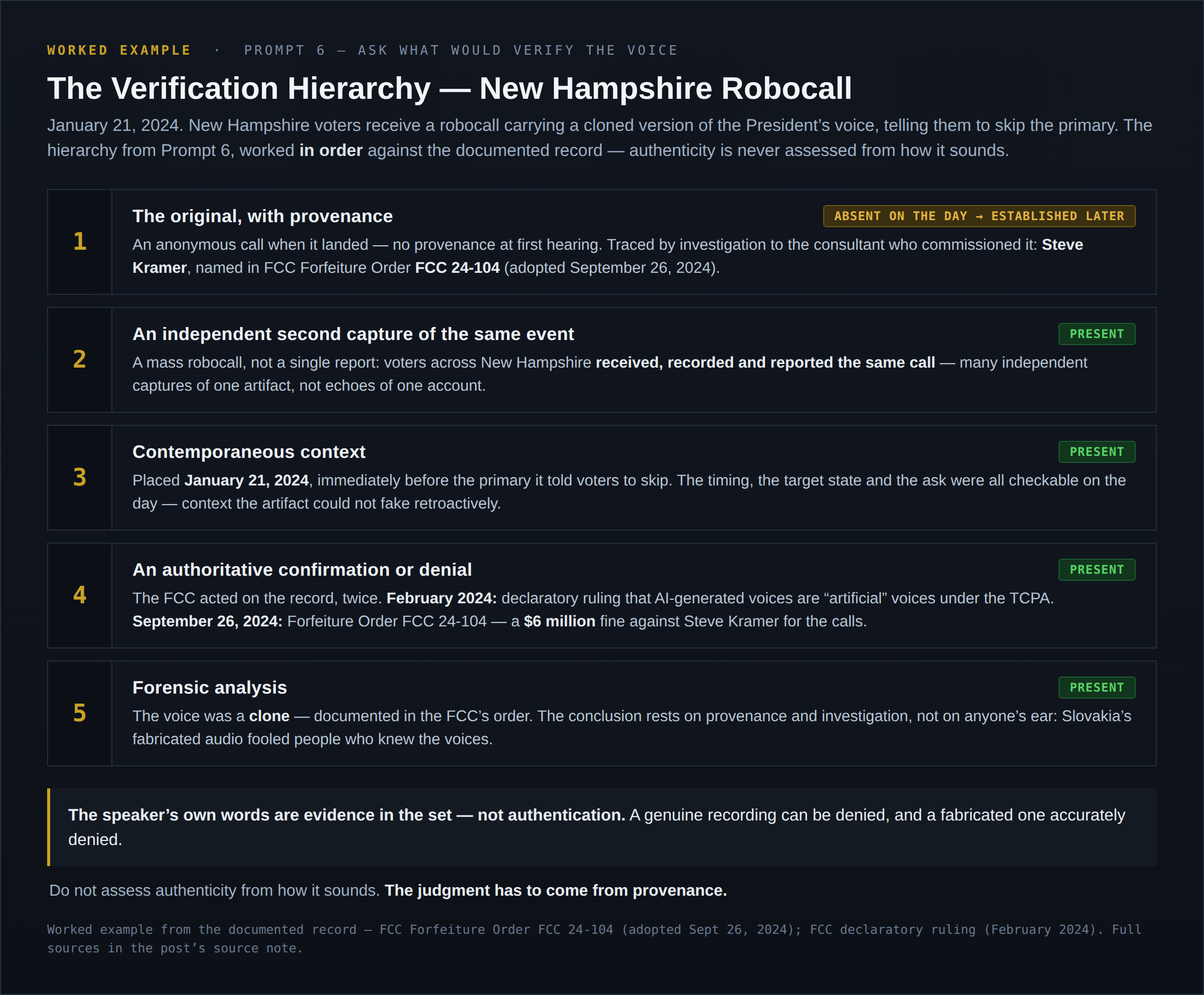
Worked example: the New Hampshire robocall (January 2024) run down Prompt 6's verification hierarchy, in order, against the documented record.
Afternoon: A claim of a hack is not a hack
7. Read the claim for its preconditions, not its reputation
At some point a claim will arrive that election infrastructure itself has been breached — a database posted, a screenshot of a console, a foreign flag planted in a defacement. It will be discussed as if "the election" were one computer. It is not. American elections are run by thousands of local jurisdictions, on infrastructure that is not one network: registration systems, electronic poll books and election-night reporting can be networked and exposed in ways vote-capture and core tabulation generally are not, and many tabulation environments deliberately isolate critical components. Nearly all votes carry a paper record, checked independently by reconciliation, canvassing and post-election audits. A January 2020 National Intelligence Council assessment, declassified since, concluded tabulation would be difficult to manipulate at a scale large enough to change a national result.
Voter registration databases and results websites, by contrast, are online, and are the genuinely exposed layer. A claim aimed at the wrong layer fails before it starts. "The election" is not an attack surface; it is a chain.
The prompt separates the three questions people collapse into one:
Separate: (1) which layer is the claim actually about — registration, poll books, ballot marking, scanning and tabulation, aggregation and transmission, election-night reporting, or canvass, audit and certification? (2) is that layer reachable as described, and does the evidence match its real outputs and formats? (3) has the responsible election office confirmed any of it on the record? Close with one classification line.
The answer I expect to write, in the shape of the one from the PHP post:
Registration and results reporting are networked and worth defending. Core tabulation is isolated and paper-checked. Do not treat a screenshot as a breach of either one.
Remove the first sentence and real risks get dismissed. Remove the second and an isolated system gets treated as a website. Remove the third and somebody mistakes the absence of confirmation for a cover-up.
Good security analysis has to accommodate several truths at once.
8. Don't let operations teleport across layers
The final move in the standard play is stitching: a genuine influence operation — foreign accounts amplifying a narrative — welded to a claimed technical intrusion, so each borrows the other's weight. The influence half is real, so the intrusion half must be too.
The prompt:
Conceptually only. Treat the influence claim and the intrusion claim as separate files. For each: what is the evidence, and whose is it? Then state what specific fact, if it existed, would connect them — shared infrastructure, shared operator, an official assessment naming both — and whether that fact is in evidence or merely implied by proximity. Influence is not intrusion, and intrusion is not effect.
The intelligence community's Bucks County statement is instructive because it did its own joining carefully: it assessed that Russian actors manufactured and amplified the video — manufacture and amplification, both named, both within the evidence. It did not claim the video touched a single real ballot. If you can't describe the connection, you don't have a combined operation. You have two stories and a conjunction.
Evening: Write it down before you write it up
9. Record what actually happened
The instruction is the shortest in the kit: "Log it." It was two words in the PHP post too. Its expanded form:
Build the day's timeline in UTC as events arrive: when each claim first appeared, its earliest identifiable source, when officials responded and in what exact words, when federal statements landed. Note what each development changed and what it did not. Preserve the classification of every sub-claim as it stood at the time, including the ones later corrected. Each claim's state travels as fields, not prose: status, as-of time, jurisdiction, source, claim.
Election disputes are litigated for weeks and remembered for years, and both run on records. Screenshots vanish; posts are edited; the claim quoted in December is not the version you saw at noon. The log is the difference between an after-action review and an argument about what everybody remembers feeling.
10. Put guardrails on public claims before writing them
The final prompt governs anything I publish, and it was written before the week started because it would not survive being written during it:
Never write "confirmed" for what an official has not said. Never write "debunked" beyond the specific claim the evidence covers. Name the jurisdiction and the official source for every factual sentence — or state plainly that no official source has addressed it. Do not invent a motive the evidence does not specify.
By the end of the week, some claims will have been fabricated and some will have been real, and the obligation runs in both directions. Slovakia's audio was fake; the New Hampshire calls were real, placed by a real consultant, and fined by the FCC. A method that only ever concludes "fake" is as broken as one that only ever concludes "stolen."
If the evidence supports "reported," don't write "confirmed." If officials say "delay," don't write "fraud" — and don't write "nothing." Every adjective carries a burden of proof.
The real lesson: AI can accelerate the work, but it can't own the judgment
When I wrote the PHP post, the prompts looked like the method. They weren't. They were decisions I had made in advance — about what counts as evidence, whose words outrank whose, when to stop and wait — written down in a form a machine could help me execute when I was too tired and too flooded to make them well.
This kit is the same idea one step earlier. Every prompt above was composed at a kitchen-table level of calm, against failure modes that are already documented history: a cloned voice in New Hampshire, a silenced rebuttal in Slovakia, a three-hour debunk in Bucks County. Election Day will supply the adrenaline. It should not be allowed to supply the standards.
An LLM will summarize the feed faster than I can read it. It will also, if I let it, average ten echoes into a consensus, upgrade a delay into a scandal, and hear a deepfake as genuine because it sounds right. They have names: source laundering, authority gained through respectable mouths; echo-counting, repetition tallied as corroboration; attribution teleportation, evidence borrowed from an unrelated operation. The prompts are how I keep the tool on the evidence side of those lines.
The judgment — what to believe, what to publish, what to leave in CLAIMED-ONLY or UNRESOLVED at midnight — stays where it was in October.
Mine.
The goal isn't to be the first person with an answer on election night. It's to be the person whose answer is still right when the canvass is done.