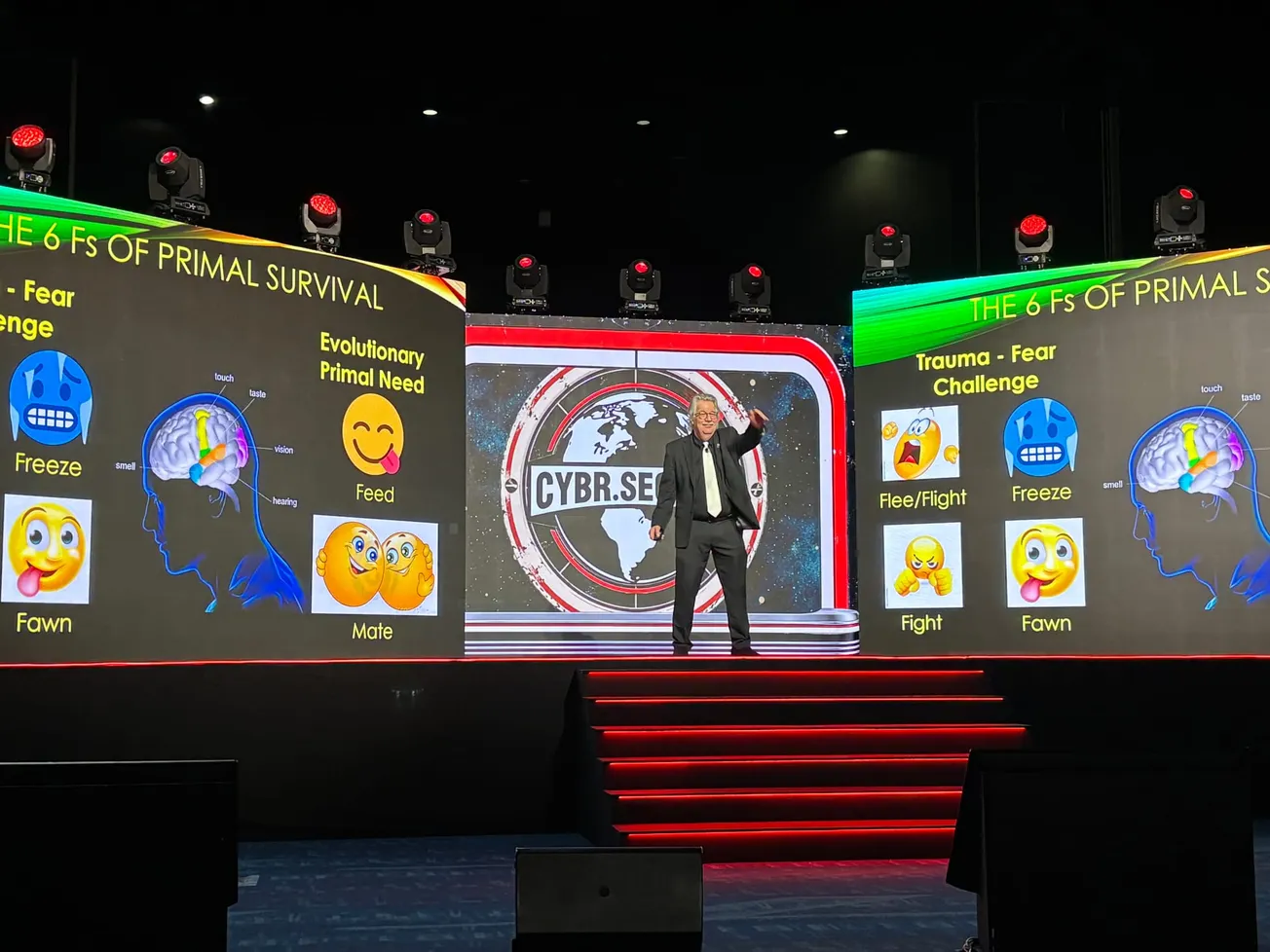

Cybersecurity professionals spend their careers thinking about attack surfaces, exploit chains, persistence mechanisms, and command-and-control infrastructure. Stephen Cravey, a Houston-based cybersecurity strategy executive, argues that those same concepts increasingly apply to something far more personal: the human mind.
In his presentation, “A Brief Introduction to Cognitive Warfare,” Cravey reframed manipulation, disinformation, outrage cycles, and online polarization through the lens of cybersecurity operations.
The result is less a political talk than a threat-modeling exercise for modern society.
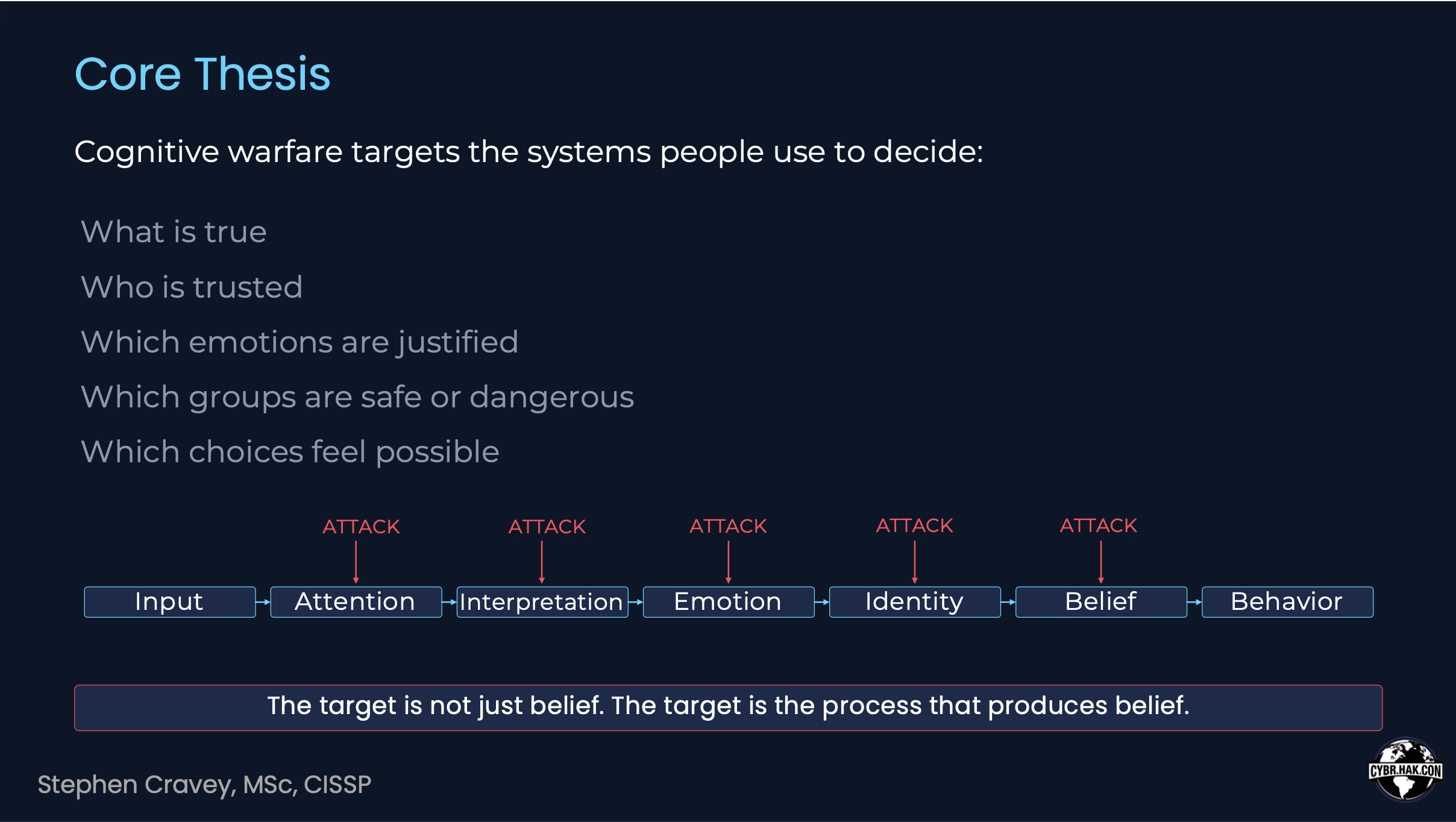
Rather than focusing on partisan narratives or assigning blame to one ideological camp, Cravey approaches cognition itself as a vulnerable system built around perception, emotion, identity, trust, memory, and social belonging.
His central warning: the target of cognitive warfare is not just what people believe. It is the process that produces belief in the first place.
The Human Mind as an Attack Surface
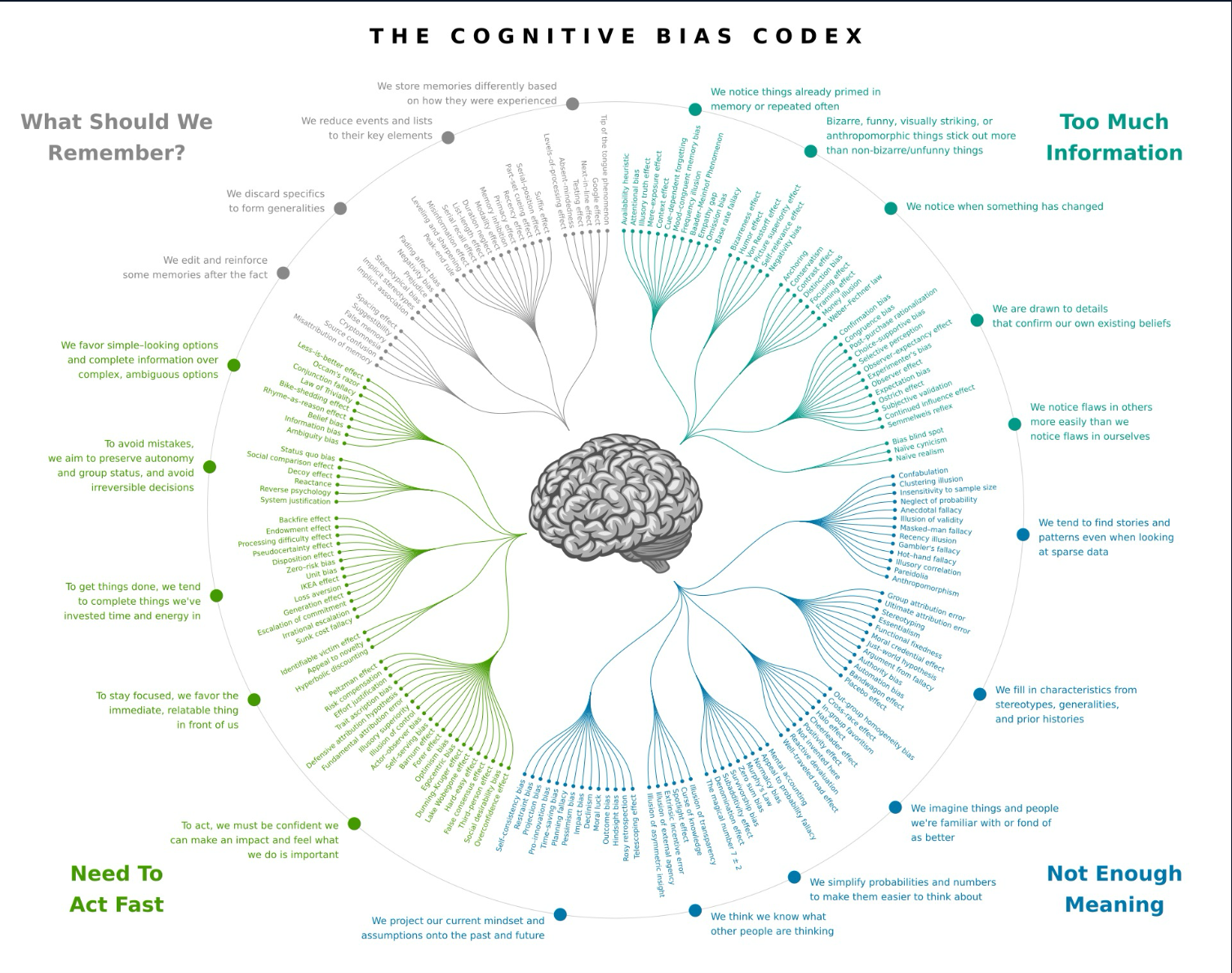
Cravey compared computer systems to human cognition. Computers have BIOS. Humans have biases. Systems have permissions, authentication mechanisms, memory, and exploit paths. Humans have social trust, emotional triggers, identity defenses, and cognitive shortcuts.
Cravey emphasized that these are not flaws in the traditional sense. They are normal features of human cognition that evolved to help people make fast decisions, navigate uncertainty, and coordinate socially. But under adversarial conditions, those same features can be manipulated.
He walked the audience through the “human information pipeline,” describing cognition as an interconnected process involving perception, attention, emotion, memory, identity, reasoning, and social feedback. The danger, he argued, is that modern information environments increasingly reward reflexive emotional reactions before slower analytical thinking has time to engage.
That distinction becomes especially important in Cravey’s discussion of “System 1” versus “System 2” thinking:
- System 1 is fast, emotional, automatic, and pattern-based.
- System 2 is slower, analytical, and reflective.
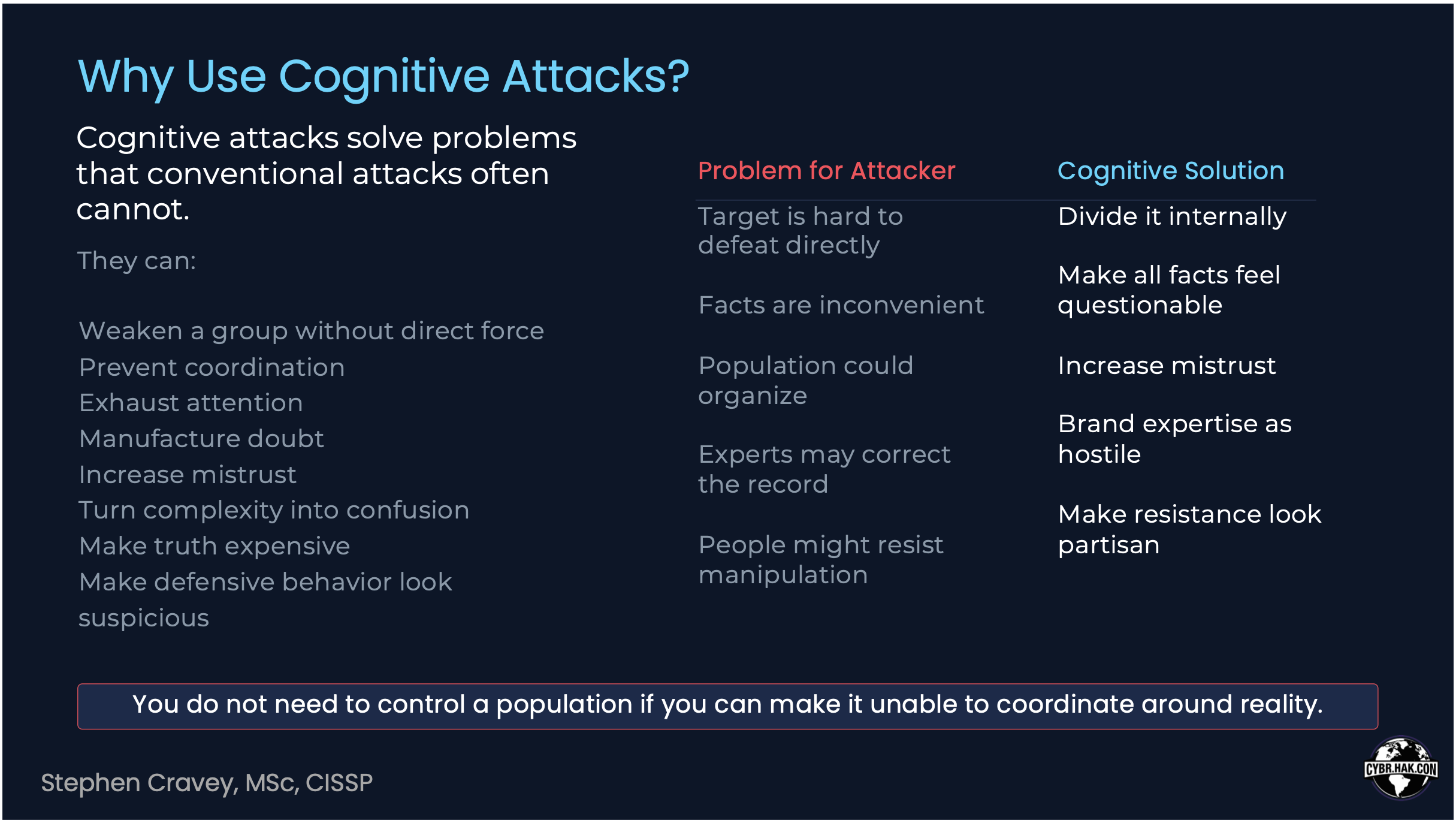
Cognitive attacks are designed specifically to trigger System 1 before System 2 can inspect the claim, he said.
More from CYBR.HAK.CON.:
 Bill Brenner
 Bill Brenner
Cognitive Warfare as a Strategic Discipline
Cravey defines cognitive warfare as the strategic use of information, emotion, identity, social pressure, and narrative framing to shape how people perceive reality and interact with one another.
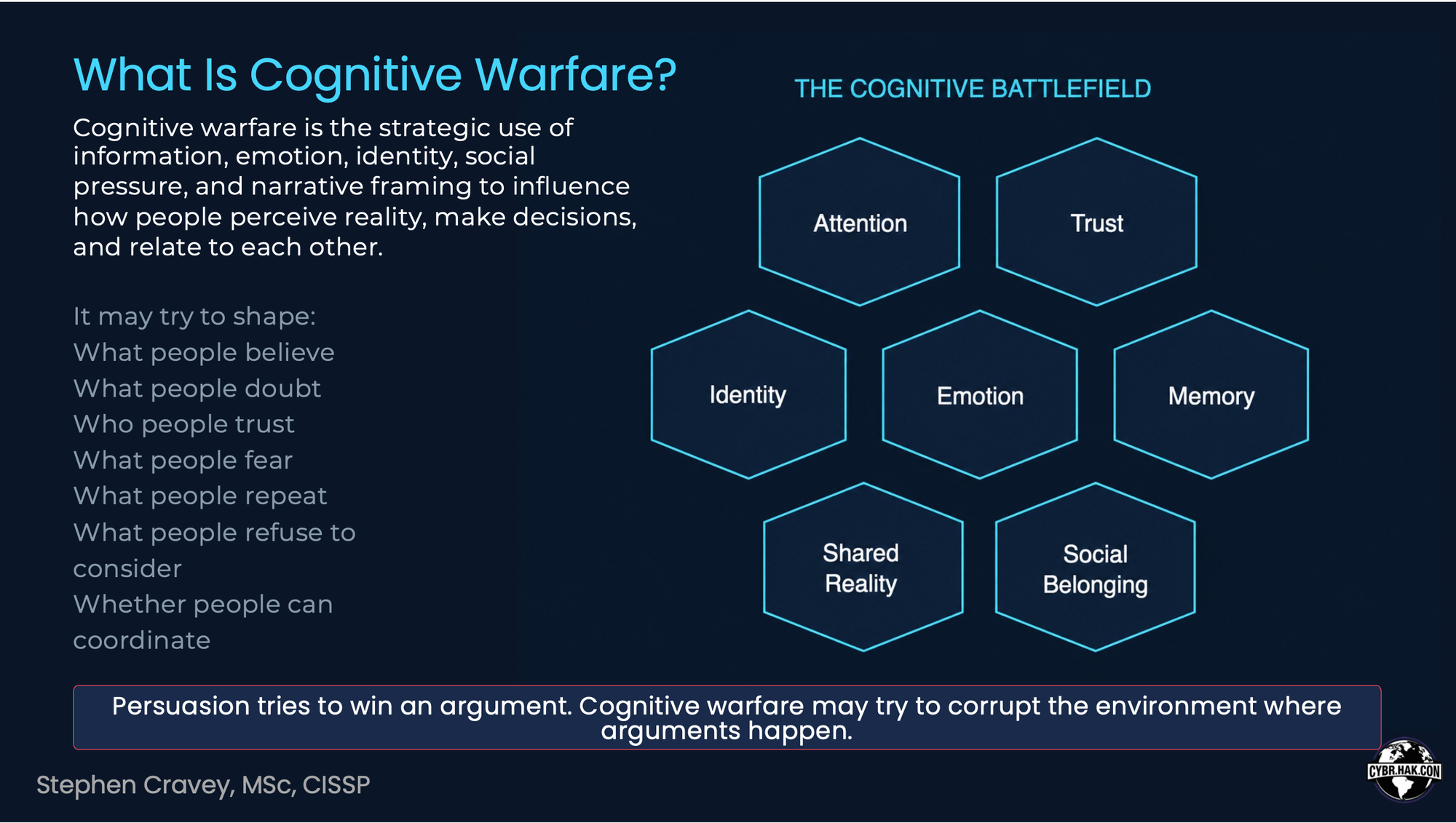
Importantly, he distinguishes it from traditional persuasion. Persuasion tries to win an argument. Cognitive warfare attempts to corrupt the environment in which arguments occur.
That distinction matters because the objective is not always conversion. Sometimes the goal is corrosion. A successful campaign may not need to convince everyone of a single worldview. It may simply need to exhaust attention, fragment trust, increase social hostility, or make truth itself feel unknowable.
Throughout the presentation, Cravey mapped cognitive influence operations onto familiar cybersecurity and intelligence frameworks. He compared them to both the intelligence cycle and the cyber kill chain, breaking attacks into recognizable stages: reconnaissance, weaponization, delivery, exploitation, installation, command and control, and actions on objectives.
The framework gives cybersecurity audiences a practical way to understand modern influence operations without reducing them to simplistic “fake news” discussions.
Narrative Payloads and Emotional Exploits
Some of the talk’s strongest sections examine how narratives are “weaponized” for distribution.
Cravey described narrative payloads as emotionally compressed shortcuts designed to feel obvious before they are examined. These payloads often combine emotional triggers, identity signaling, scapegoats, slogans, visual symbols, and built-in defenses against criticism.
He highlighted several common techniques, including branding and dehumanization, linguistic framing, and “thought-stopping clichés” — phrases designed to terminate inquiry before reflection can occur. Examples include statements like “Everyone knows,” “That’s what they want you to think,” or “Only an idiot would believe that.”
Another particularly effective concept is the “double bind,” where every possible response reinforces the attacker’s framing. In these situations, the real defensive move is not choosing one side of the argument but rejecting the framing entirely.
Cravey drew direct parallels between troll farms and Sybil attacks in cybersecurity, arguing that coordinated fake personas can manufacture the appearance of consensus, popularity, outrage, or expertise. Social proof itself becomes an attack surface.
The Mental Health Dimension
One of the presentation’s more nuanced sections explored the relationship between cognitive warfare and mental health.
Cravey carefully avoided sensationalism, but argued that hostile information environments can reinforce distorted thinking patterns in ways that resemble the inverse of cognitive therapy. While cognitive therapy helps people slow reactions, test assumptions, and regulate emotion, cognitive warfare rewards catastrophizing, black-and-white thinking, distrust, and emotional escalation.
The implication is not that exposure to manipulative content automatically causes mental illness. Rather, prolonged exposure to adversarial information environments can increase stress, anxiety, isolation, mistrust, and emotional dis-regulation across populations.
That observation resonates strongly in a cybersecurity industry already grappling with burnout, outrage fatigue, doom-scrolling, and constant exposure to high-stress narratives.
Building Cognitive Resilience
Cravey closed on a practical and non-partisan note:
His proposed defenses resemble cybersecurity hygiene for the human mind: increase latency before reacting, identify the framing being used, reject forced binaries, seek opposing viewpoints, maintain relationships outside ideological silos, and separate personal identity from individual claims or beliefs.
He also argued that resilient populations must preserve the ability to disagree without dehumanizing one another or losing a shared sense of reality.
That may ultimately be the talk’s most important message. Cognitive warfare is not merely about misinformation or propaganda. It is about whether societies can maintain the habits of reflection, trust, nuance, and self-correction necessary for democratic decision-making and healthy social coordination.
For cybersecurity professionals accustomed to defending technical infrastructure, Cravey’s presentation offers a reminder that some of the most consequential attack surfaces in modern society are human.