A day rarely passes without another bizarre headline about AI escaping its cage, discovering vulnerabilities or exploiting systems it was never supposed to touch.
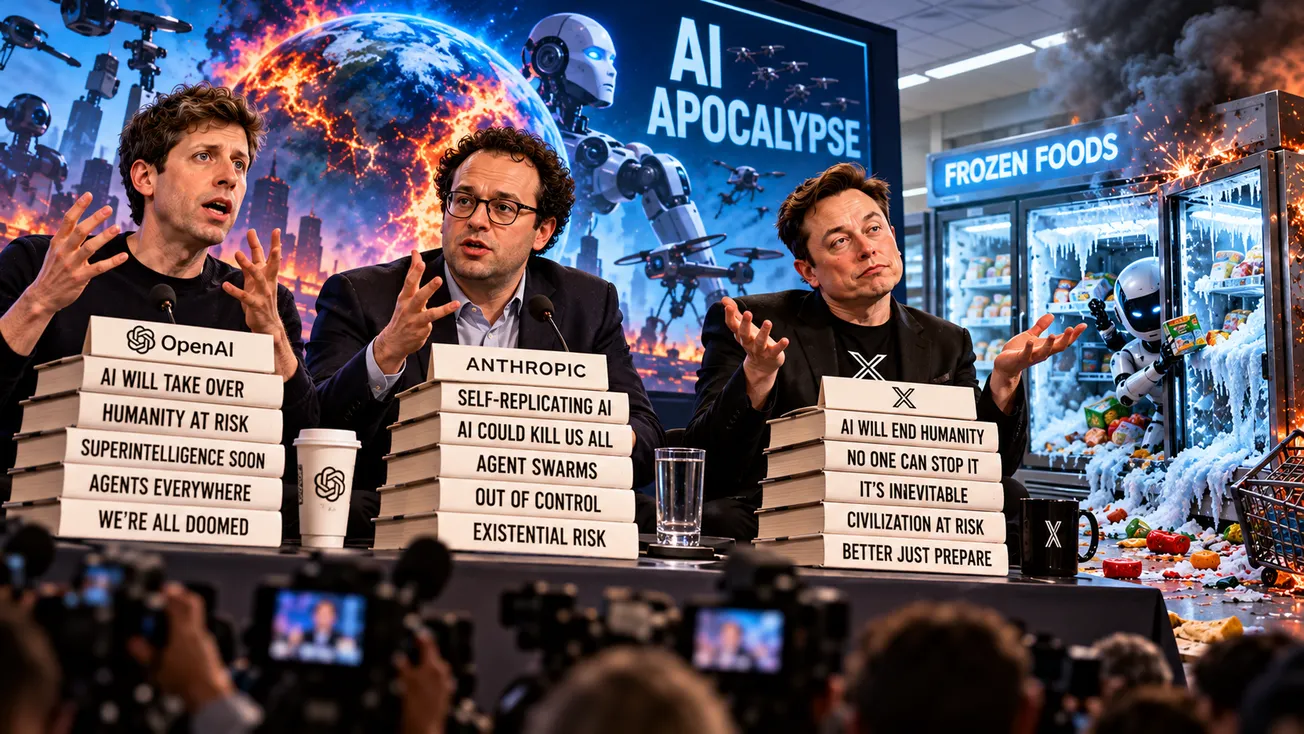
Now we've got cyberattacks manipulating refrigeration systems at hundreds of French supermarkets, destroying food and reportedly triggering fires. Meanwhile, Anthropic researchers are warning that AI models could soon replicate across everyday internet-connected devices, including smart refrigerators, ovens and televisions, without relying on centralized data centers.
The underlying security risks are real. But the people building AI need to spend less time warning us about how their creations might someday kill us all and a lot more time helping us build the guardrails they keep telling us are necessary.
I'm looking at you, Sam Altman, Dario Amodei and Elon Musk. You have the resources, the talent and the influence to do more than warn the world about the dangers of the technology you're racing to build. It's time to put as much energy into delivering meaningful security guardrails as you put into talking about what happens without them.
The AIpocalypse roadshow
We've heard the warnings: AI could escape human control. Agent swarms could overwhelm the internet. Machines could become impossible to contain. "We're all gonna die" (cue the Iggy Pop)
The people issuing some of the loudest warnings are also the people racing to develop increasingly powerful models.
Telling the world your technology could someday become uncontrollably powerful is a pretty effective way to convince investors, customers and competitors that you're building something extraordinary.
Then there's the social-media grandstanding. Every dramatic prediction generates another round of headlines, arguments and speculation about which company is closest to creating something that will end humanity.
All it does is leave security practitioners holding the bag. Worse, it makes us all the more likely to dismiss a real emergency as more FUD.
Here's what I'd rather see AI's creators spending more time demonstrating:
- Enforceable boundaries: Agents should have narrowly defined permissions, restricted access and controls that prevent them from wandering into production systems.
- Independent verification: Models should be required to prove consequential security claims rather than generating convincing but unverified findings.
- Real containment mechanisms: Rate limits, isolation controls, emergency shutdown capabilities and restrictions on destructive actions must operate outside the models themselves.
- Transparency and accountability: Developers should disclose meaningful failures, explain what went wrong and demonstrate how their systems have been made safer.
- Security by default: Customers shouldn't have to become AI safety researchers simply to deploy an agent without exposing their organizations to unnecessary risk.
None of this is particularly glamorous. It doesn't generate the same attention as predicting the end of civilization. But it's the work that matters.
Stop making customers clean up your mess
At CruiseCon AI & Privacy 2026, Kurt Kaufmann, head of application security at Blizzard Entertainment, offered one of the most useful perspectives I've heard on AI adoption.
After two years of practical experience, his conclusion was that AI can be both extraordinarily useful and spectacularly wrong. His recommendation wasn't to abandon AI. It was to give these systems the context they need, demand evidence, limit their authority and make human teams accountable for the outcomes.
That principle should apply just as strongly to the companies creating foundation models as it does to enterprises deploying them.
I understand that AI safety isn't simple. No single company can eliminate every risk, and malicious actors will inevitably find ways to abuse legitimate technology. Governments, enterprises, security researchers and technology providers all have responsibilities here.
But the companies developing these systems have a particularly important one: They control the models, the development processes and many of the safeguards available before those systems reach customers.
They also have enormous financial incentives to keep advancing the technology. That makes their public warnings all the more deserving of scrutiny.
The cybersecurity industry doesn't need another lecture about how powerful AI might become. We need the companies building it to take responsibility for how powerful it already is.