
Full [un]prompted II coverage:
 Bill Brenner
A large pharmaceutical company had a functioning AI governance program, complete with risk classifications, approval forms and committee oversight. Yet employees were largely ignoring it. Only 20 AI requests had been submitted in three months, while a review of just 24 hours of logs uncovered 35 unauthorized AI tools already in use.
The problem wasn't that the company had failed to establish AI security controls. It was that the process designed to enforce those controls was driving employees around them.
At [un]prompted II in San Francisco, Olivia Rose and Kayla Williams, former CISOs and co-founders of Williams Rose AI Cyber Advisory, described how they helped rebuild the company's AI intake process around how employees actually work.
Within three months of introducing the redesigned process, submissions climbed from 20 to 96. Low-risk approvals that previously took four weeks could be completed immediately or within one day. High-risk decisions dropped from six to eight weeks to one week.
Their presentation, Built to Spec, Ignored in Practice: Rebuilding AI Intake People Actually Use, offered a case study in why traditional governance, risk and compliance (GRC) practices can fail when applied to rapidly expanding enterprise AI adoption.
When the AI approval process becomes the problem
The pharmaceutical company's original governance program followed a familiar security playbook.
Employees submitted requests to use AI tools. Those requests were assigned risk classifications and routed through an approval process involving governance reviews and committee decisions.
On paper, the program had the right components.
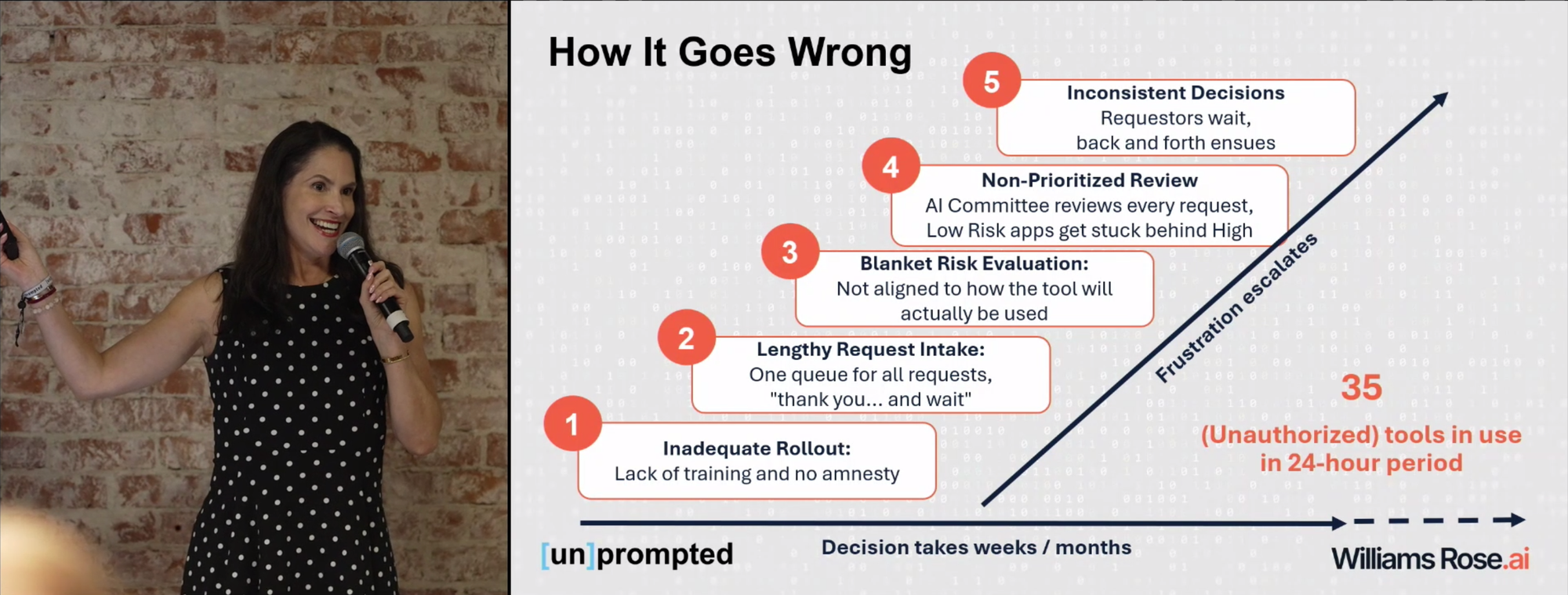
In practice, the speakers identified five problems that made the system ineffective.
First, employees had received inadequate training about the process, and there was no amnesty provision for AI tools already in use.
Second, every request entered the same lengthy intake queue, regardless of risk.
Third, evaluations focused too broadly on the tools themselves rather than how employees intended to use them.
Fourth, an AI committee reviewed every request, leaving low-risk applications stuck behind higher-risk proposals.
Finally, inconsistent decisions and repeated requests for clarification prolonged the process.
The result was a governance system that could take weeks or months to approve tools employees could begin using almost instantly.
As frustration increased, unauthorized AI adoption continued.
The discovery of 35 unauthorized tools in a single day's logs illustrated how little visibility the company had into actual AI usage.
The lesson was uncomfortable: A formally compliant governance process can create a false sense of security when employees find it easier to bypass the system than use it.
Stop evaluating the AI tool. Evaluate what employees will do with it.
The most important change Rose and Williams recommended was shifting risk classification from the AI product to the proposed use case.
The same AI platform can represent very different risks depending on what information it processes, what actions it can perform and what happens if it makes a mistake.
Their redesigned framework evaluates requests against three criteria:
- Data sensitivity: Does the application process public information, internal business data or regulated and confidential information?
- Autonomy: Does it provide recommendations for human review, modify information in a restricted environment or make consequential decisions without human intervention?
- Business impact: What financial, regulatory, operational or reputational damage could result if the system fails?
Those criteria determine whether a request falls into a low-, moderate- or high-risk category.
Low-risk requests can be approved automatically, provided baseline safeguards are met.
Those safeguards include identity controls such as SSO or SAML, registration in an AI inventory and an accountable business owner.
Moderate-risk requests require additional controls, including data classification and role-based access. Approval involves the business owner, IT/security and legal, with committee review depending on the organization's risk tolerance.
High-risk applications receive the strongest oversight.
They require formal approvals and committee review, along with measures such as independent verification, access reviews, audit trails, change control and sandboxing.
For AI agents, the framework also identifies read-only access as a default safeguard.
This approach reserves the most intensive security scrutiny for uses that create the greatest exposure.
Fast approvals without abandoning security
The redesigned process also changed what employees experienced when submitting an AI request.
Instead of sending a form into an opaque queue, the new workflow immediately displays the request's risk tier, required controls and applicable review process.
Low-risk requests can receive immediate approval.
Moderate- and high-risk requests are routed for additional evaluation, with defined outcomes including conditional approval, deferral, return for more information or prohibition.
The intake form itself is designed to be easier to complete.
Rose and Williams recommended using checkboxes, examples and clarifications instead of relying on employees to understand complex security terminology.
The system collects information about the intended use, data sensitivity, autonomy level, business impact, business owner and existing controls.
Rules can then automatically route submissions based on their responses.
Keywords involving protected health information, Social Security numbers, research or regulated data can trigger additional scrutiny.
The objective is not to eliminate human judgment. It is to stop spending human review time on requests that can be evaluated safely through established rules.
The results: More visibility, faster decisions
The presentation's most compelling evidence came from a before-and-after comparison of the company's governance process.
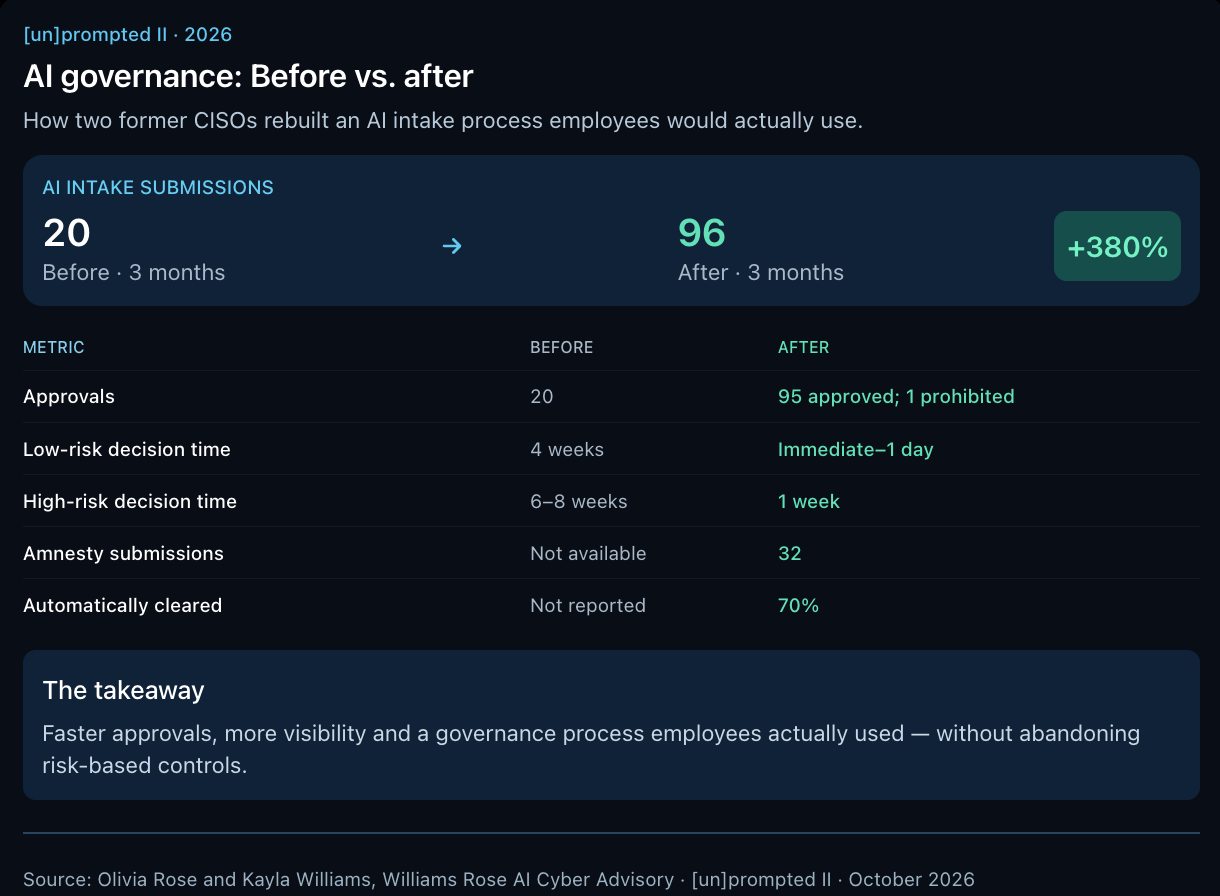
The increase from 20 to 96 submissions represents a 380% rise in recorded requests. The faster decisions were equally important. Low-risk employees no longer had to wait weeks for a committee to review routine applications.
The redesigned program also introduced an amnesty process for previously unauthorized AI use. That produced 32 submissions from employees seeking to bring existing tools into the approved governance framework.
By the time of the presentation, 70% of the total request volume was being cleared automatically. The company's next target was 90%, including more moderate-risk use cases.
The results demonstrate improved participation and faster processing in this particular organization. They do not, by themselves, establish that all unauthorized AI use was eliminated or that every approved application was free of security risk.
But they show how simplifying governance can produce substantially better visibility into enterprise AI adoption.
Amnesty may be as important as automation
One of the more significant lessons involved employee behavior rather than technology.
Organizations frequently discover unauthorized AI usage and respond by tightening restrictions.
Rose and Williams recommended a different approach: Give employees a way to disclose existing AI tools without immediately facing punishment.
Their presentation emphasized amnesty as a practical method for confronting shadow AI.
The reasoning is straightforward.
Employees who have already adopted unauthorized applications may have little incentive to disclose them if doing so creates personal or professional consequences.
An amnesty program can encourage those users to bring existing tools into the governance process, giving security teams a better understanding of what is already operating inside the organization.
The speakers paired amnesty with other measures designed to improve adoption: employee training, office hours, executive support and a centralized, accessible inventory of approved and prohibited tools.
These steps address a problem that technology alone cannot solve.
Employees need to know the rules, understand why they exist and believe that following them will not prevent them from getting their work done.
Six steps to rebuild AI governance
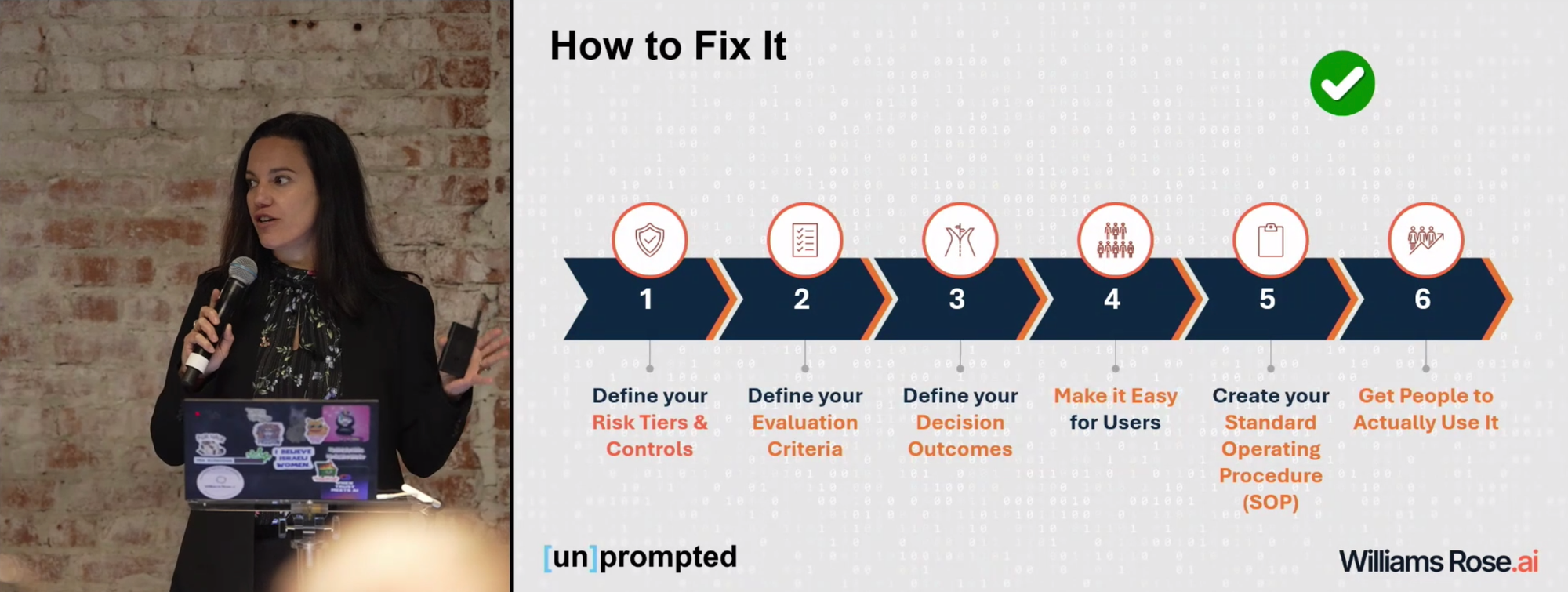
Rose and Williams organized their recommendations into a six-stage process.
First, organizations should define risk tiers and the controls required for each level.
Second, they should establish evaluation criteria based on data sensitivity, autonomy and business impact.
Third, they need consistent decision outcomes so employees understand whether a request is approved, conditional, deferred, returned or prohibited.
Fourth, the intake process must be easy to use, with automated routing and clear explanations.
Fifth, organizations should document the process in a standard operating procedure covering evaluation criteria, approval responsibilities, committee roles and performance measurements.
Finally, they must drive adoption through communication, training, executive sponsorship and amnesty for existing tools.
The speakers' central recommendation was to design AI governance around the people expected to use it, rather than assuming employees will adapt to a traditional GRC workflow.
The bigger lesson for CISOs
The pharmaceutical company's experience exposes a growing challenge for enterprise security teams.
AI adoption can move faster than conventional approval processes, particularly when employees can access powerful tools through a browser or existing workplace applications.
Governance programs that treat every AI request as an exceptional risk may end up concentrating security resources on paperwork while losing visibility into actual usage.
The Williams Rose case study suggests a more practical alternative: Classify the use, automate low-risk decisions, reserve human oversight for consequential applications and make it easier for employees to disclose what they are already doing.
The numbers illustrate the potential benefit.
A process that captured 20 requests in three months was redesigned to capture 96 over the same period, while cutting routine approval times from weeks to hours or less.
For CISOs struggling with shadow AI, the message is clear:
The effectiveness of an AI governance program isn't measured by how thoroughly its rules are documented. It's measured by whether employees actually use it.