

While the Cybersecurity and Infrastructure Security Agency’s (CISA) Binding Operational Directive 26-04 (BOD 26-04) is formally addressed to federal civilian agencies. The long-term impacts are yet to be felt with tech procurement, cyber insurance, regulatory frameworks, and the increased importance of asset management for most organizations.
The directive, issued earlier this month, establishes a tiered patching model that compresses remediation timelines for the most dangerous vulnerability classes. Analyst and vendor summaries describe three days for Known Exploited Vulnerabilities (KEVs) on internet-exposed assets susceptible to automation and capable of yielding system control; seven days for KEVs on internal assets; and 14 days for other common vulnerabilities and exposures (CVEs) with evidence of active exploitation. The underlying logic prioritizes based on actual exploitation risk, asset exposure, and the potential for attacker automation rather than on the Common Vulnerability Scoring System (CVSS) severity score alone.
Related:
 George V. Hulme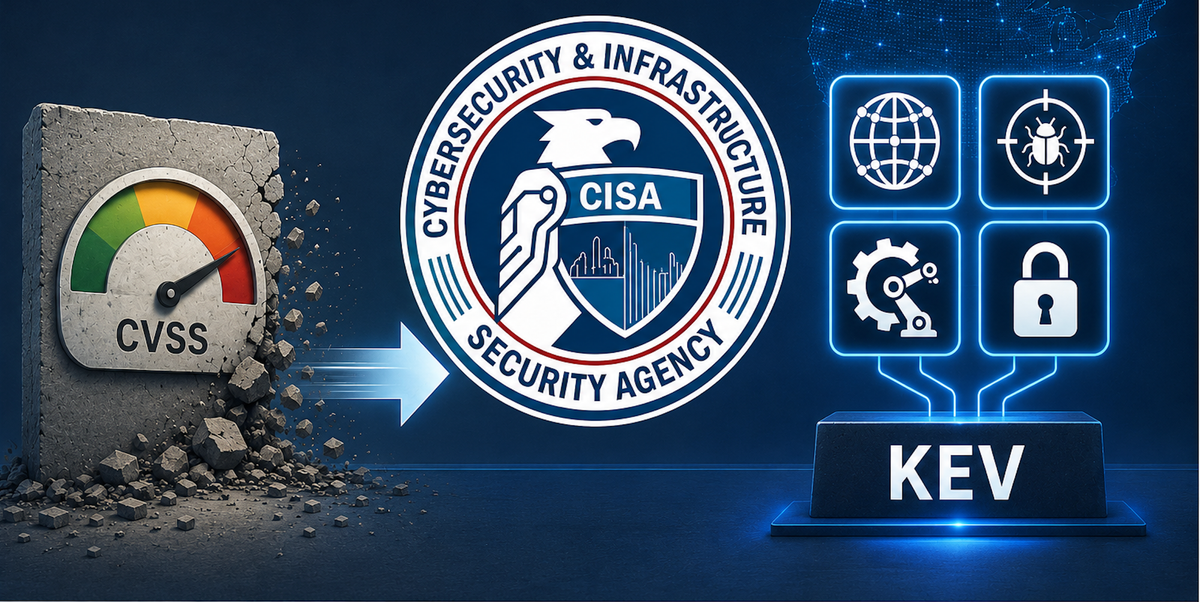
 Lauren Andrus
Over the coming months, the impacts will be felt across procurement contracts, insurance underwriting, and regulatory frameworks well beyond the federal perimeter.
The various risk-based patching timelines will likely extend beyond federal agencies as well. And federal acquisition requirements appear likely to extend BOD 26-04's timelines to contractors and SaaS providers, according to analysis from Nucleus Security. Integrators are already passing those expectations down the stack to their vendors, and cloud providers are leaning on downstream services. "Can you patch to a three-day clock for certain vulnerability classes?" is becoming a standard line in RFPs and security questionnaires, per Nucleus Security's assessment. For commercial security teams, those expectations may be set by a vendor contract before they appear in any regulatory requirement.
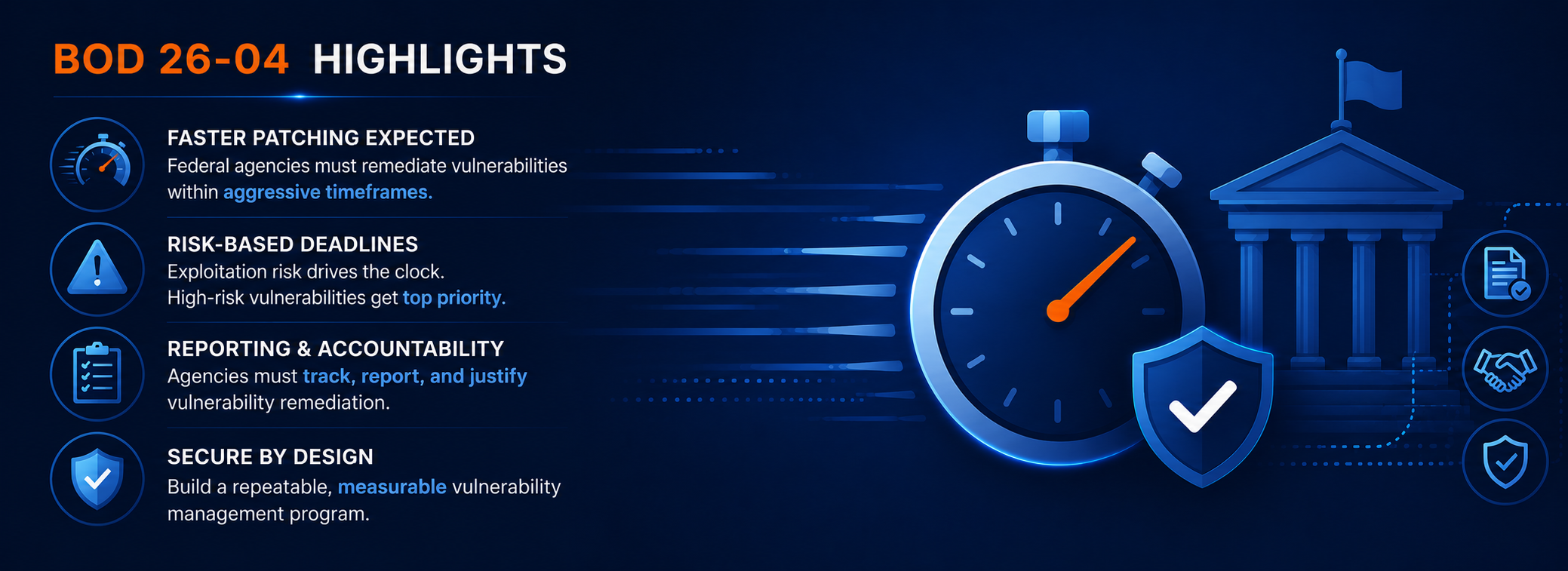
The insurance market is heading down similar lines. Cyber underwriters are expected to incorporate BOD 26-04's model into policy questionnaires: specifically, how quickly organizations remediate KEV flaws on internet-exposed assets, and whether they can document it, according to Tenable's analysis of the directive. The documentation requirement matters. Risk-based patching has long been described as a best practice; BOD 26-04 provides insurers and regulators with a specific government-defined benchmark to measure against. “Insurers and auditors like defined variables because defined variables are measurable, so the BOD's explicit definitions will likely show up in policy questionnaires and audit checklists,” John Laliberte, CEO of ClearVector, an identity-driven cloud security startup, said.
Eric Parizo, founder and chief analyst at Cernivera Research, said some pain in evolving legacy vulnerability management programs is inevitable. “But in every challenge, there’s also opportunity–every CISO that hasn’t been able to obtain the necessary budget to modernize vulnerability management should be running to the C-Suite with this new leverage. Now that CISA has established this as the new benchmark for federal agencies, the private sector has no excuse not to follow suit,” he said.
“Additionally, I don’t think there’s any question that cyber insurers will soon heed this new guidance as well, and reset their expectations accordingly,” he continued. “Cernivera expects cyber insurance underwriting to absorb BOD 26-04's logic within the year. Underwriters already ask about patch cadence for internet-facing, actively exploited vulnerabilities; the directive gives them a government-sanctioned benchmark upon which to formalize. Expect questionnaire language and likely premium or coverage consequences tied to time-to-remediate for KEV-listed, exposed assets,” Parizo said.
Beyond cyber insurance, regulatory alignment is also already underway. FedRAMP has stated its expectations will conform to BOD 26-04. Commentary from policy analysts suggests NIST control interpretations, CMMC, and European frameworks, including NIS2 and DORA, are likely to treat three-day patching for the highest-severity vulnerabilities as a working definition of "timely" remediation, according to AIGovHub's assessment. That puts private-sector organizations doing business with the federal government or subject to EU cybersecurity requirements in a position where BOD 26-04's timelines apply in practice, regardless of whether the directive formally names them.
“You never really know where regulations will go, but hopefully 'patch smarter, not harder' will propagate. The ECB has already told euro-zone banks to accelerate AI-era cybersecurity investment via a 'dear CEO' letter model that I think other regulators are likely to copy. U.S. sector regulators, including those in the financial, healthcare, and critical infrastructure sectors, are the natural next adopters. The risk-based framing is also politically durable; it reduces busywork rather than adding it,” Parizo said.
One of the primary reasons is, from an audit perspective, the new framework gives auditors something to really sink their teeth into, he added. BOD 26-04 turns prioritization into a governance and documentation problem, he explained, as "Show why you remediated X first and prove you met the timeline" becomes the norm. “Auditors will gravitate to the four-factor model as a testable control. Watch for it to surface in SOC 2, FedRAMP-adjacent, and third-party risk assessments as a reference benchmark,” he said.
When it comes to vulnerability management tooling, vendors are quickly repositioning. Exposure management platforms, cyber asset attack surface management (CAASM) and attack surface management (ASM) tools, and threat intelligence providers are incorporating CISA's prioritization factors KEV status, exploit automation potential, asset exposure, and system criticality directly into risk scoring and dashboard logic, according to Flashpoint's analysis. "BOD 26-04 compliant" and stakeholder-specific vulnerability categorization "SSVC-ready" are appearing as product positioning claims, and platforms are surfacing explicit SSVC-style decision trees in place of opaque composite risk scores, per CrowdSec. Whether those claims reflect genuine methodology changes or marketing adaptation is a question security teams will need to evaluate independently.
The directive will also have architectural implications within organizations. Organizations already operating containerized, API-first, CI/CD-driven environments where patches can be tested and deployed in hours are structurally positioned to meet a three-day clock. Those running tightly coupled legacy stacks with monthly or quarterly change windows are not, regardless of tooling investment, per Pulse Adyog's analysis.
For security leaders, the directive offers a useful resource regardless of sector: a government-validated framework for explaining remediation priorities to boards and procurement teams. The prioritization mandate to treat KEV on internet-exposed, automatable, high-impact assets as a distinct risk category from everything else is progressively reflected in what regulators, insurers, and enterprise customers will ask about.
Programs that can demonstrate they operate that way will have an easier time going forward. Programs that cannot will have a harder time explaining why.
“Overall, BOD 26-04 is a rare positive change in cybersecurity guidance from the federal government,” concluded Parizo. “While it only binds federal agencies, its gravity will be felt by everyone. Within 18 months, Cernivera expects “time-to-remediate for exposed, exploited vulnerabilities” to be a benchmark across the industry, from vulnerability management and exposure management programs to insurance questionnaires and audit checklists, and the industry will be better for it,” he said.