Humans are remarkably good at making decisions. We have to be. Thousands of years of survival have rewarded people who can quickly observe their surroundings, understand what is happening, choose a course of action and act. Much of that process happens without intensive conscious thought.
But Andy Ellis sees a problem: The environment in which humans now make decisions is changing much faster than the humans making them. Ellis, CEO and principal at Duha Security and a longtime CISO, explored that collision at CYBR.SEC.CON 2026 in a keynote titled “AIpocalyptic Decisions.”
Full Coverage of CYBR.SEC.CON 2026:
 Bill Brenner
The premise is not simply that artificial intelligence might make bad decisions. It is that AI and content-targeting algorithms could reshape the information environment around humans in ways that exploit weaknesses in our decision-making.
Ellis thinks that combination could become dangerous enough to threaten humanity itself.
Humans evolved to decide quickly
Ellis built the presentation around the OODA loop: Observe, Orient, Decide, Act. The framework helps illustrate why humans have been so successful. We do not approach every decision as an entirely new intellectual exercise. Training and experience allow complicated behaviors to become increasingly automatic.
Ellis used Gordon's stages of learning — unconsciously unskilled, consciously unskilled, consciously skilled and unconsciously skilled — to show how practiced behaviors can move from intensive thought toward reflexive action.
Humans are constantly filtering their environments. Ellis' slides describe our cognitive systems as optimized to discard what appears unnecessary, allowing us to concentrate limited attention on the information that seems important.
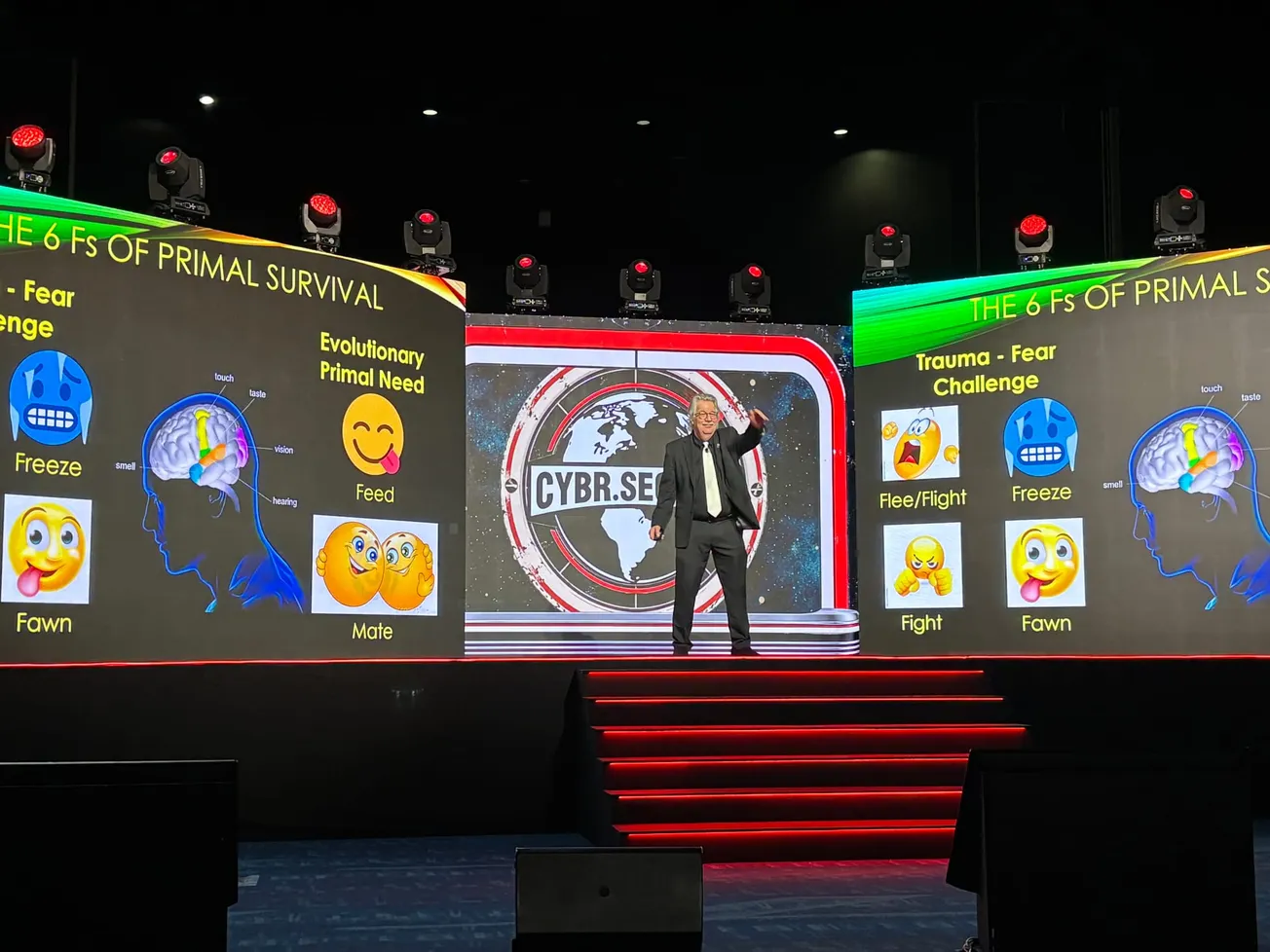
Experience also trains people to act quickly. Ellis summarized several characteristics of individual decision-making this way: people filter unnecessary information, tend to hold onto existing frames, learn through doing uncomfortable things and develop preferences for reflexive actions.
Those shortcuts are features, not necessarily bugs. Without them, every decision would require exhaustive analysis. But they also create openings for manipulation.
Related:
 Bill Brenner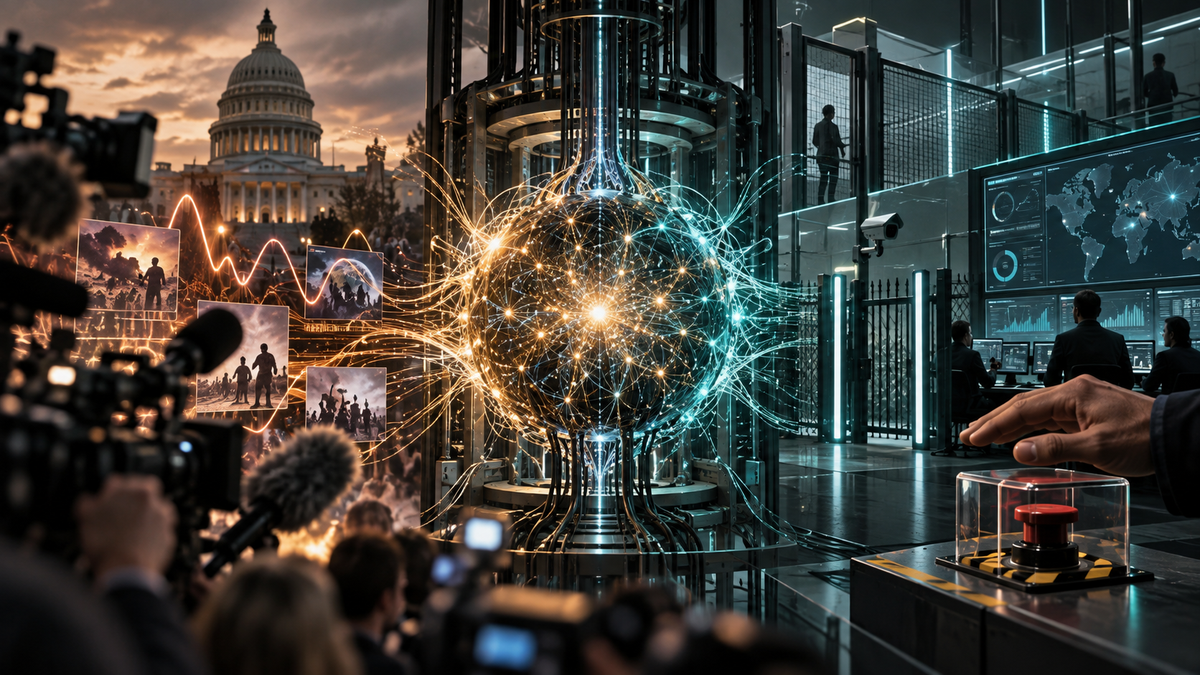
What we see shapes what we decide
The “Orient” stage of the OODA loop becomes particularly important in Ellis' argument.
People do not merely receive information and objectively process it. We interpret observations through existing frames — assumptions and mental models about how the world works.
And, as Ellis put it, “Frames tend to be sticky.”
Once established, a frame can influence how subsequent information is interpreted. What people observe affects how they orient themselves; orientation shapes decisions; decisions determine actions.
That creates an obvious question in an algorithmically mediated world: What happens when someone else increasingly controls what we observe?
Social platforms, recommendation systems and content-targeting algorithms do not present users with a neutral representation of reality. They select information. AI adds another layer by generating, analyzing, summarizing and potentially acting upon that information.
Humans are still running their ancient decision-making machinery. The inputs are changing.
Organizations have weaknesses of their own
Ellis then expanded the model from individuals to organizations. Groups can compensate for some individual weaknesses. Teams bring multiple perspectives and can highlight information relevant to collective goals. But organizational decision-making introduces its own tendencies.
Ellis identified several: organizations highlight data relevant to teams, competing frames can become melded together, groups may focus on comfortable things and decision-makers can prefer known paths. That has obvious implications for cybersecurity.
Security leaders rarely make decisions with perfect information. They operate under time pressure, conflicting priorities, incomplete visibility and institutional assumptions built from previous experience.
Training and experience make many of those decisions faster and better. They can also make certain responses predictable. AI now enters that system as another decision-making participant.
Then comes AI
The final piece of Ellis' model examines AI across the decision cycle, from observation and orientation through deciding and acting.
Its strengths are formidable.
AI can access significant data sources, analyze information at speeds humans cannot match and repeat tasks consistently. Ellis' framework includes data analysis, machine learning, expert systems, generation and automation among the capabilities increasingly entering decision workflows.
But Ellis' slides also identify characteristics that should make anyone considering AI-assisted decision-making pay attention.
AI has access to significant amounts of data. It can focus on outlier frames. It is extremely good at repetition. It can hallucinate. And its preferences can become sticky.
Put humans, organizations and AI together and the problem becomes more interesting.
Humans filter information aggressively and rely on established frames. Organizations tend toward comfortable and known paths. AI can operate across enormous datasets and repeat actions at scale, but it can hallucinate and reinforce persistent preferences.
None of those characteristics alone guarantees disaster. Combined badly, however, they can amplify one another.
The AI apocalypse may start with ordinary decisions
The popular AI-doomsday narrative often imagines an extraordinarily powerful autonomous system suddenly turning against humanity. Ellis' framework points toward a potentially more mundane path.
Humans could remain the ones making the decisions.
The danger is that the environment influencing those decisions becomes increasingly optimized by machines.
Algorithms can determine which information reaches people. AI can generate that information. Automated systems can analyze it, recommend actions and increasingly execute those actions. Humans can then apply cognitive shortcuts developed for an entirely different information environment.
The problem isn't necessarily that people stop making decisions.
It is that we may become increasingly confident in decisions whose inputs, framing and available choices have already been shaped for us.
Ellis' slides bring the individual, organizational and AI characteristics together in the same decision-making framework: human filtering and reflexes, organizational preference for familiar paths, and AI's scale, repetition, persistent preferences and risk of hallucination.
For cybersecurity leaders, that makes AI governance about more than preventing a model from leaking sensitive information or producing an inaccurate answer.
It means asking harder questions about the entire decision chain.
What information did the system choose to surface? What did it ignore? What assumptions shaped its analysis? Did a human independently evaluate the recommendation, or simply approve it? And as organizations automate more of the OODA loop, where does meaningful human judgment remain?
Ellis' warning is intentionally extreme: Humans evolved into the planet's dominant species in large part because we became exceptionally good at making fast, inexpensive decisions.
AI may not have to become smarter than humanity to create an existential problem.
It may only have to become very good at influencing what humanity decides.