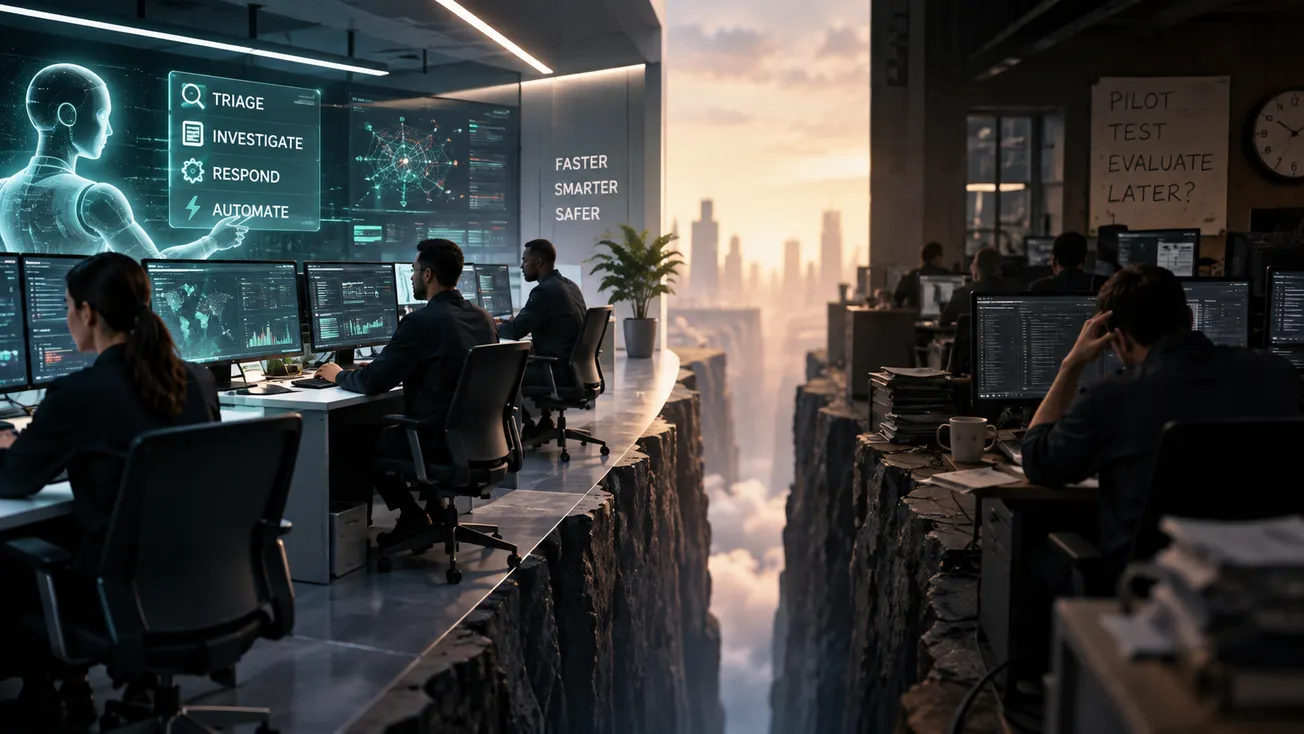

The AI SOC has arrived. Maybe not fully formed. Maybe not mature enough to deliver everything vendors are promising. But the technology has advanced quickly enough that security leaders are no longer talking about AI-driven security operations as something that might happen someday. They're buying it.
That's a significant change from even a year ago, when replacing meaningful portions of Tier 1 security operations with AI still felt more like a roadmap item than something a CISO could reasonably deploy.
Alfred Huger, chief product officer at Command Zero, believes that has changed.
"I think the technology's come so far in such a short period of time," Huger said during a recent episode of CYBR.HAK.CAST.
Full episode and related article:
 , and CYBR.SEC.Media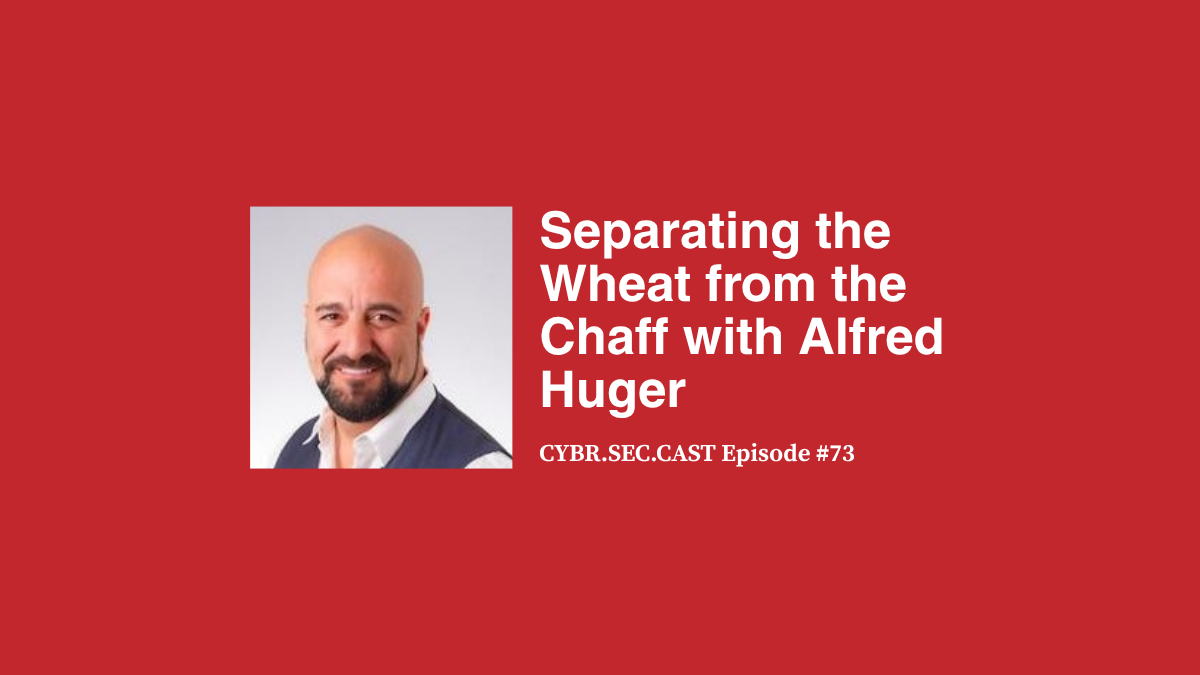
 Bill Brenner
Huger, who joined hosts Michael Farnum and Sam Van Ryder, has spent roughly three decades in cybersecurity, including stops at SecurityFocus, Symantec, Sourcefire and Cisco. Today, he's helping build an agentic SOC platform at Command Zero.
But the more interesting part of the conversation wasn't what AI SOC platforms can do. It was how CISOs should determine whether they actually do it well.
As AI SOC vendors multiply, the harder problem for security leaders is becoming less about whether they should investigate the technology and more about how they separate serious security platforms from something that was, as Huger put it, "vibe coded over a weekend."
Before buying an AI SOC, know what your SOC actually does
The first mistake CISOs can make happens before they ever sit through a vendor demo. They don't establish a baseline.
Security teams need to understand exactly what they're trying to change and how their existing SOC performs before introducing AI into it. That means establishing measurable objectives around cost, staffing, case volume, escalations, risk reduction and other operational metrics.
It also means confronting a more uncomfortable question: How good is the SOC today?
"You won't be able to measure how well your AI SOC vendor does for you if you don't truly know what your existing baselines are," Huger said.
SOC performance has historically been measured through metrics such as mean time to detect, mean time to respond, alert volumes and cases closed. Those numbers can describe activity without necessarily demonstrating the quality of the underlying investigation.
An AI system that processes more cases isn't necessarily improving security if those investigations are worse.
The same problem applies when organizations are considering moving away from an MDR or MSSP. Dissatisfaction with managed providers — including what organizations pay for those services — is helping drive interest in AI alternatives.
But assuming AI will automatically be cheaper creates another potential trap.
More on the AI SOC:
 George V. Hulme
 Bill Brenner
Don't assume the AI SOC will stay cheap
One of Huger's more important warnings for buyers has little to do with security architecture. It has to do with economics.
"It is an unproven statement that AI SOC will end up being cheaper than MDR and MSSPs over time," he said.
Today's pricing doesn't necessarily tell CISOs what these platforms will cost several years from now. AI companies are aggressively competing for customers while absorbing significant infrastructure and model costs. Early adopters may therefore be buying under economic conditions that won't last forever. That becomes especially important at renewal.
Farnum pointed to the familiar enterprise technology problem: organizations adopt an emerging product at an attractive price, integrate it into their environment and then discover at renewal that the economics have changed.
The faster AI SOC platforms become embedded into security workflows, the harder they could become to replace.
Huger's advice is straightforward: Ask vendors how pricing is calculated and negotiate protections around future increases.
"Your vendor should be able to give you clear, transparent models on how they do their pricing and a commitment for at least year two and three on their increase in pricing," he said.
Interestingly, Huger doesn't necessarily believe that means organizations should lock themselves into long-term contracts. AI technology is changing too quickly.
He argues that modern AI platforms can absorb business context and integrate into environments faster than previous generations of technology, potentially making it practical to replace an AI SOC vendor after a year if the platform isn't delivering.
That gives buyers leverage — but only if they preserve it.
An AI SOC without business context is just processing alerts
This is where the difference between an AI SOC demo and an operational AI SOC becomes much clearer. Security analysts don't investigate alerts in a vacuum. An experienced analyst gradually develops knowledge about the environment that may never appear in the alert itself.
Who owns this asset? Who normally accesses it? Has this system generated false positives before? Was similar activity caused by a red-team exercise? Is this machine sitting on a factory floor in Singapore or supporting a finance operation in Manhattan? What access does this identity normally have? What's its potential blast radius? What scripts or files routinely cause the EDR platform to light up?
A good analyst accumulates that context through experience. It becomes part of how that person determines whether an alert represents an attack, expected activity or noise.
An AI SOC needs access to that same organizational reality.
"A good AI-driven SOC extracts that information and uses it to navigate a case," Huger said.
Without it, the AI can still analyze the technical information in front of it. In some cases, Huger believes that alone may outperform inexperienced Tier 1 analysts.
But it won't outperform good analysts consistently. Those analysts have something an AI model doesn't automatically possess: time in the environment. They know its weirdness. They know that Michael regularly travels, for example, so a login from Singapore may not automatically indicate account compromise. But they also know that fact shouldn't become a permanent free pass that causes the system to ignore contradictory evidence.
That's where AI SOC evaluation has to move beyond whether the system can summarize an alert, execute a query or assemble an investigation. It needs to determine whether the system can understand context, weigh conflicting information and make decisions accordingly.
That, Huger said, is "what separates out a good AI SOC from something that was vibe coded over a weekend."
AI SOC security depends on what agents are allowed to touch
There's another distinction buyers can't afford to overlook: access control.
An AI SOC may require extraordinary visibility into an enterprise environment. Depending on how it's designed, agents could potentially interact with email, Microsoft 365, identity infrastructure, administrative systems and other highly sensitive resources.
That creates an obvious problem. The AI system you're deploying to protect the organization can itself become extraordinarily powerful infrastructure.
Huger argues that role-based access control and architecture therefore matter enormously. Agents shouldn't simply receive unrestricted direct access to critical systems.
"It's extremely thoughtful and does not give agents direct access to your systems because we can't guarantee that they won't slip the reins of control," he said.
Instead, AI agents should operate through intermediary controls that limit what they can reach and what they're authorized to do.
The real opportunity isn't eliminating analysts
There's a temptation to frame AI SOC adoption as another workforce-reduction story.
The more interesting opportunity is changing what security analysts spend their time doing.
Tier 1 SOC work has historically been repetitive, difficult to staff and expensive to scale. Junior analysts spend enormous amounts of time triaging alerts, gathering evidence and determining which cases deserve escalation.
Meanwhile, experienced Tier 2 and Tier 3 analysts wait further down the escalation chain for the problems that make it through.
Huger thinks agentic SOC technology could begin changing that structure. If AI can credibly handle more of the basic blocking and tackling, organizations can move human talent toward higher-level investigations and security problems that teams previously didn't have enough time to address.
The question for CISOs evaluating AI SOC platforms therefore shouldn't be whether the product has an agent or whether its demo can investigate an alert.
Nearly everyone in this emerging category will be able to show that. The questions are harder.
Do you know how your existing SOC performs well enough to prove the AI improved it? Does the platform understand your business, rather than merely your telemetry? Can you control what its agents are allowed to touch? Can you explain what happens when those agents make the wrong decision? And do you understand what the technology will cost once today's AI land grab settles down?
Those are much less exciting questions than watching an autonomous agent tear through an investigation in a demo.
They're also increasingly what separates an AI SOC from an AI demo.