
When cybersecurity professionals examined the $6.34 billion Binance theft, most focused on the familiar questions: How did attackers get inside? Why didn't existing defenses stop them? And what could have prevented the damage?
Mark Knowlton saw something else.
Knowlton, a longtime cybersecurity recruiter who spent more than four years hosting OWASP Boston and now serves as founder and CEO of TechScreen, looked at the fake recruiting scheme used to compromise a Binance engineer and saw a threat extending far beyond cryptocurrency exchanges.
The remote job interview itself had become an attack surface. And in Knowlton's view, the recruiting industry was dangerously unprepared.
His realization came in what he describes as two shock waves:
- First, attackers had demonstrated how an ordinary recruiting interaction could become a pathway into sensitive corporate systems.
- Second, artificial intelligence was creating a different kind of threat: candidates who use AI to manufacture technical expertise, consuming valuable time and resources as companies struggle to distinguish genuine talent from convincing impostors.
Knowlton calls the second problem an "asymmetric DDoS on productivity."
The comparison is provocative, but his underlying point deserves attention. A fraudulent candidate doesn't have to breach a network to inflict damage. Every hour an engineer, hiring manager or recruiter spends screening, documenting and advancing someone whose qualifications are artificially manufactured is an hour lost.
And unlike traditional distributed denial-of-service attacks, the traffic in this case looks perfectly legitimate. It arrives with a resume, a calendar invitation and a smiling face on Zoom.
Knowlton believes the answer lies in a cybersecurity principle the industry already knows well: Zero Trust.
From fake recruiters to fraudulent candidates
As CYBR.SEC.Media previously reported, the Binance incident combined a poisoned developer environment with a social engineering campaign disguised as recruitment. The attackers exploited a trusted professional interaction to help compromise an employee's workstation and ultimately facilitate the theft.
Knowlton's concern extends that lesson in another direction.
In the Binance case, the attacker posed as a recruiter targeting a legitimate employee. In the scenario Knowlton is warning about, the deception comes from the other side of the interview: an applicant using AI to impersonate technical competence.
The two schemes aren't identical, but they exploit a common weakness. Organizations routinely place considerable trust in recruiting interactions without treating those interactions as potential security events.
AI is making that trust increasingly difficult to justify.
Real-time transcription, AI-generated answers, hidden browser overlays, audio assistance and other tools can potentially help candidates appear far more knowledgeable than they are. A candidate who once might have struggled through a technical screening can now receive assistance while the interviewer is asking questions.
The consequences extend beyond hiring the wrong person.
Before an offer is even made, organizations may have invested hours in resume reviews, technical assessments, interviews, internal discussions and documentation. Multiply those costs across large recruiting operations, and the cumulative productivity loss could become substantial.
Knowlton argues that fraudulent candidates can effectively overwhelm hiring workflows with seemingly legitimate requests for attention.
"The time spent reviewing resumes and prepping for the screens is unavoidable," he said. "Conducting, documenting, and advancing a fraud candidate sends the interviewer's productivity time straight to the Phantom Zone."
His broader claim that AI-enabled interview fraud is costing organizations trillions of dollars in productivity remains unsubstantiated by the material provided. But the underlying resource-exhaustion problem is worth examining.
Zero Trust comes to the job interview
Knowlton's proposed response is Integrity AI 360, developed by TechScreen, a vendor-neutral interview protocol he is distributing for free.
The premise borrows directly from the Zero Trust security model pioneered by John Kindervag: Don't assume something is trustworthy simply because it appears to be operating inside an accepted process.
- CYBR.SEC.Media recently talked to Kindervag about this, which you can explore in this podcast, this article and this article.)
In cybersecurity, that means verifying users, devices and access requests rather than granting implicit trust. In recruiting, Knowlton argues, it means verifying both a candidate's demonstrated competence and the conditions under which that competence is evaluated.
The framework divides the interview into two complementary pillars.
The first, evaluation integrity, emphasizes structured technical questioning. Instead of asking questions that can be answered with memorized definitions or short AI-generated responses, interviewers probe candidates' reasoning, decisions and practical experience.
A candidate might be asked to explain why a particular architecture was chosen, what tradeoffs were considered, how an implementation failed or how a problem was diagnosed.
Follow-up questions test whether the candidate actually understands the material rather than merely repeating a convincing answer.
The second pillar, environmental integrity, is where Knowlton's approach becomes more unusual.
Rather than attempting to detect every AI cheating tool individually, he proposes changing the interview environment to remove the channels those tools commonly exploit.
A surprisingly low-tech defense
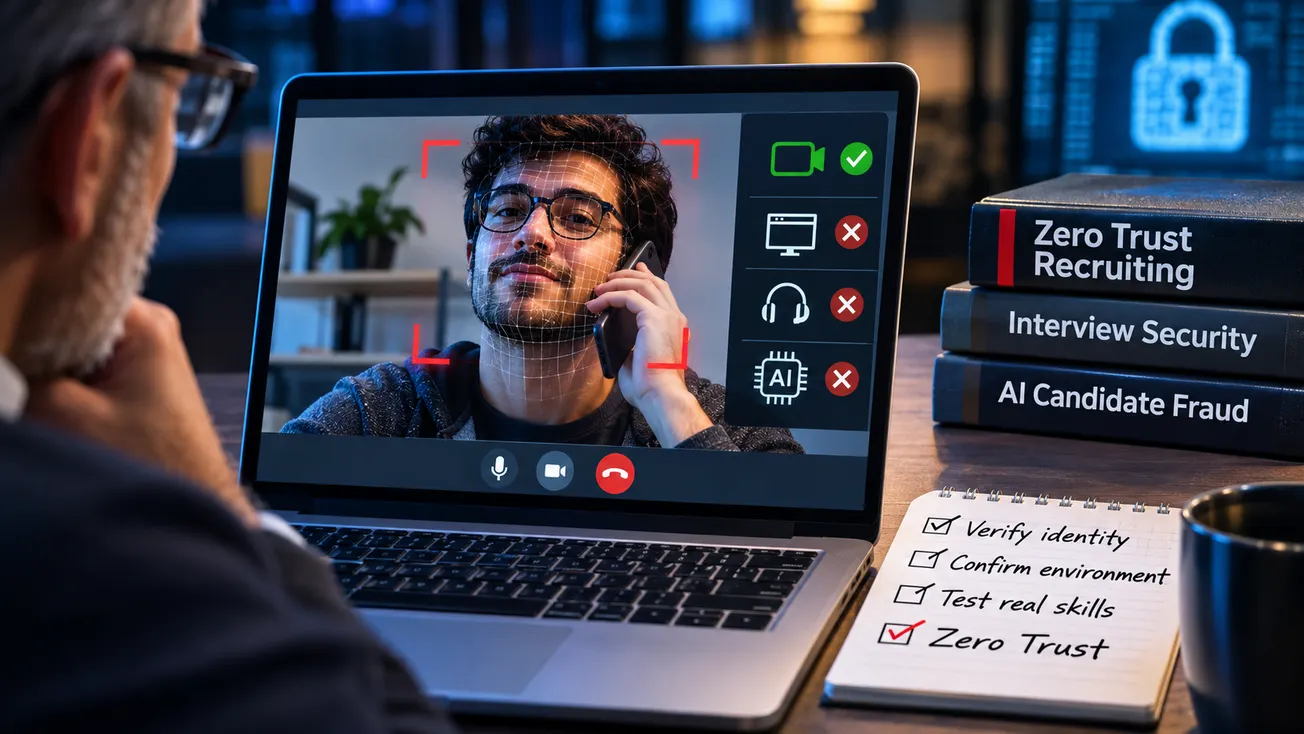
Integrity AI 360 begins with a conventional video interview using Teams, Zoom or a similar platform.
But the actual conversation takes place over a separate cellular voice call.
The candidate remains visible on camera while holding a mobile phone against their ear. No speakerphone. No Bluetooth earbuds. No desktop audio connection.
Before the interview proceeds, the recruiter asks the candidate to show both ears to confirm the absence of earbuds. The interviewer then places a call to the candidate's mobile phone while keeping the video connection active and its audio muted.
The recruiter watches the candidate's lips as they answer, looking for inconsistencies between the visible speaker and the voice coming through the phone.
The interview is recorded, subject to applicable consent and recording requirements, and the answers are subsequently reviewed against the job's technical requirements.
TechScreen says the approach addresses 18 known AI-assisted cheating vectors across five categories, including visual overlays, audio manipulation, browser tools, timing tactics and device spoofing.
According to the company's framework, 16 of those vectors are defeated through environmental design, while two are addressed through recruiter procedures.
Those are TechScreen's claims, not independently established results. The framework has not been demonstrated in the supplied material to eliminate every possible form of AI assistance or deception.
A determined candidate might still find ways to circumvent environmental restrictions, and the approach introduces practical questions around accessibility, candidate privacy, recording consent and interview logistics.
Nevertheless, the underlying security principle is recognizable: Rather than continually chasing new attack techniques, redesign the environment to reduce the opportunities available to an adversary.
The productivity problem hiding in plain sight
The most interesting part of Knowlton's argument may have less to do with detecting AI and more to do with understanding the economics of deception.
Cybersecurity teams already recognize resource exhaustion as a legitimate attack strategy. An attacker doesn't necessarily need to steal data or deploy ransomware to cause harm. Sometimes forcing an organization to expend time, computing power or personnel on illegitimate activity is enough.
Knowlton sees a parallel in recruiting.
Consider a senior security engineer who spends an hour interviewing an applicant who appears knowledgeable because an AI system is supplying answers. Add the recruiter who conducted the initial screening, the manager who reviewed the application and the additional employees who participate in subsequent rounds.
If the deception succeeds, the costs compound. If the candidate is hired, the consequences could extend to poor technical decisions, operational mistakes and additional security exposure.
Not every candidate who uses AI is necessarily acting fraudulently. Using AI to prepare for interviews or organize experience is different from secretly using it to fabricate qualifications during a live assessment.
That distinction matters. The objective should be verifying actual competence, not treating every applicant who uses modern technology as a potential attacker.
It also raises a difficult question for employers: How much friction are organizations willing to introduce into recruiting to improve the integrity of their hiring decisions?
Knowlton believes the industry has waited too long to confront that question.
A public-service push, with questions still to answer
Knowlton has launched a GoFundMe campaign to support the creation of educational and marketing materials explaining the protocol to recruiting teams.
He says he intends to keep Integrity AI 360 freely available rather than positioning it as another commercial detection product.
That public-service approach is part of his pitch, although it does not remove the need to independently evaluate the protocol's effectiveness.
There is a larger issue here than whether any single interview procedure can defeat AI-assisted cheating.
Recruiting has become increasingly digital, remote and dependent on tools that can be manipulated. The same technologies making it easier for organizations to evaluate candidates across geographic boundaries are also making it easier to misrepresent identity, experience and technical knowledge.
For cybersecurity organizations, that should sound familiar.
The industry has spent years learning that a legitimate-looking email can carry malware, a trusted software package can conceal malicious code and a properly authenticated user can still pose a threat.
The recruiting process deserves similar scrutiny.
The Binance attack demonstrated how a fraudulent recruiting interaction could help compromise a legitimate employee. Knowlton is warning that fraudulent candidates can exploit the same underlying assumptions about trust, even without compromising a single endpoint.
His solution may not be the final answer. But the question he's raising is difficult to dismiss.
Cybersecurity spent years learning not to trust a connection simply because it appeared legitimate.
Perhaps it's time hiring managers stopped trusting an interview for exactly the same reason.