
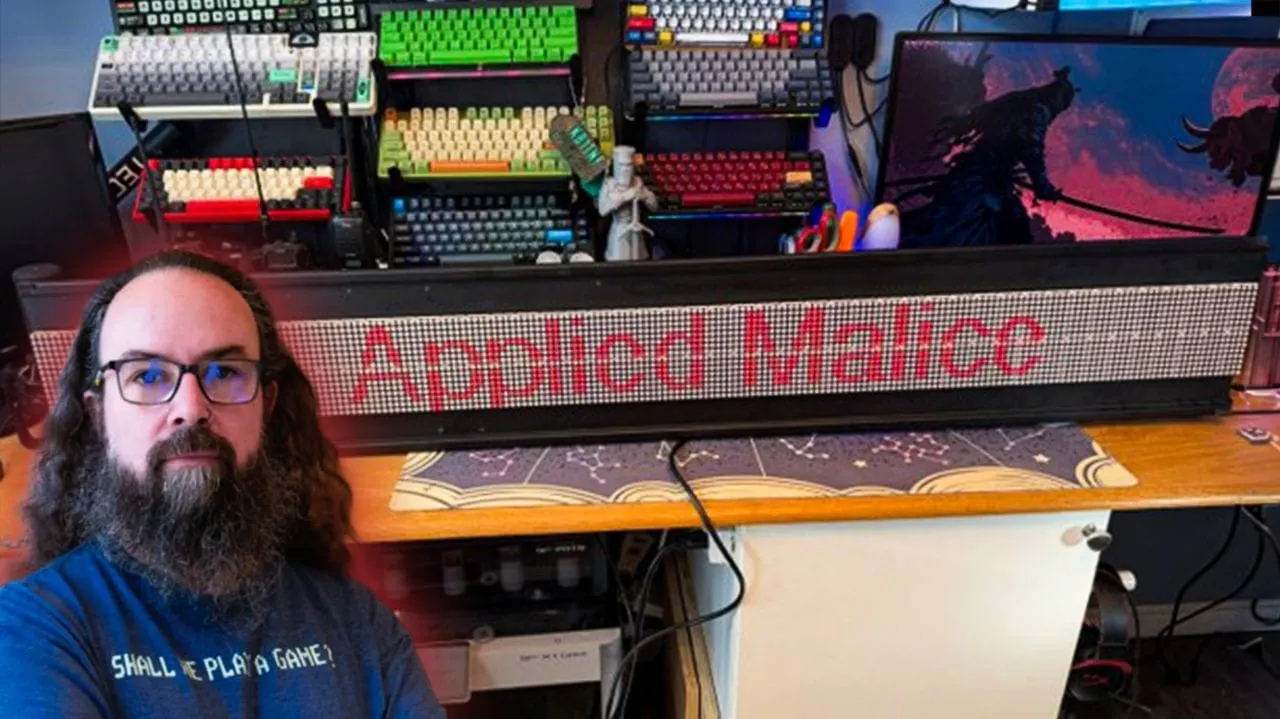
A cybersecurity researcher has used artificial intelligence to revive a nearly 30-year-old LED message board that had been unusable for more than a decade, demonstrating how AI assistants can help overcome technical obstacles associated with obsolete hardware and unsupported software.
Larry Pesce, executive director of research at Secure Ideas and leader of its Applied Malice research group, detailed the project in a November 23 blog post.
Using Anthropic's Claude AI assistant, Pesce was able to research the hardware, reconstruct its electrical connections, develop replacement firmware, troubleshoot wiring problems and design a new circuit board.
The project centered on an Inova LightLink CFM16.200S-IP LED sign manufactured in 1998. Pesce had purchased the 200-by-16-pixel display at DEF CON more than a decade earlier, hoping to control it through its Ethernet connection.
That proved more difficult than expected.
The sign relied on proprietary software and an undocumented communications protocol. Without the original software or technical documentation, Pesce was unable to send messages to the display. It eventually spent at least 10 years sitting unused in his basement.
AI takes on the reverse engineering
Pesce revisited the project after working on another LED display and decided to use Claude to investigate whether anyone had successfully modified the old LightLink hardware.
The assistant identified a 2015 project by researcher Yadid Ramot, who had replaced the original controllers in two similar signs with alternative microcontrollers.
Claude examined Ramot's published firmware and circuit schematics to reconstruct the display's wiring and operating requirements. It also analyzed photographs of Pesce's hardware to identify components and potential electrical compatibility issues.
One important finding involved voltage differences between the original display electronics and the ESP8266 microcontroller Pesce intended to use as a replacement.
The AI identified the need for additional components to reliably translate the ESP8266's 3.3-volt signals to the levels expected by the display's 5-volt circuitry.
Rather than attempting to reproduce the original proprietary network protocol, Pesce bypassed the existing controller and connected the display panels to the ESP8266.
From firmware to troubleshooting
Claude then generated firmware providing capabilities unavailable through the original hardware configuration, including Wi-Fi connectivity, a web-based management interface, message playlists, scrolling text, a REST API and over-the-air firmware updates.
The firmware also supported Falcon Player sequence files, allowing the sign to participate in synchronized lighting displays.
According to Pesce, the AI compiled the firmware and checked portions of its implementation against published specifications before he installed it.
The first hardware test exposed a problem: colors appeared incorrectly across different sections of the display.
Pesce photographed the malfunction and submitted the images to Claude, which identified a likely missing green data connection in the upper portion of the sign.
The diagnosis proved correct. Pesce had connected one input to ground instead of the appropriate microcontroller pin. Moving a single jumper wire resolved the problem.
The display subsequently operated as intended.
AI also designs replacement circuit board
With the sign functioning, Pesce asked Claude to develop a permanent printed circuit board to replace the temporary breadboard wiring.
The assistant used KiCad design software to generate a board layout incorporating the ESP8266, voltage-level translation components and connectors compatible with the original display cables.
During the process, the AI encountered an execution restriction that prevented it from running a downloaded third-party routing tool. It instead developed its own routing approach and used KiCad's design-rule checks to verify the resulting layout.
The design passed those checks, although Pesce emphasized that the board had not yet been manufactured or physically tested.
He subsequently published the firmware, wiring diagrams, documentation and circuit-board design files in an open-source GitHub repository.
What the project demonstrates
The experiment illustrates a practical application of AI-assisted engineering beyond conventional software development.
Claude did not independently repair the device. Pesce supplied photographs, selected components, assembled the electronics, tested the hardware and verified the assistant's recommendations.
The AI's contribution was accelerating work that otherwise required extensive manual research, interpretation of technical documentation, programming and troubleshooting.
Pesce also acknowledged catching at least one issue the assistant had missed, reinforcing the importance of independently verifying AI-generated technical work.
The restored sign now supports commands through an HTTP interface, allowing it to display status updates from automated systems.
Pesce plans to use that capability to monitor automated IoT penetration-testing jobs being developed by Applied Malice.
The broader significance extends beyond one vintage LED sign. As organizations contend with unsupported equipment and aging embedded systems, AI-assisted reverse engineering could provide another way to maintain or repurpose hardware that manufacturers no longer support.
The project does not establish that AI can reliably reverse engineer arbitrary devices without human expertise. It does, however, offer a documented example of AI shortening the path from an unsupported piece of hardware to a working, independently controlled system.