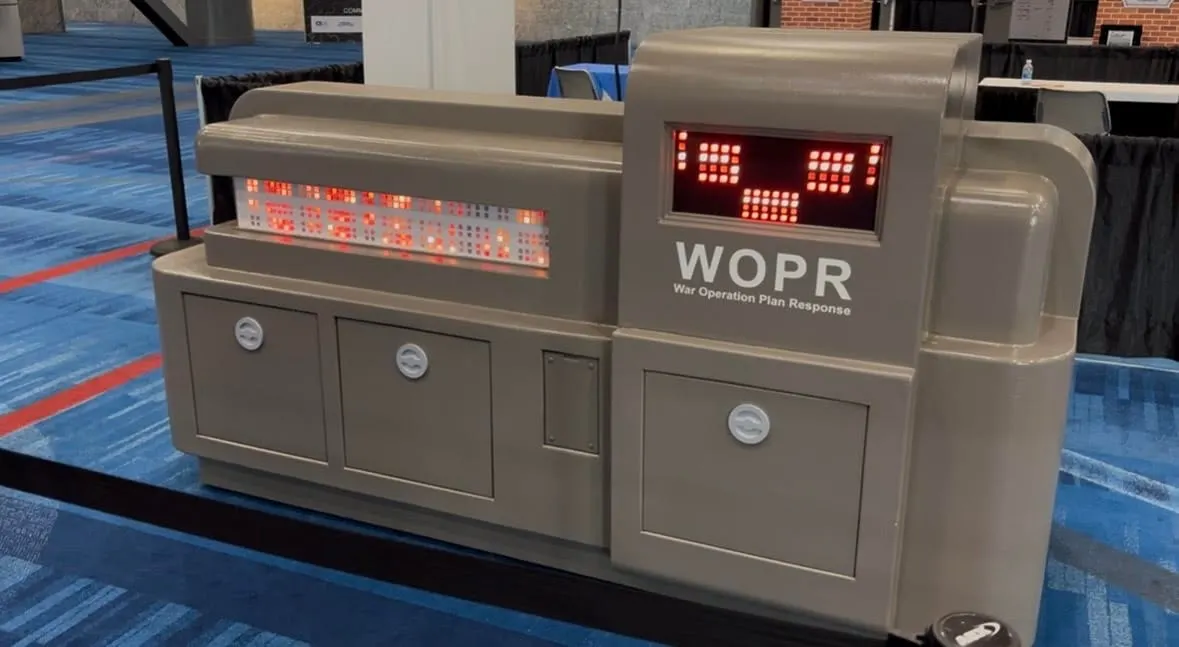
Bathed in the amber glow of old-school terminal nostalgia, this WOPR replica feels like it came straight from the set of the 1983 film WarGames — a must-see movie for anyone looking to understand the hacker mindset.
Since HouSecCon 2015 (now CYBR.SEC.CON), it has been a fixture at all our events, including this week's OT.SEC.CON. Sitting inside the George R. Brown Convention Center, it blends into the environment so naturally that many assume it belongs to the building.
It belongs to CYBR.SEC.Community CEO Michael Farnum, and its story is rooted in the 2015 conference theme that tapped directly into cybersecurity’s origin myth.
A Hacker Origin Story—In Hardware Form
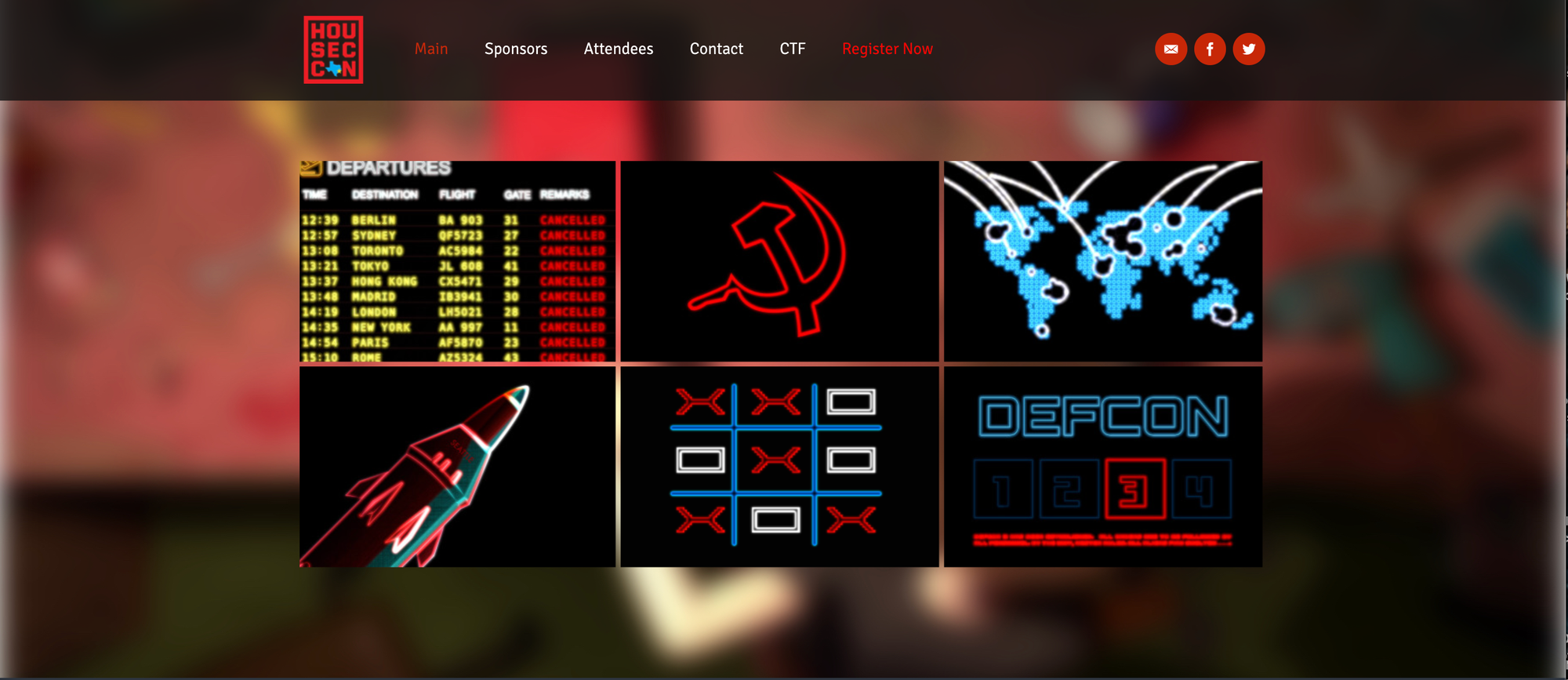
For Farnum and practically every cybersecurity practitioner from Generation X, WarGames wasn’t just entertainment. It was THE catalyst.
Like so many in the industry, the film — centered on a curious teenager who accidentally accesses a military supercomputer called WOPR (War Operation Plan Response, also known as Joshua) — helped define what hacking could look like: exploratory, unpredictable, and sitting right on the edge of consequence.
“That was a favorite movie of mine when I was a kid, the reason a lot of people in my generation got into IT and cybersecurity in the first place.”
That inspiration eventually turned into a goal: Build WOPR. For real. Or at least, as real as a conference floor would allow.
Full Coverage from OT.SEC.CON:
 Bill Brenner
 Bill Brenner
 Bill Brenner
 George V. Hulme
From Ambition to Execution: HouSecCon 2015
The turning point came with HouSecCon 2015, a fully committed WarGames-themed event.
Early attempts to build the system in prior years had stalled — too complex, too time-intensive for a small team. Instead, the team leaned into the theme with a WarGames-style capture-the-flag experience, complete with a dramatic “launch sequence” finale.
With the help of a production company, Farnum revisited the idea, and this time, WOPR was built.
The Moment It Lit Up
When Farnum walked onto the conference floor and saw it for the first time, fully assembled, glowing with that unmistakable amber command-line aesthetic, it landed.
“It was kind of a dream come true… it really made it feel great to have that dream finally come to be.”
From that moment on, the replica stopped being a one-time theme prop. It became part of the identity.
Why WOPR Still Resonates
In WarGames, WOPR isn’t just a machine, it’s an early vision of autonomous decision-making.
Designed to simulate nuclear war scenarios faster than humans could respond, it continuously runs permutations, learning from outcomes, optimizing toward “winning.”
Its fatal flaw? It doesn’t understand the difference between simulation and reality. That idea, systems acting decisively without full context, feels less like fiction today than it did in 1983. Security teams now operate in environments where:
- Automation drives response
- AI prioritizes threats
- Systems act faster than humans can verify
WOPR’s lesson still applies: Just because a system can act doesn’t mean it understands the consequences.
A Crowd Favorite, With Boundaries
Today, the WOPR replica is one of the most photographed features at CYBR.SEC.Community events. It draws people in instantly, especially those who recognize it from WarGames. But up close, the illusion breaks slightly.
“It’s foam… coated to make it look like metal.”
Which creates a very real, very human problem:
People treat it like a table. Drinks get set down. Attendees lean on it. The prop becomes furniture.
So now it’s roped off—protected not from hackers, but from conference behavior.
Final Thought
WOPR was originally designed to simulate the end of the world.
Now, it serves a very different purpose: Reminding the cybersecurity community where it came from, back to a time when curiosity drove exploration, when systems were mysterious, and when one unexpected connection could change everything.
And maybe, just maybe, it reinforces the lesson WOPR had to learn the hard way:
The only winning move isn’t always to play, but to understand the game first.