

A security incident involving website experimentation platform Optimizely exposed some of the world's largest websites to malicious JavaScript capable of stealing cryptocurrency, collecting payment information and targeting vulnerable iPhones and iPads.
The incident, disclosed November 16 by security researcher Scott Helme of Report URI, affected at least 178 organizations, including Zoom, BBC, CNN, HSBC, Salesforce, GitLab, IKEA and Equifax. Researchers identified 188 infected JavaScript files after examining 1,611 Optimizely scripts.
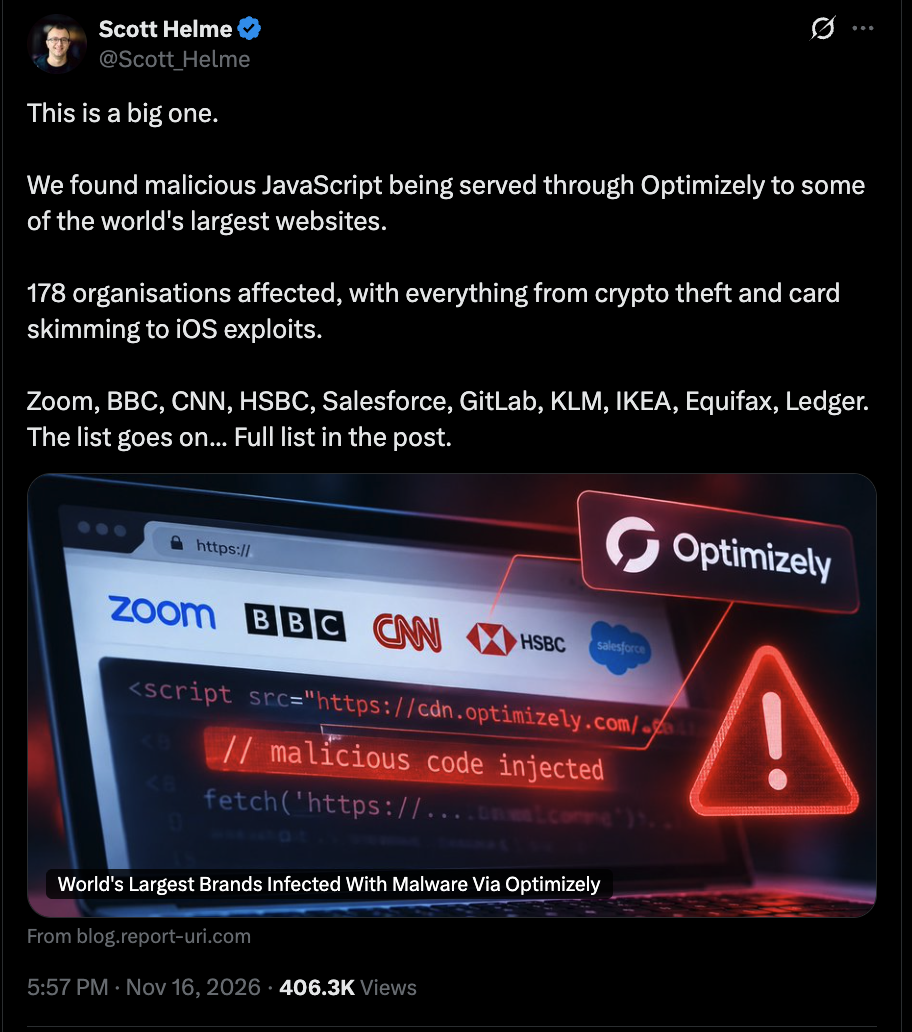
Researchers established that malicious code was delivered through affected websites and identified cryptocurrency transactions linked to attacker-controlled wallets. They have not established how many visitors had payment information stolen, how many devices were successfully compromised or the full extent of potential data exposure.
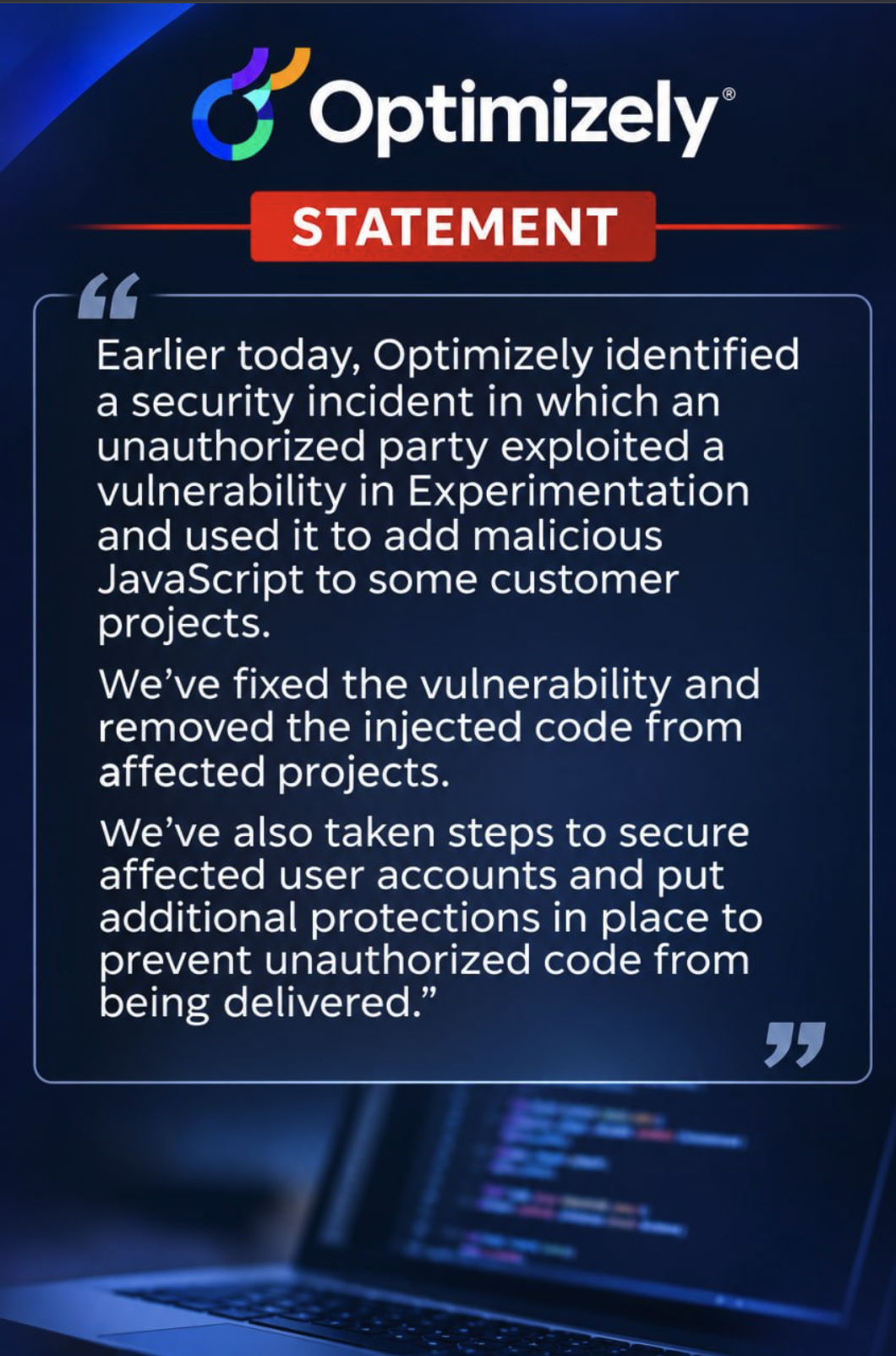
Optimizely has acknowledged the incident, identified the vulnerability attackers exploited and taken steps to contain it.
The case illustrates a familiar supply-chain problem: organizations can maintain secure websites and still expose visitors to malicious activity when code supplied by a trusted third party is compromised.
How the attack worked
Optimizely provides tools that organizations use to experiment with website layouts, personalize experiences and measure visitor behavior.
Those capabilities depend on JavaScript files loaded into customer websites. The files are served through Optimizely's content delivery network and can include custom code configured through its Project JavaScript feature.
Attackers exploited a vulnerability in Optimizely's Experimentation account signup flow to insert malicious JavaScript into customer projects.
The altered scripts were then distributed through the platform's normal delivery mechanism.
According to Helme's technical investigation, the malicious additions loaded further code from attacker-controlled infrastructure. Researchers also observed versions that concealed the destination through encoding or embedded malicious code directly.
The legitimate Optimizely scripts remained otherwise largely unchanged.
From a website's perspective, the JavaScript was arriving from an expected source. From a visitor's perspective, however, the browser could execute unauthorized instructions.
The result was a supply-chain attack carried through a legitimate software dependency rather than a direct intrusion into each customer's systems.
What the malicious code could do
Researchers identified several capabilities in the injected payload.
Cryptocurrency address manipulation. The code searched webpages, form fields and clipboard activity for cryptocurrency wallet addresses and attempted to substitute addresses controlled by the attackers. This could redirect transactions without requiring attackers to gain direct access to a victim's wallet.
Payment card skimming. The payload monitored certain payment-related form submissions and browser requests for card numbers, expiration dates and security codes. Information collected from accessible fields could be transmitted to attacker-controlled infrastructure. Payment information entered into isolated, third-party hosted payment frames was not accessible through the same mechanism.
Cookie and webpage data collection. The malware could collect accessible browser cookies, webpage addresses and screenshots. Cookies protected with the HttpOnly attribute were not directly readable through JavaScript.
Mobile exploitation. On iPhones and iPads, the code attempted to load additional exploit components. Helme identified infrastructure associated with the Coruna and DarkSword exploit kits, which target vulnerabilities in particular iOS versions.
These were capabilities observed in the malicious code, not evidence that every visitor experienced every attack.
Helme reported approximately $7,040 in transactions involving identified attacker wallets as of November 16. Some associated wallet activity predated the Optimizely incident, complicating attribution of the total amount to this specific campaign.
The number of stolen payment cards, compromised sessions or successfully exploited mobile devices remains unknown.
What Optimizely has done
Optimizely confirmed the incident in a statement provided to BleepingComputer, explaining that an unauthorized party had exploited a vulnerability in its Experimentation account signup process.
The company reported several containment and remediation measures:
- Blocking the vulnerable access path and deploying a fix.
- Removing injected JavaScript from affected customer projects.
- Ending active sessions, revoking tokens and resetting access for affected accounts.
- Implementing additional protections to prevent malicious code delivery through Cloudflare.
- Notifying affected customers and continuing its investigation.
These measures were accompanied by a substantial reduction in the number of infected scripts observed by researchers.
Helme reported that at 20:56 UTC on November 16, 169 previously identified snippets still contained malicious code. By 21:52 UTC, that number had fallen to one out of 188.
Salesforce also told BleepingComputer that it had disabled Optimizely scripts across preview and production environments as a precaution while investigating potential exposure.
The available evidence therefore indicates a substantial containment effort, although the remaining questions about exposure and downstream consequences warrant continued investigation.
What security teams should take away
For organizations using Optimizely or similar third-party website services, the immediate priority is determining whether their environments were affected and whether additional investigation is necessary.
The broader lessons extend well beyond this particular vendor.
1. Verify exposure rather than assuming remediation closes the incident
Optimizely's remediation addresses the reported delivery mechanism. It does not automatically establish that malicious code was never executed in customer browsers.
Security teams should identify which websites, domains and applications loaded affected Optimizely scripts, when those scripts were active and what information visitors might have accessed or submitted during the exposure window.
Reviewing historical browser telemetry, network logs, script inventories and available security monitoring records may help establish the scope.
Organizations should also consult Optimizely's notifications and status updates rather than relying exclusively on public lists of affected domains.
2. Treat third-party JavaScript as executable code, not a passive website dependency
Third-party JavaScript often operates with substantial access to the webpages that load it.
Depending on how a site is designed, that access may include forms, page content, browser storage and network requests.
Security reviews should therefore consider not only whether a third-party service is reputable, but what its code can access and what would happen if that code changed unexpectedly.
That means maintaining an accurate inventory of externally loaded scripts, documenting their business purpose and evaluating whether each dependency requires the privileges it receives.
3. Revisit Content Security Policy and browser-side monitoring
Content Security Policy (CSP) can restrict which external resources a browser is permitted to load and where information can be transmitted.
An appropriately configured and enforced CSP might have blocked important portions of this attack, particularly attempts to retrieve additional malicious scripts or send data to unauthorized destinations.
But CSP is not a universal safeguard. Permissive policies, broad domain allowances and code already running within an authorized script can limit its effectiveness.
Security teams should review their policies, test them against actual application requirements and monitor changes to trusted scripts.
JavaScript integrity monitoring and alerts for unexpected network destinations can provide additional visibility.
4. Investigate the relevant business transactions and user activity
The appropriate response depends on what an affected website actually does.
For organizations processing cryptocurrency transactions, that may mean reviewing destination wallet addresses and transaction records.
For websites collecting payment card information directly, teams should determine whether sensitive fields were accessible to the injected script and whether further payment-security investigation is warranted.
Where authentication sessions or sensitive customer information may have been exposed, organizations should assess whether session revocation, additional monitoring or customer notification is appropriate.
Mobile security teams should also examine potential exposure involving vulnerable iOS devices and ensure applicable security updates are deployed.
These decisions should be based on evidence of exposure and plausible impact, not simply the appearance of an organization's name on the affected-site list.
5. Build a response plan for compromised third-party services
Organizations should know how to disable or isolate nonessential third-party scripts quickly without disrupting critical website functions.
That includes establishing ownership of marketing, analytics, personalization and experimentation integrations, which may be managed outside traditional security and IT teams.
The incident also reinforces the importance of coordinating with vendors on technical indicators, remediation timelines and customer communications.
A vendor may successfully remove malicious code from its infrastructure while customers still need to investigate what occurred during the period of exposure.
The larger lesson: Trust requires verification
The Optimizely incident is notable for its reach, the variety of malicious functions researchers identified and the prominent organizations whose websites were affected.
It is also a useful example of why incident response needs to distinguish between a serious technical finding and a confirmed downstream compromise.
There is evidence of malicious JavaScript distribution, a confirmed vulnerability in a widely used platform and observable cryptocurrency-related losses. There are also important unanswered questions about the number of affected visitors and the ultimate impact.
Optimizely's reported remediation is encouraging. It suggests the immediate delivery problem was addressed quickly once the incident came to light.
For security teams, however, the lasting lesson is about visibility and control.
A trusted vendor can become an unintended delivery mechanism for malicious code. A familiar domain and valid certificate establish where code came from, not whether its contents remain safe.
The objective is not to eliminate every third-party dependency. It is to understand those dependencies well enough to detect unexpected behavior, contain exposure and recover when trust is violated.
That is a more practical response than assuming every affected website suffered a full-scale breach — or assuming the incident is over simply because the malicious scripts have been removed.



