

Two critical vulnerabilities in PHP have triggered an urgent security warning, leaving organizations running the widely used programming language scrambling to prepare for emergency patches before attackers potentially gain the information needed to exploit them.
The PHP security team confirmed Tuesday that it plans to release fixes Wednesday, October 21, at 14:00 UTC (10 a.m. Eastern). Both vulnerabilities carry CVSS 4.0 severity scores of 9.2.
The flaws, identified in preliminary reporting as CVE-2026-109618 and CVE-2026-109619, are reportedly remote code execution (RCE) vulnerabilities. If exploitable under the conditions described in early reports, they could allow attackers to execute malicious code on affected servers.
The precise technical details, affected configurations and attack prerequisites remain unconfirmed. But the warning is serious enough that PHP's security team has encouraged all users to prepare for immediate upgrades.
It also warned that patches could arrive even earlier if vulnerability details become public or evidence of active exploitation emerges.
That makes this more than another vulnerability disclosure. It's a race to identify exposure before attackers have a clearer picture of how to exploit it.
Leaked PHP vulnerability details accelerate the timeline
The warning followed reports that information about the two vulnerabilities had leaked ahead of a planned Thursday disclosure.
Security research firm watchTowr published an advisory describing the vulnerabilities and warning that reports suggested PHP versions dating back to PHP 5 could be affected.
That sweeping version range has not been officially confirmed. Neither has a particular configuration requirement or a viable workaround.
Matt Johansen of VulnerableU captured the urgency in a video analysis posted Tuesday.
Johansen initially encountered an unverified Hacker News warning about two critical PHP vulnerabilities. He became more concerned when established security intelligence companies began publicly acknowledging the pending disclosure.
His central warning was that organizations should prepare now rather than wait until the technical details become public.
These are reportedly vulnerabilities in PHP itself, not simply flaws in a particular WordPress plugin, theme or application. That means security teams cannot assume their environments are safe simply because their application plugins are current.
However, the presence of PHP alone does not establish exploitability. The official advisory will be needed to determine which installations, configurations and attack paths are actually affected.
Five steps PHP users should take immediately
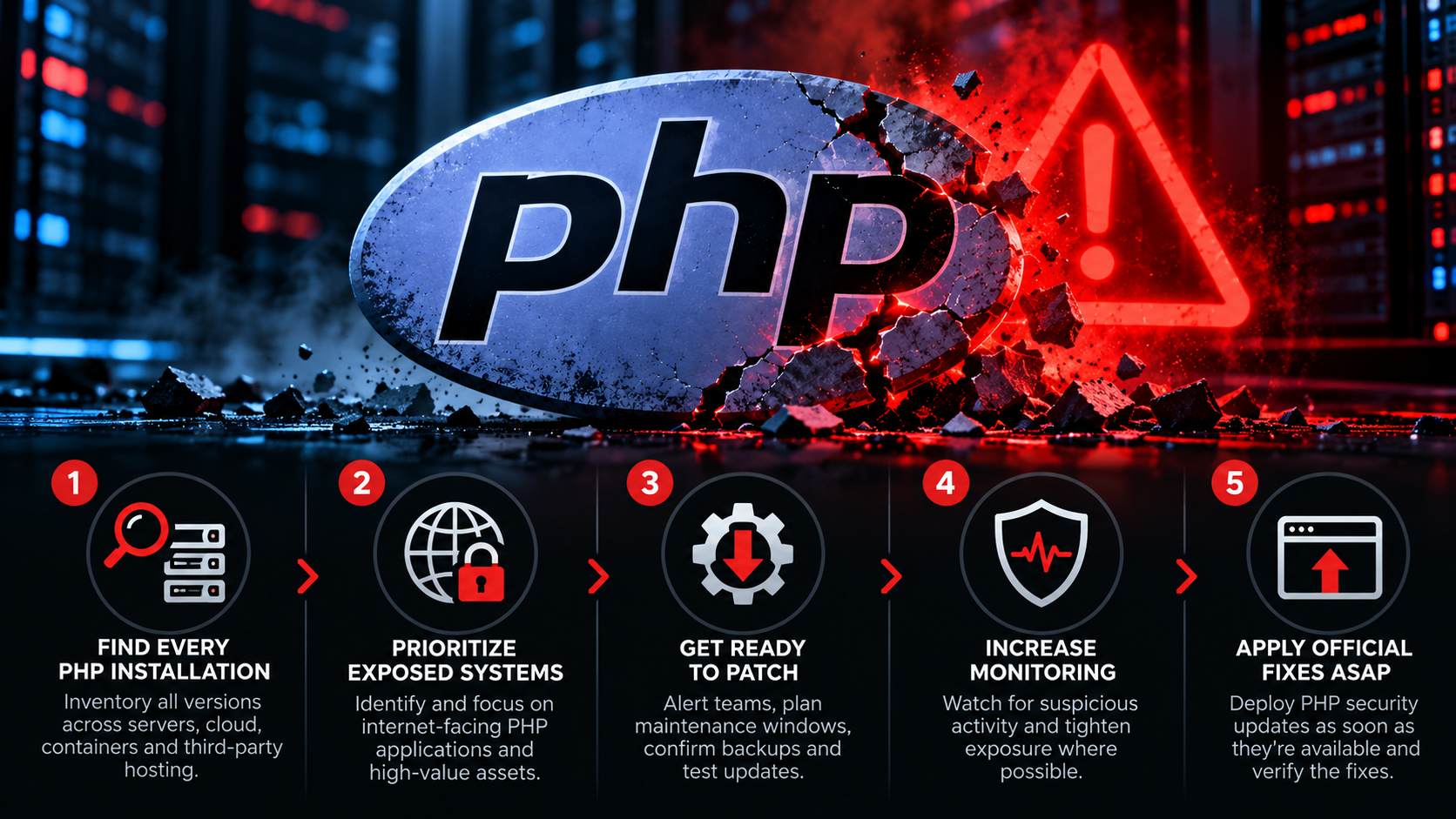
For defenders, the immediate priority is preparation. With no confirmed fixed versions available at the time of the warning, organizations should use the remaining hours to reduce the time between patch availability and deployment.
1. Inventory every PHP installation. Identify PHP versions running across production servers, containers, cloud workloads, content management systems and internal applications. Include legacy systems and infrastructure maintained by third-party hosting providers. Security teams cannot patch installations they don't know exist.
2. Prioritize internet-facing PHP systems. Identify publicly reachable applications and servers running PHP, particularly those handling sensitive information or privileged business functions. These systems deserve immediate attention once the official advisory identifies the affected configurations.
3. Prepare emergency patching procedures. Alert application owners, infrastructure teams and managed hosting providers. Establish maintenance windows, confirm backups and rollback procedures, and test upgrade compatibility where possible. Do not wait until the security release arrives to determine who owns the update process.
4. Increase monitoring for suspicious activity. Review web server, PHP application and endpoint telemetry for unexpected processes, unusual outbound connections, suspicious file modifications and other signs of compromise. These are general indicators worth investigating, not confirmed detection signatures for the new vulnerabilities. Organizations should also review internet exposure and restrict unnecessary access where operationally feasible.
5. Apply official fixes as soon as they become available. Monitor PHP's official security announcements and obtain updates through trusted vendor or distribution channels. Verify that the installed packages actually contain the fixes. Organizations running unsupported PHP branches should determine whether their vendors will provide backported patches or whether an upgrade to a supported release is necessary.
Why the PHP warning matters beyond individual websites
PHP underpins a substantial ecosystem of web applications, including content management platforms, e-commerce systems, enterprise portals and custom business software.
A serious vulnerability in the underlying language runtime could therefore create a remediation problem extending far beyond any single application or software vendor.
That does not mean every PHP-powered website is vulnerable. It means organizations need to determine whether the flaw affects the runtime, the way applications invoke it, particular PHP configurations or some combination of those factors.
The distinction will determine both the real attack surface and the urgency of individual deployments.
It also complicates the patching process. Some organizations control their PHP installations directly. Others rely on operating system maintainers, cloud providers, hosting companies or application vendors to distribute fixes.
Even when upstream patches arrive promptly, downstream availability and deployment can take longer.
That gap is where defenders risk losing valuable time.
The bottom line: Prepare now, patch when confirmed
As of Tuesday's initial disclosure, watchTowr had not reported confirmed exploitation in the wild, and no official technical advisory had established the full scope of the vulnerabilities.
Security teams should avoid treating leaked claims about affected versions or exploitability as established facts.
But the official warning removes any reasonable doubt about the need to prepare.
PHP's maintainers have confirmed two critical vulnerabilities, assigned both a 9.2 severity score and accelerated their security release schedule.
For organizations running PHP in production, the immediate task is straightforward:
Find every installation, identify the most exposed systems, get the patching teams ready and deploy verified fixes as soon as they become available.
We'll update this article as the situation unfolds.