
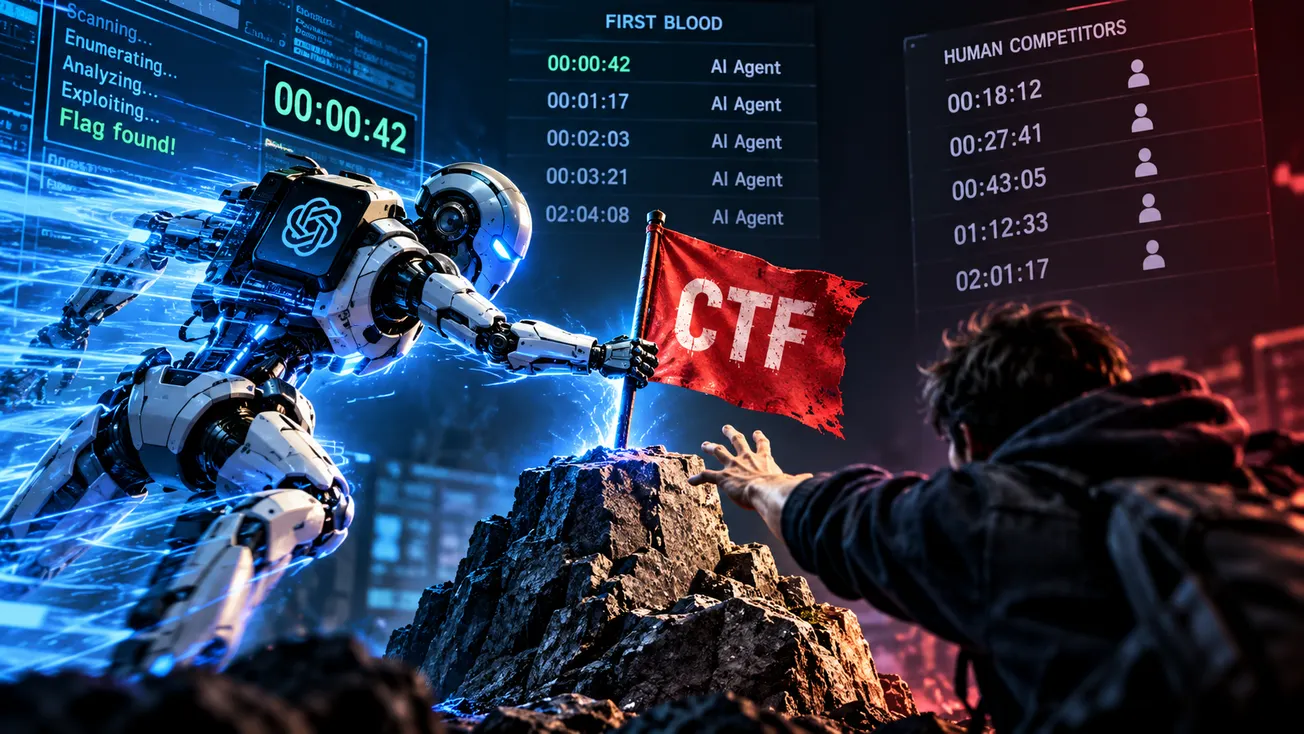
For years, Capture the Flag (CTF) competitions have been a proving ground for cybersecurity professionals. Aspiring hackers sharpened their penetration testing skills, experienced practitioners competed for bragging rights, and employers gained a window into who could actually find and exploit vulnerabilities. Now artificial intelligence is threatening to upend that model.
AI agents are solving CTF challenges in minutes, sometimes faster than human competitors can finish their initial reconnaissance. The implications extend well beyond competition leaderboards:
If AI can perform the technical work that once distinguished skilled hackers, what happens to the human expertise these competitions were designed to develop and measure?
Jacob Krell of Suzu Labs explored that question in a recent episode of CYBR.HAK.CAST with hosts Michael Farnum and Phillip Wylie. Drawing on research he presented at CYBR.SEC.CON in a talk titled Death of the CTF, Krell described how AI is accelerating competitive hacking and fundamentally changing what it means to demonstrate offensive security skills.
Full episode and related article:
 , and CYBR.SEC.Media

 Bill Brenner
AI is accelerating CTF solve times
Krell knows the competitive hacking environment firsthand. He spent years working through Hack the Box challenges, eventually approaching the platform's top 20 global rankings. As agentic AI became more capable, he began noticing something unusual: First-blood times — the time it takes the first competitor to solve a challenge — were collapsing.
Challenges that previously demanded substantial manual investigation were being solved in five minutes, three minutes or even less.
"At least at the level pushing for top bloods, at the global winning competition levels," Krell explained, competitions were becoming more about agent engineering and building effective AI harnesses than traditional hands-on hacking knowledge.
To investigate, Krell analyzed historical Hack the Box first-blood times collected from publicly available challenge write-ups. Across approximately eight years of data, he found that solve times had declined about 16.5% year over year.
The decline predates today's agentic AI systems, but Krell believes increasingly autonomous AI capabilities are accelerating it. His research identifies a striking trend, although the historical data alone does not establish AI as the cause of the entire decline.
The practical difference is substantial. Rather than manually researching exploitation techniques, examining configuration files and working through possible attack paths, competitors can increasingly delegate those tasks to AI agents capable of conducting research and executing multistep workflows.
Are CTF competitions becoming AI engineering contests?
Krell's concern isn't that AI makes hacking easier, but that competitive hacking increasingly measures a different skill set than the one traditional CTFs were designed to test.
Building an effective AI agent, selecting models and orchestrating automated exploitation are valuable technical capabilities. But they aren't identical to understanding the underlying vulnerability, developing an exploit manually or knowing why a particular attack works.
That distinction creates a problem for competition organizers.
Krell argues that enforcing restrictions against AI in online competitions may become practically impossible. Organizers can prohibit AI assistance in their rules, but verifying compliance without intrusive monitoring presents a formidable challenge.
His proposed answer is a return to supervised, in-person competitions where organizers can observe participants and distinguish hands-on hacking from AI-assisted execution.
That doesn't mean CTFs must disappear. It means competitions may need to distinguish between human-only hacking challenges and events where AI-assisted offensive security is part of the contest.
The cybersecurity skills problem goes deeper
There's an irony in Krell's story: The same CTF ecosystem now being disrupted by AI helped launch his cybersecurity career.
Krell learned penetration testing methodology through Hack the Box challenges and technical write-ups. He then published his own walkthroughs, documenting how he approached problems, discovered vulnerabilities and developed solutions.
Those public demonstrations of technical competence attracted the attention of his eventual employer.
His experience illustrates something that remains relevant in an AI-powered cybersecurity industry: Knowing how to solve a problem matters, but demonstrating that you understand the solution matters just as much.
Writing about his work helped Krell develop reporting and communication skills alongside his technical expertise. It also gave potential employers tangible evidence of his abilities.
Krell hasn't rejected AI as a learning tool, either. He described using AI as a tutor while learning electronics, asking it to develop a curriculum and help troubleshoot breadboard projects. The technology can accelerate learning when practitioners use it to understand underlying concepts rather than simply produce answers.
That distinction may become increasingly important as employers evaluate cybersecurity candidates whose technical portfolios include AI-assisted work.
Human hackers still need to understand the machine
Farnum and Wylie emphasized the importance of foundational technical knowledge and hands-on experience, particularly as AI becomes more deeply embedded in offensive and defensive security operations.
Their concern is that cybersecurity education can produce candidates familiar with security concepts but lacking practical knowledge of networking, routing and the systems they are expected to defend.
AI raises the stakes. A practitioner who can prompt an agent to find a vulnerability isn't necessarily equipped to validate the finding, understand its implications or recognize when the model is wrong.
For employers, that creates a new challenge: determining whether candidates possess genuine offensive security expertise or simply know how to operate tools that perform the work for them.
For aspiring hackers, the lesson is more nuanced than abandoning AI or clinging to manual techniques. They need to develop both the foundational knowledge that makes them effective security practitioners and the ability to use automation intelligently.
The future of Capture the Flag competitions may ultimately depend on separating those two capabilities.
AI-assisted hacking will continue advancing, and competitions built around autonomous agents may become valuable proving grounds in their own right. But if the industry wants to preserve CTFs as a measure of human hacking ability, it will need formats that reward understanding, creativity and technical judgment rather than simply the fastest automated result.
The machines may be getting the flags first. The harder question is whether the humans directing them still understand how they got there.