

This article is based on Marcus Botacin's discussion with Michael Farnum and Phillip Wylie on CYBR.HAK.CAST, including research presented at CYBR.SEC.CON 2026 and his earlier work on hardware-based antivirus technologies. Full episode and related article:
 , and CYBR.SEC.Media

 Bill Brenner
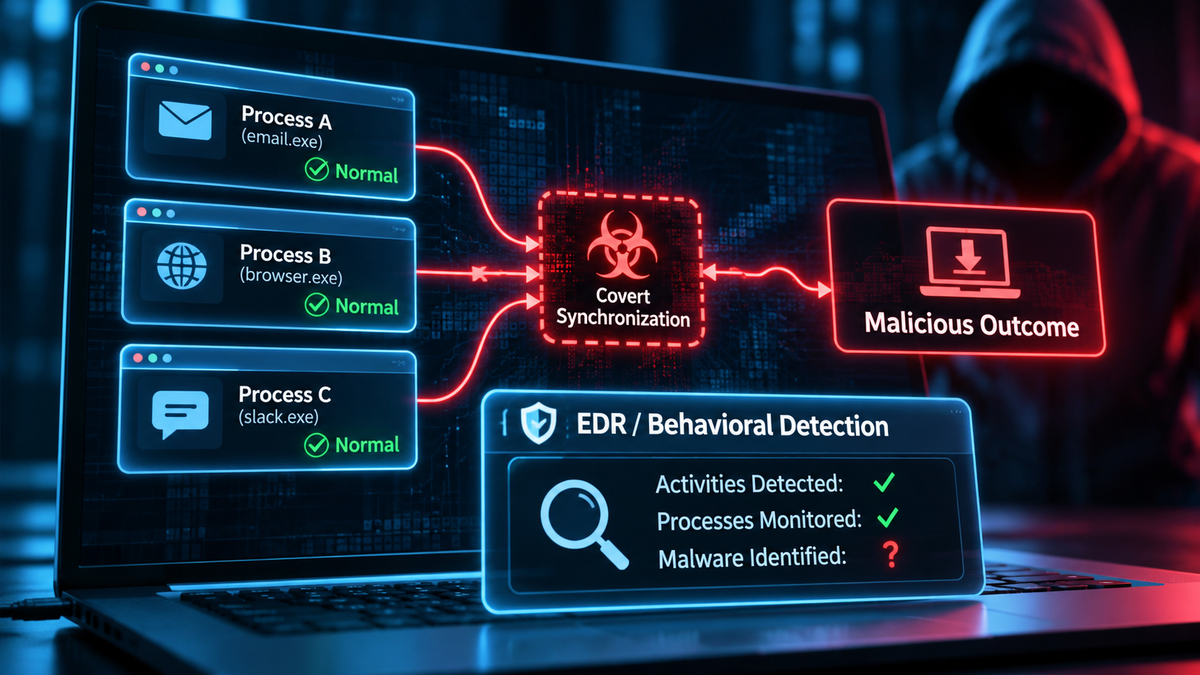
For decades, cybersecurity has operated around a familiar cycle: Attackers develop new techniques, defenders learn to detect them, and attackers find another way around the defenses. Each turn of the wheel produces more sophisticated malware, more elaborate detection technologies and more telemetry for security teams to analyze.
But what if the next breakthrough in malware defense isn't about detecting the attack at all?
That's one of the questions Texas A&M University professor and cybersecurity researcher Marcus Botacin raised during a recent episode of CYBR.HAK.CAST with hosts Michael Farnum and Phillip Wylie.
Botacin's research explores how attackers could distribute malicious behavior across multiple processes, coordinating their activities through mechanisms that conventional endpoint detection and response (EDR) platforms may struggle to observe.
But the conversation took an interesting turn when Farnum asked whether defenders really needed to identify every component of such an attack.
What if simply disrupting one component could cause the entire operation to fail?
Botacin's answer points toward a different approach to cybersecurity: Instead of continually chasing the next malicious technique, make the environment itself less accommodating to attacks.
And while he's exploring that possibility, his research team is also investigating something even more ambitious: moving antivirus detection directly into computer hardware.
The more invisible the attack, the more fragile it becomes
In his CYBR.SEC.CON 2026 presentation, You Can See Me, But You Can't Track Me: Evading Behavioral Detection with Distributed Malware and Covert Synchronization Channels, Botacin examined how attackers could divide malicious activity among multiple processes.
The individual components might appear harmless. Their combined behavior, however, could accomplish the attacker's objective.
The challenge for defenders is recognizing the relationship between those components, particularly when attackers deliberately conceal how they communicate.
Botacin described three approaches to coordinating distributed malware: conventional application programming interfaces, shared-memory mechanisms and covert side channels involving CPU cache behavior.
Each successive approach can make the coordination harder for defenders to observe.
But there's a catch.
"The more evasive we become, the less resilient, the more preconditions must be met for the attack to work," Botacin explained.
Consider malware that coordinates its components through conventional APIs. Those interactions provide defenders with potential opportunities to identify and interrupt the operation.
Attackers could avoid those observable interactions by coordinating through shared memory. But that introduces dependencies on particular memory conditions.
Take the idea further, using CPU cache behavior as a covert communication channel, and the operation becomes even more sensitive to changes in the computing environment.
A cache flush, an interrupted process or an unexpected scheduling change could interfere with the synchronization needed for the attack to succeed.
The very techniques that make the malware difficult to detect could also make it easier to disrupt.
For defenders, that's an important distinction.
An attack doesn't necessarily have to be identified in its entirety to be rendered ineffective.
Stop chasing the attacker. Change the environment.
Botacin believes this tradeoff offers a promising direction for future defensive research.
Rather than relying exclusively on detecting malicious behavior, defenders could make systems sufficiently unpredictable that certain coordinated attacks cannot operate reliably.
Modern operating systems already perform activities such as process scheduling, cache management and memory translation maintenance. Botacin suggests that understanding and potentially strengthening these mechanisms could help undermine attacks that depend on precise coordination.
"If we make our system non-predictable enough," he explained, attackers may be unable to maintain the conditions their techniques require.
The objective isn't necessarily to recognize the attacker's next move.
It's to prevent that move from working.
That doesn't mean disabling detection technologies or introducing arbitrary instability into production systems. Nor does it mean existing operating-system behavior automatically provides adequate protection against these techniques.
Botacin is describing a research direction: using controlled changes in system behavior to interfere with the assumptions on which particular attacks depend.
The distinction matters because defensive unpredictability must not come at the expense of legitimate application reliability.
Still, the underlying idea challenges a familiar cybersecurity assumption.
Security teams have invested heavily in technologies designed to observe and classify malicious behavior. Botacin's work suggests there may be circumstances in which preventing an attack from functioning is more practical than trying to recognize every component.
And that raises another question: If attackers increasingly operate beneath the visibility of conventional security software, should defenders move their detection capabilities closer to the hardware?
What if antivirus lived inside the memory?
Botacin's research doesn't stop at disrupting malware coordination.
His team has also explored hardware-based antivirus architectures designed to address limitations in conventional software monitoring.
The motivation is straightforward.
As malicious activity moves deeper into system memory, detecting it through traditional software instrumentation can become increasingly difficult and expensive.
Comprehensive memory monitoring can impose substantial performance overhead. Security products must balance visibility against the resources consumed by collecting and analyzing system activity.
Botacin sees an opportunity to rethink where detection occurs.
"What if we move our antivirus to inside the memory?" he asked during CYBR.HAK.CAST.
The concept involves integrating security capabilities directly into the hardware responsible for storing and processing data.
Instead of relying entirely on software to observe activity after it occurs, hardware-based detection could potentially examine information closer to the point where it is accessed or processed.
Botacin described research prototypes involving antivirus capabilities integrated into memory, CPUs and GPUs.
One possibility involves circuitry capable of examining data as it moves from memory toward the processor.
The idea is that malicious activity might be identified at a level where conventional endpoint security tools have limited visibility.
This is not a commercially established replacement for EDR. Botacin is discussing experimental architectures and longer-term research, with substantial engineering and performance questions still to resolve.
But the implications are significant.
If attackers can evade detection by avoiding observable software interactions, defenders may eventually need security capabilities that operate below the software layer.
The result could be a fundamentally different relationship between operating systems, processors, memory and endpoint protection.
A new role for EDR, not necessarily its replacement
It's tempting to frame hardware-based antivirus as the technology that will finally make today's endpoint protection obsolete.
Botacin doesn't make that argument.
In fact, one of the recurring themes of his research is that security improvements should build on existing technologies wherever possible.
He distinguishes between solutions that require organizations to abandon their current investments and those that can complement existing defenses while enabling a gradual transition.
That approach is particularly important for enterprises operating complex environments where wholesale architectural changes are rarely practical.
Existing EDR platforms can continue improving their ability to correlate activity across processes. More sophisticated monitoring could help identify distributed malware that relies on conventional synchronization mechanisms.
Hardware-assisted capabilities might eventually address some of the visibility gaps that software monitoring cannot efficiently close.
And system-level disruption techniques could provide another layer of protection against attacks that depend on fragile environmental conditions.
These approaches aren't mutually exclusive.
They suggest a future in which malware defense involves multiple complementary capabilities: observing malicious behavior, understanding relationships between processes and preventing attacks from maintaining the conditions necessary to succeed.
The challenge will be determining which approaches provide meaningful protection without creating unacceptable performance, reliability or operational costs.
Why academic research matters before the threat arrives
One of the more revealing parts of Botacin's conversation with Farnum and Wylie concerned the relationship between academic research and the cybersecurity industry.
Industry researchers, he explained, generally work under immediate constraints. They must address current vulnerabilities, improve existing products and respond to threats organizations are encountering today.
Academic researchers have greater freedom to explore what attackers might do years from now.
Botacin doesn't consider one approach inherently superior.
The difference is largely a matter of timing and focus.
Industry must solve today's problems. Academia can investigate tomorrow's.
His own work reflects an effort to connect the two.
During his graduate studies, Botacin researched techniques for evaluating and improving malware sandboxes. He also consulted with antivirus companies, applying academic methods to practical detection challenges.
Today, his research examines both offensive techniques and potential defensive responses.
The distributed malware work asks how attackers might exploit limitations in behavioral detection.
The hardware-based antivirus research asks what defenders could build to address those limitations.
Both are part of the same effort to anticipate the next stage of the attacker-defender competition.
"We create the problems, and we also sell the solutions in the hope that if they become true, we are ready," Botacin joked.
There's a serious point behind the humor.
Waiting until a new attack technique becomes widespread before investigating its defensive implications leaves security teams perpetually reacting.
Research that anticipates future threats can give defenders time to develop and evaluate countermeasures before those threats become operational realities.
The next generation of malware defense may require a different question
For CISOs and security architects, Botacin's research doesn't provide a ready-made purchasing checklist.
There isn't a hardware-based antivirus product in his discussion that organizations can simply deploy tomorrow to eliminate the risks posed by distributed malware.
Nor does the research suggest that security teams should abandon their existing detection and response capabilities.
Instead, it challenges them to think beyond the traditional cycle of detecting the latest attack technique and developing another rule to recognize it.
Security teams can begin by examining how well their existing tools correlate behavior across multiple processes and whether their defensive architectures depend too heavily on observable software communication.
Red and purple teams can explore the resilience of their controls against coordinated activity, rather than testing only whether an individual malicious executable triggers an alert.
Security architects can also consider how hardware-assisted monitoring and system-level protections might eventually complement conventional endpoint security.
The broader lesson is that better visibility, while valuable, may not always be sufficient.
Some attacks may be difficult to identify precisely because their components are designed to appear unrelated.
Others may be so dependent on carefully controlled operating conditions that disrupting those conditions offers a more effective defense.
Botacin's research suggests the next generation of endpoint security may need to pursue both possibilities.
For years, defenders have asked how they can get better at finding attackers.
The more important question may eventually be: How do we make sure the attack fails, even when we never see it coming?



